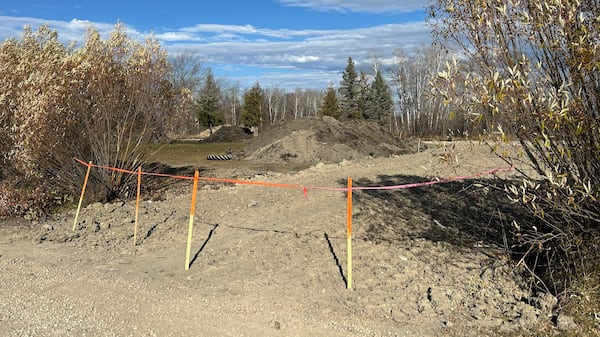
Thanks to advances in DNA technology, North Bay police have solved a 50-year-old mystery that has allowed them to put a name to human remains discovered in the area in June 1975. Investigative genetic genealogy was used to identify the individual, whose skull was found in a swampy area behind the former Bomarc missile base off Highway 11 north. The remains of Claude Hamilton Brownscombe were discovered by summer students working with the Ministry of the Environment in 1975. The students alerted police, who conducted an extensive search of the area, but didn’t find anything that could help them solve the case. It was believed the individual had been dead for a year or two before the remains were found. An anthropologist’s report estimated he was between the ages of 24 and 75 at the time of death. Over the years, the investigation was reviewed. However, the investigative tools and information available at the time didn’t provide sufficient leads to identify the remains. “Without additional investigative leads or forensic technology available that we have today, investigators were unable to determine the individual’s identity and the investigation became inactive,” North Bay police Insp. Scott McFarlane said at a Thursday morning media conference. New attempts were made over the years. In 2006, DNA testing was attempted, but a usable DNA profile could not be developed. More DNA testing was conducted six years later and the resulting DNA profile was compared against three local missing persons. No match was identified and the DNA sample was not suitable for use through the available databases. Then three years ago, the investigation was revisited following advancements in forensic science, including investigative genetic genealogy. It’s a forensic tool that combines DNA analysis with genealogy research to help identify unknown individuals. It gave officers the opportunity to re-examine the DNA and police were able to identify his surviving relatives. “Forensic genealogists then use those connections to build family trees and develop new leads that may help identify a person,” said Det. Const. Mike Kelly, of the Toronto Police Service homicide and missing persons unit. The process allowed police to determine that the remains belonged to Brownscombe, a First World War veteran. He was born on Oct. 24, 1896, in Uxbridge, Ont., north of Toronto. Police found newspaper records that pointed out that Brownscombe lived in Timmins beginning in the late 1920s. Records confirmed he was on the city’s voting lists in 1949 and 1957. North Bay police Det. Const. Shawn Hofmann told reporters that military records placed Brownscombe in Toronto in 1917, when he was 22. “Military medical records … described him as being 5 feet 2 inches tall, blue eyes and brown hair,” Hofmann said. Two surviving family members “He worked at the McIntyre Mine and participated in community activities, including local bowling leagues.” Police interviewed two of Brownscombe’s surviving family members in the U.S., a great-niece and a great-nephew. They both submitted DNA for analysis, which confirmed the match. His great-nephew recalled that Brownscombe lived a quiet life in a northern Ontario cabin. Police said there isn’t enough information to determine his cause of death, since they only have so much evidence at their disposal. But officers don’t believe foul play was involved and consider the case closed -- finally. “While our thoughts are with Mr. Brownscombe’s family and loved ones, we hope this identification provides answers and a measure of closure after so many years,” said North Bay police Chief Daryl Longworth. “This identification reflects the dedication of our investigators, the strength of our partnerships and the power of modern forensic science. Most importantly, it provides long-awaited answers to Mr. Brownscombe’s family and to our community.” The investigation demonstrates the value of revisiting historic cases as forensic science continues to evolve, officials said, offering hope of providing answers to families even after so many years. “There is always hope and that is what we hope that all our families with missing people who I truly feel for take (from) this,” McFarlane said. “There is hope.”