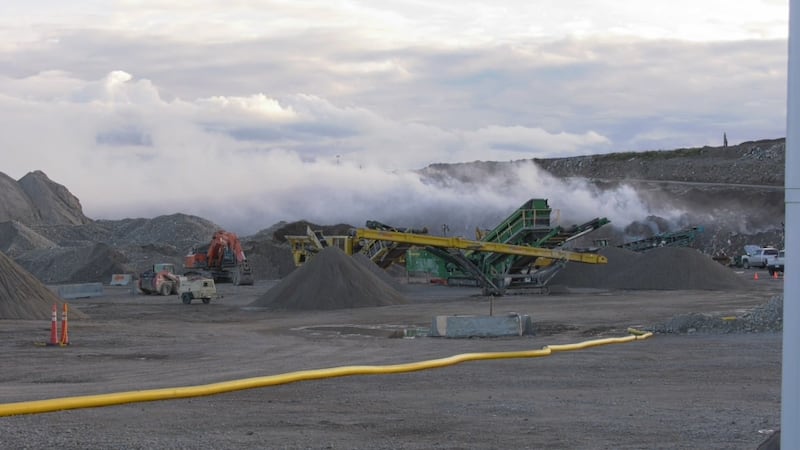
High atop a mountain of compacted garbage, an unlikely pair of caretakers get ready for takeoff. Abatement falconer Keegan Rollinson sends a peregrine falcon up above the Green Lane landfill outside London to scare off seagulls. “We use the bird to do a natural process that they would do out in the wild and its helps to manage the gulls. It keeps the seagulls from getting poisoned as well because they’ll go in the garbage and eat things we don’t want them to eat,” explained Rollinson. They are but one cog in a giant machine that processes Toronto’s trash at the city of Toronto-owned landfill. “So all of the Toronto garbage that is collected at the transfer stations comes here,” said Sara Little, Green Lane manager. The massive, sprawling site looks, at least in some areas, like greenspace and parkland. But in other parts there are construction vehicles, garbage haulers and other heavy equipment at work in this active landfill. Last year, Green Lane managed 725 thousand tonnes of waste of all streams. About two thirds of that was garbage collected in Toronto and brought to the site. At this rate, Green Lane is projected to run out of capacity in ten years. “We work with our operators to make sure that they’re compacting the waste as tightly as possible because we are government by airspace here, so we only have a finite amount of volume that we’re allowed to fill,” said Little. With time running out on the landfill, Toronto City Council is considering a number of options for its trash. Among them is a proposal to expand Green Lane horizontally or vertically, which could extend the life of the landfill by 25 years. It could also build a new landfill, elsewhere. However, no municipality within 500 kilometres of Toronto has expressed interest in being a host-community for Toronto trash. And it’s considering incineration. Toronto would build sites to create energy from waste. It’s proving to be the most controversial of options. London City Councillor, Elizabeth Peloza, took an opportunity to tour a garbage incineration plant in Quebec City. She says this method of garbage processing is not without concerns about environmental impact on neighbours. “If you look at the Quebec City reports, sometimes they exceed the allowable limits of things they’re putting out into the environment, including arsenic and other materials, so it’s going to be a question of monitoring wind direction,” said Peloza. Peloza says if Toronto wants to incinerate garbage, it should consider building a plant within its own borders. “You can process waste where you make it. It’s a savings, reduces greenhouse gas emissions,” Peloza suggested.