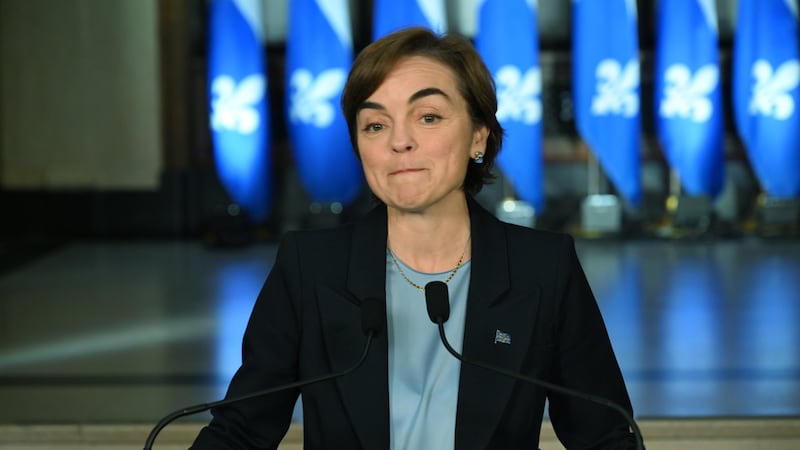
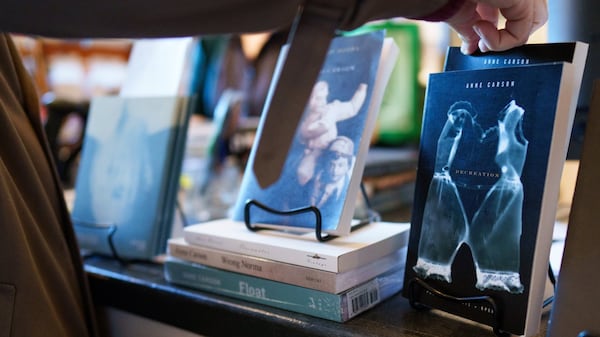
Anne Carson, the Toronto-born poet and scholar who’s said to have invented her own genre with work that blends the ancient and the avant-garde, has won the Nobel Prize in Literature. The famously private Carson became the 123rd Nobel laureate in literature on Thursday, thrusting her somewhat reluctantly into the limelight, according to Ingrid Carlberg, permanent secretary to the Swedish Academy. “We didn’t have much time to speak, and all she had time to tell me was that she is for the moment in Iceland where she’s listening to the wind,” Carlberg said. “She was taken by surprise, but very happy. I could hear that in her voice.” Carlberg said the academy rewarded Carson for her “bold and inventive oeuvre that, in playful dialogue with the classical tradition, has created new forms for contemporary literature.” Prime Minister Mark Carney commended Carson on social media, calling her win “a proud moment for Canada.” “With wit, imagination, and a style entirely her own, Canadian poet Anne Carson has reimagined the classics. She has brought ancient stories to new audiences and transformed the way we think about literature,” Carney wrote on X. A poet, essayist, classical scholar and translator, Carson is renowned as a master of esoterica. She’s defied literary conventions with a bibliography of more than 20 books of poetry, essays, plays, libretti and translations of ancient Greek texts. “Almost all her literary production has centred upon the intersection between the philologist’s obsession with words and the poet’s desire for new meaning,” said Anders Olsson, chair of the Nobel committee for literature. She’s amassed a devoted readership and a raft of critical accolades, including two Griffin Poetry Prizes, a Governor General’s Literary Award, the T.S. Eliot Prize for Poetry, a MacArthur “genius grant” and a Guggenheim Fellowship. Elizabeth Harvey, a retired English professor at the University of Toronto, described how Carson manages to “invent and reinvent form.” “She takes things that don’t look like poetry, like a lecture or an essay, and makes it into poetry,” she said, pointing to Carson’s lyric essays. “They look like prose pieces, but they’re really deeply poetic in their sensibility.” But as Carson’s profile has grown over four decades, the particulars of her personal life have remained elusive. Her public reticence is encapsulated by her scant book-jacket biography: “Canadian poet, essayist and translator of Greek mythology.” Carson was born in Toronto in 1950 and various accounts suggest she studied classics at the University of Toronto, and has held teaching positions at institutions including McGill University, Michigan University and Princeton University. The Swedish Academy confirmed her year and city of birth, but offered few other details. Concetta Principe, an assistant professor of English at Trent University who wrote a book on Carson, recalled first reading the writer’s author bio. “It was like two sentences. That’s unusual,” she said. “In that way, it signified humility -- that’s how I saw it initially, and I do still feel that to be the case with her.” But Principe said she also sees it as a statement about the role of the author. “We associate what’s on the page with the writer. We think it’s the writer’s life story that we’re reading, and that brings us close to the writer,” she said. “I think her resistance to sharing is a way of reminding us that even if we think we have found her, even if we had all her biography, we still wouldn’t grasp where she is in the text, (or) what of her life is really there.” After Carson’s PhD thesis in 1981, she made her publishing debut in 1986 with academic essays on love, “Eros the Bittersweet.” That book was formative for Louis Ruprecht, director of the Hellenic Studies Institute at Georgia State University. He said he picked it up when he was a newly minted PhD studying Sappho. “I was mesmerized and blown away by the book. And when I got back to Atlanta, I wrote her a fan letter,” Ruprecht recalled. She responded, and they corresponded for a while, he said. They talked mostly about the work -- “we had Sappho in common,” he said. Carson gained recognition with a series of genre-bending books in the 1990s establishing her style of culling from the literary canon to explore eternal themes. She invoked influences ranging from the Bronte sisters to the Greek poet Stesichorus in the early sixth century BC. Carson cemented her reputation with her 1998 novel in verse, “Autobiography of Red,” which reimagines the 10th labour of Hercules, telling the life story of the monster he slays, Geryon. Carson became the inaugural Canadian winner of the Griffin Poetry Prize for “Man in the Off Hours” in 2001, and was awarded England’s T.S. Eliot Prize for “The Beauty of the Husband” the same year. In 2014, Carson took the Griffin again for “Red Doc,” a quasi-sequel to “Autobiography of Red.” It made her the first two-time winner of the prize. At the time, she told The Canadian Press she was surprised to win, partly because she doesn’t “really like the book” and partly because she’d already won the honour and “thought it wouldn’t be fair” to get it again. “I don’t mean it’s a bad book,” she said. “I mean, I don’t know if it’s a good book or a bad book. I just have a vision when I start of what a thing is and sometimes it gets there and sometimes it doesn’t.” Scott Griffin, the award’s benefactor, said Thursday that Carson’s win is a win for Canada and Canadian poetry. “Anne Carson has raised the profile of poetry to its rightful place, in my opinion, right to the pinnacle of literature,” he said. Griffin got to know Carson a little bit when they travelled to Edinburgh together after she won the inaugural prize. “On stage, she tends to come through -- sometimes, for some people -- as a little bit severe,” he said. “But she’s very warm and loves to have fun.” Carson also prevailed in the poetry category at the 2020 Governor General’s Literary Awards for “Norma Jeane Baker of Troy,” which in trademark style blends the story of Helen of Troy with elements from Marilyn Monroe’s life. She was shortlisted again two years later for “H of H Playbook,” a retelling of Euripides’s Greek tragedy, Herakles. Among her more recent books is 2024’s “Wrong Norma,” her first original work since 2016. The collection of “poetic prose pieces” was published alongside her own illustrations. Carson is the second Canadian woman to be named a Nobel laureate in the literature category, following short story master Alice Munro’s 2013 win. The American playwright and novelist Saul Bellow, who was born in Montreal and grew up in Chicago, was awarded the Nobel in 1976. The prize is worth 12 million Swedish kronor, or roughly $1.7 million. This report by The Canadian Press was first published Oct. 8, 2026. Nicole Thompson, The Canadian Press