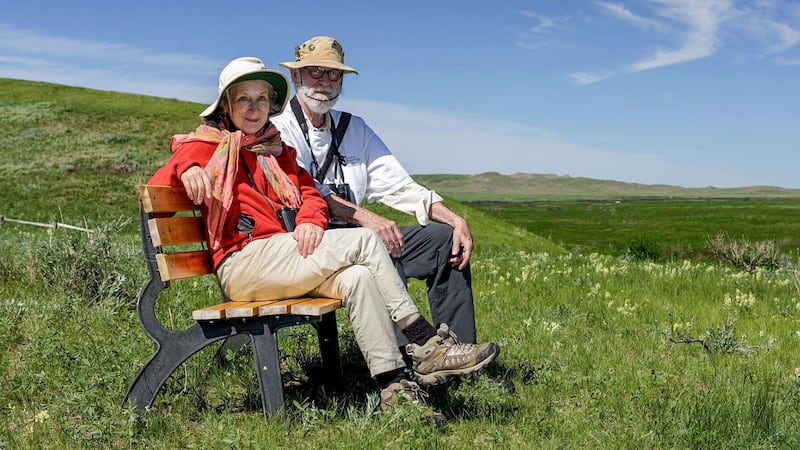
KANANASKIS – Derek Ryder has been on the other end of a shovel, knee-deep in Kananaskis Country bush more times than he can count. Whether it’s rerouting trails, clearing brush or building berms, no two days have been the same for the longtime Friends of Kananaskis Country (FKC) volunteer. “There’s no such thing as trail fairies,” said Ryder, who is also the former director of communications and board member with FKC. “The 1,200-ish kilometres of official trails in K-Country don’t stay nice by themselves.” Trail fairies might not exist, but FKC comes pretty close after 30 years of stewarding hundreds of kilometres of well-loved trails across all ends of K-Country which consists of both protected and public lands. Name a day of the week and a small trail crew staff along with a multitude of volunteers that make up the non-profit are likely roaming the trails – clearing them, fixing them, building them and protecting them. “I’ve been wandering around these forests somewhere since the early late ’70s and my observation is that … the vast majority of people experience K-Country on a trail,” said Ryder. “I love trails, and there’s nothing I hate worse than a trail that sucks that shouldn’t.” Of the approximately 1,200 kilometres of official trail in the region, a majority have been regularly maintained by the organization that was formed in the wake of government cutbacks and a diminishing Alberta parks trail crew in 1996. “Because of the loss of trail staff, in particular, and the unlikely expectation that they’d be replaced by the government, we decided to try figuring out what sort of approach might work for a volunteer trail group,” said Don Cockerton, former Parks planner, who worked as the liaison between FKC and Alberta Parks, and later served as a volunteer. It started with approaching seniors hiking groups for help and the first trail day, powered by a generous donation of Tim Hortons donuts, kicked off in the late ’90s and continued to grow. But in those early years, trail care was just one drop in the bucket of FKC’s work, Ryder says. “The early years, interestingly enough, weren’t really focused at first on trail care,” he said. The FKC’s fingerprints were all over early research, education programs, permit distribution, a memorial bench program and even some retail endevaours when they ran stores inside visitor information centres. “The first thing we ever did was invest in the Central Rockies wolf research project. The Friends bought wolf GPS collars for members of the Peter Lougheed wolf pack,” said Ryder, noting FKC also supported the Eastern Slopes Grizzly Bear Project along with many other studies. Then there was education; FKC provided resources for interpretive and school programs along with funding updates to backcountry cabins, including the Three Isle Lake and Aster Lake patrol cabins. But having their hand in a bit of everything started to become a problem, Ryder says. “The problem was the Friends were into everything and weren’t doing anything very well,” he said. “So, we went broke … and if it wasn’t for Parks, we would’ve folded.” With a hefty debt forgiven, FKC took a step back, revaluated and came out of “the crisis years” of 2009-12 with a renewed vision. “It was a tough time, but we came out of it very strong because we came out of it focused on two things and two things only. The first was trail care, and the second was a small ‘E’ education.” said Ryder, noting FKC’s website is now one of the “best information sources on all things Kananaskis Country.” The comeback came just in time for the 2013 floods that changed the face of trails, recreation areas and campgrounds across K-Country. “We were uniquely positioned that we could help, and so in 2013, a broke organization two years earlier was able to make a donation of $30,000 worth of powered wheelbarrows to Parks,” said Ryder. “We put in 5,000 hours of trail work in 2013. It took us until last year to exceed that.” Thirty years later, countless trails at the Canmore Nordic Centre, including the popular EKG and Odyssey, Tibitts Quarry behind Harvie Heights and the Chester Lake snowshoe trail, to name a few, are all thanks to FKC, who also built their own trail by hand in 2001, the Lac des Arcs Waterfowl Viewing Trail. Trevor Julian, executive director of FKC, says that well-built trails have a role to play not only in recreation but sustainability and the protection of wildlife and their habitats in K-Country. “It was thought, ‘what’s a few hikers in the woods? How does that affect animals?’ But research has shown that animals adapt their movement, they adapt their denning, their breeding, all of that when there’s people around, so it’s important to have good trail systems that, one, keep people on the trails,” said Julian, noting that reducing erosion on trails also helps protect fish habitat. “We always tell people when we’re doing trail work that there’s three enemies of trails: water, vegetation and people,” added Ryder. “Those three things are never gonna go away ever and there will always be a need and it’s kinda cool when you fulfill that need.” Ryder says that “fulfilling the need” can look like removing animal attractants from public use areas one day and prying mud off bridges with a kitchen knife and a car snow brush on another. “You’re literally laying on the bridge deck digging mud out of the slots,” Ryder said with a laugh, noting the work prevents bridges from rotting. “We do some strange jobs, but they’re important.” “People discover the wonder of K-Country by being on our trails,” he added. “If I can help somebody come around a corner and have their jaw drop because they get to see something they wouldn’t have otherwise seen because they wouldn’t have been on this trail, that’s a win.” Ryder says creating personal connections to a trail is often where stewardship begins. “If we had more ownership from people, personal connection with the Kananaskis spaces, that’s how they get protected.” “I’m not talking about government rules and regulations. I’m talking about people not tolerating bad behaviour. When you go, ‘this trail needs help. I helped it, and I’m going to keep helping it.’” Cockerton agrees, noting he’s seen many volunteers come back over the years having developed an appreciation for the work and planning that goes into trails and a new level of care for the area. “[FKC] would quickly come to the defence of Kananaskis Country if needed. If future cutbacks were proposed by the government, they became a first line of defence,” he said. ‘Kananaskis Country is always under pressure’ When the COVID-19 pandemic rocked the world in 2020, Kananaskis Country wasn’t exempt from the fallout. “COVID saw a massive explosion in people coming to K-Country,” said Ryder of the more than five million visitors that year. “K-Country is always under pressure. It’s been under pressure the first time I saw it. It’s under pressure continuously, whether it’s being loved to death or used to death.” When Ryder first started exploring K-Country a couple 100,000 people were doing the same. As of 2025, the area also drew five million visitors. “The big concern for the future is going to be how to manage increasing numbers of people,” added Cockerton. “One of the real awesome gems about Kananaskis is that it still supports a pretty healthy population of grizzly bears and cougars and other predators, even a few wolves.” After the Alberta government designated two ski hills in Kananaskis, Nakiska Ski Area and Fortress Mountain as all-season resorts in late 2025, FKC knows that with the potential for more development, visitation is likely to only increase. “The government is encouraging tourism in a place that’s already, one could argue, in certain places over-touristed and how do we manage that?” said Ryder. “The four-season resort legislation, that’s going to lead to more development in Kananaskis again. I don’t think we’re going to stop that, so let’s make sure we do it as well as we can to make sure we’re preserving wildlife, preserving wild areas, travel patterns of animals,” added Julian. But as long as FKC is around, Cockerton says he’s hopeful. “I’m very pleased to see that not only have the Friends of Kananaskis survived for 30 years, but they seem to be thriving nowadays, and as long as the government maintains its desire to use the partnership approach with groups like the Friends, the future looks good.” While change is on the horizon, one thing’s for sure, the Friends of Kananaskis Country aren’t going anywhere. “The job of the friends is to manage the pressures as best we can in the ways that we can,” said Ryder. “Kananaskis Country always needs help, and the Friends will always be there to give help.” The Local Journalism Initiative is funded by the Government of Canada. This position covers Îyârhe (Stoney) Nakoda First Nation and Kananaskis Country. Leah Pelletier, Local Journalism Initiative Reporter, Rocky Mountain Outlook