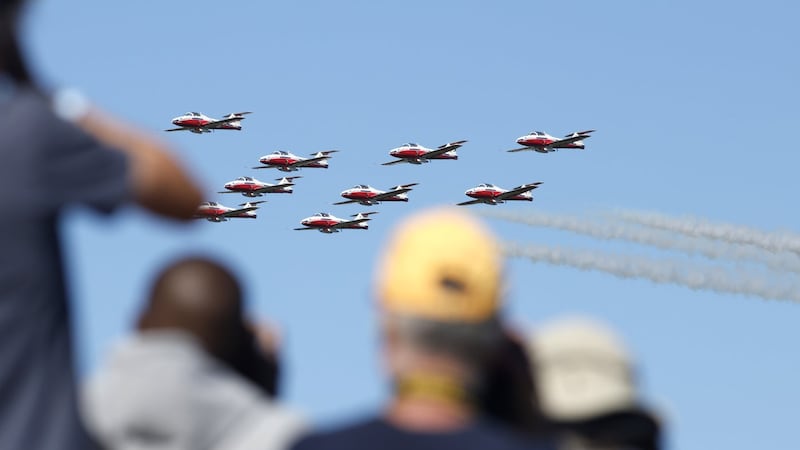
Some military experts say the federal government’s choice to turn to Europe for defence spending may be motivated by the wrong factors. Rob Huebert, director of the centre for military, security and strategic studies at the University of Calgary, spoke with CTV Your Morning Calgary on Thursday. He says while our country is closely tied with our southern neighbours, we’ve also held long connections with Europe. Those partnerships led to the recent deal for GlobalEye, an advanced aerial surveillance system developed in Sweden that uses Canadian-made jets. The GlobalEye is an airborne warning and control system (AEW&C) created by Swedish defence and security company Saab. The radar system is integrated into Bombardier’s Global 6500, transforming the corporate jet into a cutting-edge surveillance aircraft. The federal government is negotiating a deal that would see at least one third of the projected fleet of the GlobalEye aircraft manufactured in Canada over the next 15 years. “It is a non-American system that we’re buying,” Huebert said. “It continues with that effort of the Carney government to separate itself from purchases that are coming from U.S. sources.” Huebert says this push by Canada to seek alternative sources for defence technology is being influenced by the economy, jobs and a need to reduce Canada’s dependence on the U.S. However, some important arguments are being ignored, he says. “Where is the discussion about which of these systems are actually going to be the best if we find ourselves engaged in conflict with, say, the Russians or the Chinese?” The deal for GlobalEye is also fuelling talk that Canada could be changing course on a deal for new fighter jets, Huebert says. “A lot of people are now assuming, since we’re getting the GlobalEye, that we are either going to be buying the Gripen, which is a Swedish fighter, or a mixed fleet. “There have also been some discussions that, until the July 1 deadline for the CUSMA (Canada-U.S.-Mexico trade agreement) conversations to be over, you’re not going to see a decision be made because that’s going to be held as leverage.” Huebert does admit that the F-35 fighter is “one of the most important” new elements needed for our military. If a deal is struck, the F-35s would replace Canada’s fleet of F-18s. Canada also in the market for submarines Air defence isn’t the only military spending project that Canada is embarking on, Huebert said. Carney is examining competing bids to upgrade Canada’s fleet of submarines. “Everybody is looking at the economic side of it,” Huebert said. “The South Koreans have their submarine visiting on the West Coast and there’s all sorts of other discussions for business opportunities.” He says Canada is going to be selling natural gas to Germany, a deal that expected to “sweeten the pot.” “We’re seeing this huge set of economic discussions about do we get a better deal buying from the Germans or do we get a better benefit by buying from the South Koreans?” Huebert says there are differences between the subs involved in the bids – the German sub is a lot more a “hide-and-stealth-type” capability while the South Korean sub is “more robust but not quite as quiet.” But, like with the fighter jets, the talks shouldn’t be primarily about economics, Huebert says. “It’s not about jobs – it’s about which one is going to provide the Canadian Forces with the best means to engage in a naval war.” ‘Operational needs’ In a statement to CTV News, the Department of National Defence (DND) said its spending commitments will help Canada defend its people and values, secure its sovereignty and protect its allies. “The capabilities we are building will always be driven by the operational needs of the CAF,” the DND said. “We also recognize that a robust Canadian defence industry provides technological and operational advantage to our country in the form of increased defence readiness and economic resilience. Our national security and our economic security go hand in hand.” This year, Canada invested more than $63 billion in the Canadian Armed Forces and Budget 2025 announced a further $82 billion over five years toward the service. An additional $87 billion over 20 years will be invested in capabilities to secure the Arctic, alongside approximately $100 billion in long-term defence investments. “Canada’s Defence Industrial Strategy committed to providing a clear, long-term demand signal to Canadian industry for defence and dual use goods so it can be better prepared to meet the requirements of the CAF, build key sovereign capabilities, and strengthen our economy.” With files from CTV’s Judy Trinh