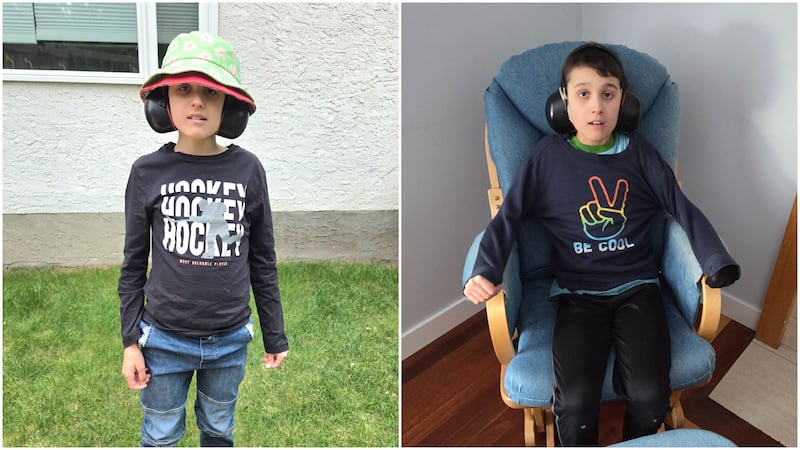
The disappearance of 11-year-old Parker Wells, a non-verbal autistic boy, has prompted a Calgary mother to call for changes to Alberta’s emergency alert system. Jennifer Ball argues vulnerable children who go missing should trigger a faster public notification, even when there is no evidence they have been abducted. Ball, whose son is non-verbal and autistic, says she was shocked to learn Alberta’s Amber Alert system is reserved primarily for child abductions after following the search for Parker Wells, who disappeared from a northwest Calgary day home Thursday. “I truly thought that it was a missing child, point blank. Period,” Ball said. “I didn’t realize that there was such a gap in the system in that it’s only for child abductions.” Police activated the Missing Children’s Society of Canada’s Child Search Network within the first 24 hours of the investigation. They did not initially issue an Amber Alert because investigators said there was no evidence Parker had been abducted. But more than 48 hours after his disappearance, the alert was issued as concern for his safety continued to grow. In a Monday press conference, Calgary police say now is not the time to debate whether Alberta’s alert system should change. “There is going to be plenty of time to quarterback any decisions on this investigation afterwards,” Staff Sgt. Scott Guterson told reporters. “Our primary focus will be on Parker and must remain on Parker.” Ball said children with autism can face immediate dangers when they wander because many cannot communicate with strangers or recognize hazards. “They have no sense of danger. They will walk into traffic immediately and not have any cognition that there’s a car coming,” she said. Ball said initially describing Parker only as vulnerable did not convey the level or type of risk he faced. “If they say that he is autistic, it opens up a realm of new worries because you don’t know what disabilities they have,” she said. She has launched an online petition calling either for broader Amber Alert criteria or the creation of a separate alert specifically for vulnerable children who go missing. “I think that either we broaden the spectrum … or we create something called an Indigo Alert,” Ball said. “I think that if an Indigo Alert pops up, it’s hyper-awareness.” Amanda Pick, chief executive officer of the Missing Children’s Society of Canada, said the current Amber Alert system has a deliberately narrow purpose. “Amber Alert is activated once police have determined that that missing child has been abducted,” Pick said. “For cases that aren’t abduction, that is why the Amber Alert is not activated or used.” She said police must also believe the child’s life is in imminent danger and have enough information about a suspect, abductor or vehicle to share with the public. While Pick said she understands why families want broader alerts, she said officials must also consider concerns about alert fatigue if emergency broadcasts become too common. Instead, she points to the Child Search Network, a police-operated system developed with the Missing Children’s Society of Canada that allows police agencies to send geographically targeted SMS alerts in high-risk missing child cases that do not meet Amber Alert criteria. Still, Pick said vulnerable children require an immediate community response. “I think what would be helpful is for us to be able to alert all community members as soon as a case like Parker’s happens, because that’s what we know works,” she said. Pick said children with autism can respond differently than other missing children when people try to find them. “They will flee, potentially, instead of going towards help. They will go towards water immediately. Parker very well could be hiding instead of trying to be found,” she said. Asked whether Canada should consider a separate alert similar to systems used in some U.S. jurisdictions for vulnerable missing people, Pick said she understands why the idea is gaining support. “I do understand the call to action around having a geographically specific broadcast alert,” she said. “And I get it; that makes sense.” Pick said the Child Search Network was designed to help fill the gap in cases that fall outside Amber Alert criteria, but many people do not know it exists. The system can be initiated only by police. Members of the public can register their phone numbers to receive geographically targeted SMS alerts and view active missing child cases through MCSC Rescue. “It is a system that only police can operate, and it was specifically designed so that police could activate an alert immediately when the escalation risk happened outside of Amber Alert,” Pick said. She said wider public participation is essential because police cannot find missing children without help from the community. “What I would hope is, first and foremost, this discussion is important, but what’s more important (immediately) is finding Parker, any way we can,” Pick said. “Keep looking, keep searching, don’t lose hope.” More information about the Child Search Network, including how to register for geographically targeted SMS alerts and view active missing-child cases, is available at rescue.mcsc.ca.