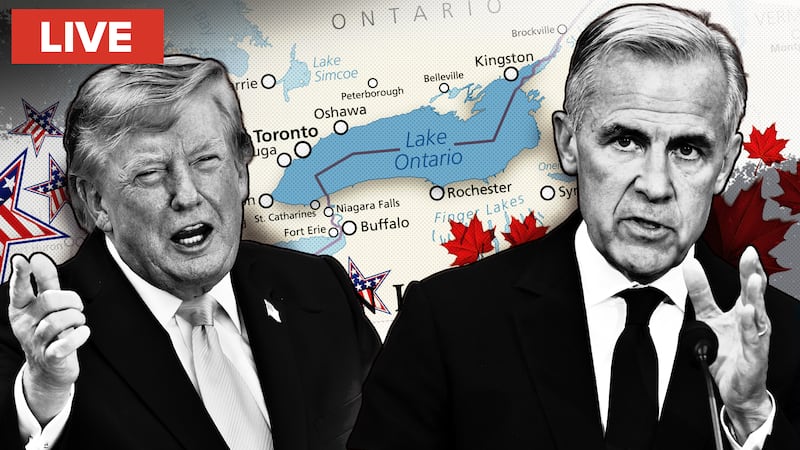
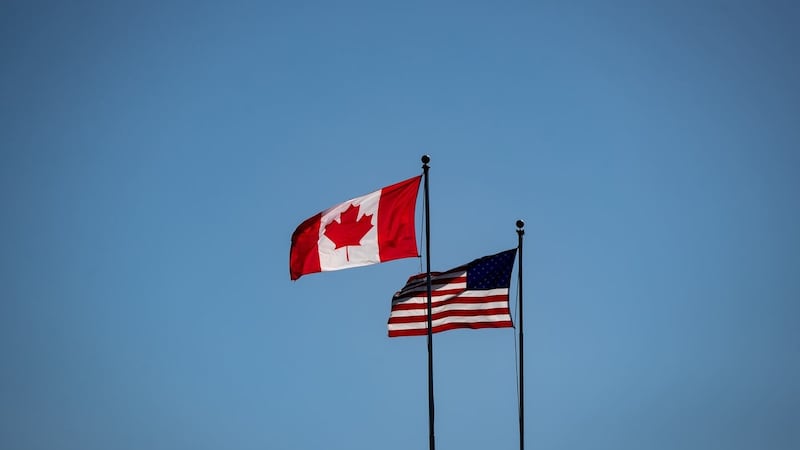
U.S. President Donald Trump has signed an executive order to rename Lake Ontario as “Lake America.” Prime Minister Mark Carney responded to Trump’s executive order, reaffirming that no matter what the U.S. calls it, Canadians will know it as “Lake Ontario – then, now and always.” The news comes after a public spat between Trump and Ontario Premier Doug Ford, as the U.S. imposed tariffs on about $28 billion worth of Canadian goods and Trump threatened 50 per cent tariffs on Canadian autos. The federal government has since responded with dollar-for-dollar tariffs that will come into effect after Labour Day. Key details: Follow along for the latest updates: Trump says Lake renaming is ‘effective immediately’ U.S. President Donald Trump has signed an executive order to rename Lake Ontario as “Lake America.” Trump made the announcement in the Oval Office Thursday afternoon. Trump said the move was “official, effective immediately” and that his administration has “filed all the necessary papers, documents” and “notified all of the various people that we have to notify.” Kayla Thompson, CTVNews.ca journalist ‘Lake Ontario – then, now and always’: PM Carney Prime Minister Mark Carney responded to Trump’s executive order on Thursday, reaffirming that no matter what the U.S. calls it, Canadians will know it as “Lake Ontario – then, now and always.” “The name Lake Ontario comes from the Wendat word Ontari’io, which, appropriately, means ‘the lake is beautiful, the lake is big,’” Carney posted on social media on Thursday afternoon. “The name is more than 400 years old, predating both the Confederation of Canada and the Declaration of Independence of the United States of America,” he continued. Carney highlighted that the United States is changing “their trading relationships, their foreign policies, their national monuments and their hydronyms,” but that “Canadians also know that naming reality means calling it Lake Ontario.” Kayla Thompson, CTVNews.ca journalist Can Trump rename Lake Ontario? CTV News’ chief political correspondent Vassy Kapelos answered the question on a lot of Canadians’ minds: Can Trump change the name of Lake Ontario? “The short answer is yes and no,” Kapelos explained Thursday after Trump’s announcement. “He can do what he wants as far as what the United States is able to, or wants to, or decides to call any body of water or any landmark,” she said. “But he cannot dictate what Canadians call that body of water, or maybe more importantly … what the international community or other countries call it.” Kayla Thompson, CTVNews.ca journalist How did Lake Ontario get its name? The name is older than Canada itself. Historians believe Lake Ontario’s name has Iroquoian roots meaning “beautiful lake” or “sparkling water,” according to the Canadian Encyclopedia. Europeans began calling the lake “Ontario” in 1641, the encyclopedia entry says, and by 1656 the name was appearing on maps. The province of Ontario is named after the lake. The Canadian Press Read the full story here U.S. Board of Geographic Names ordered to rename lake U.S. Interior Secretary Doug Burgum issued an official order to the U.S. Board of Geographic Names to change the name of Lake Ontario to “Lake America.” Burgum shared the order in a social media post on Thursday with the caption “Make the Great Lakes Great Again!” “The area formally known as Lake Ontario has long been an integral asset to America, as a critical artery for America’s early trade and commerce, and as a vital economic resource for America,” the order said. “President Trump has directed the change in the name of Lake Ontario to Lake America, and the BGN must immediately take steps to accomplish the President’s instructions,” the document read. “This order is effective immediately.” ‘Not his best work’: Kinew on Trump Manitoba Premier Wab Kinew responded to Trump’s renaming of Lake Ontario, telling reporters the move is not the U.S. president’s “best work.” “You know when a rock band is really over the hill, and you see them in a casino playing some song from like 50 years ago?” he said. “I think that’s the part of Donald Trump’s presidency we’re at now.” Kinew said Trump “thought he had a real hit, a real golden oldie,” when he renamed the Gulf of Mexico the “Gulf of America” in January 2025, and “he’s trying (to) bring back that and he’s trying to play the hits for his base.” “But I think everybody here thinks it’s a little sad and it’s not his best work,” he added. Kayla Thompson, CTVNews.ca journalist ‘They feel entitled’ Trump says about Canada When asked by reporters why he’s so focused on America’s ally, Trump said “they haven’t treated us well.” “The Canadian officials have treated us very badly. They’re nasty people. They charge our farmers 400 per cent tariffs,” Trump responded. “People oftentimes, they’ll ask me who’s the worst to deal with… and I said that’s easy: Canada. They are the worst, and they feel entitled, and just we can’t have that.” Kayla Thompson, CTVNews.ca journalist Trump: Canada ‘ripping us off for a long time’ When asked what message Trump is attempting to send to Canada with the renaming, the president reiterated that Canada has been “ripping us off for a long time on trade.” “Very sadly, even the military. You know, we defend Canada for nothing. We don’t get anything. They don’t pay us to defend Canada, but we defend Canada, and they understand that,” he told reporters. Trump brought up 11 brand new icebreakers as an example of his grievances. “They’d like to use the icebreakers. They don’t pay for anything, and they want to be treated like a state, but they’re not a state.” Kayla Thompson, CTVNews.ca journalist ‘Do I care about how the Québécois speak?’ Lutnick says U.S. Secretary of Commerce Howard Lutnick claims the U.S. did not raise issues with the French language or the Québécois in trade negotiation talks with Canada last week. “If you think I ever said the words ‘French,’ do I care about how the Quebecois speak?” he said to reporters in Washington on Thursday. “I mean, what could matter less to America? We don’t care. So, the fact is, we never brought those words up.” Lutnick claims the detail was “manufactured” by Prime Minister Mark Carney to end negotiations with the U.S. “There’s the sovereignty party trying to run, and they’re in the lead in Quebec, and so this was Mark manufacturing something that would try to keep them from winning.” Kayla Thompson, CTVNews.ca journalist ‘The math was sensational’: Lutnick “We’re just being used by them,” Lutnick told reporters about Canada’s decision to end trade talks. “That’s why it ended. It didn’t happen for math. The math was sensational,” he said. “It was a great deal that we shook hands on.” Lutnick also claimed that concerns about medium- to heavy-duty trucks were strategically held by Canada until the last moment in trade negotiations. Despite meeting with LeBlanc 10 times and speaking to Carney twice, “the words ‘medium’ and ‘heavy-duty trucks’ were raised in these trade negotiations at Friday at 4:00,” he added. “These were things they put in in order to make it end,” he said. “It was nonsense.” Kayla Thompson, CTVNews.ca journalist Canada replacing seafood counter-tariffs with other items The federal government is replacing its counter-tariffs on seafood with 50 per cent levies on a series of other American goods, according to Finance Minister François-Philippe Champagne’s office. “This decision was made in the interest of strengthening Canada’s sectors and our tariff response — and to better match the American tariffs dollar for dollar, rate for rate,” Champagne’s press secretary John Fragos wrote in a statement to CTV News, adding the federal government has been consulting with stakeholders and provinces when it comes to counter-tariff options. Fragos also tells CTV News that the decision to remove seafood from Canada’s list of counter-tariffs was made in part to avoid giving the appearance of escalation by Canada in the face of a simmering trade conflict with the United States, as the U.S. does not tariff Canadian seafood imports. Newly added to Canada’s list of counter-tariffs include: Spencer Van Dyk, CTV News writer & producer and Stephanie Ha, CTV News Ottawa National Bureau manager Read the full story here Trump ‘hell-bent’ on ending Canada-U.S. friendship: Reid According to CTV News political commentator Scott Reid, Trump’s executive order to rename Lake Ontario to Lake America shows how unserious he is. “People make jokes about it, I’ve made jokes about it, but it isn’t really funny,” Reid, who once served as director of communications for former prime minister Paul Martin, told CTV News Channel on Thursday. “He’s treating it like it’s a clown show,” he added. The last time Trump attempted to rename an international body of water, changing the Gulf of Mexico to the “Gulf of America,” it was largely ignored by domestic and international media. “I guess this is what makes Donald Trump feel good about being Donald Trump, but all that signals to serious people on either side of the border, is that the president isn’t serious,” Reid said.He added that it shows the U.S. president doesn’t take his job, people’s income, or trade seriously. “Donald Trump is hell-bent on making sure Canada is not a friend and does not become a friend again anytime soon. That appears to be his mission,” Reid said. Joe Van Wonderen, CTVNews.ca journalist ‘We are still going to call it Lake Ontario’: Brampton mayor Brampton Mayor Patrick Brown told CNN on Thursday afternoon that Trump’s efforts to rename Lake Ontario are a “bit preposterous” and are mostly being laughed off in Canada. “We are still going to call it Lake Ontario, I think many of you will still call it Lake Ontario. The only person who is going to have trouble with what to call it is your president,” Brown said. “Just like if our prime minister wanted to rename the Mississippi (River) you might get a bit of a chuckle out of it. It is having the same reaction in Canada.” Brown is the latest in a line of Ontario politicians to appear on CNN and other U.S. television networks in recent days to make a direct appeal to Americans. The Brampton mayor said the trade war is “not something Canada has sought” and that it has “bewildered” most Canadians. “The only people sipping champagne right now are our competitors from Asia and the EU who look at this chaos in North America as an opportunity to increase market share,” he said. Chris Fox, CTVNewsToronto.ca journalist ‘Just doesn’t seem very serious’: political analyst A U.S. political analyst told CTV News Channel on Thursday that Americans found the proposed renaming of Lake Ontario confusing and laughable. “It’s a mixture of laughter and of raised eyebrows, wondering when the other shoe is going to drop,” said Jeffrey Bloodworth, a political analyst at Gannon University. “Its one thing to rename a lake, and people kind of laugh,” he said, adding “normal regular people” are wondering “what the heck is going on, because this just doesn’t seem very serious.” Bloodworth highlighted that although the move may appear “comical,” hundreds of billions of dollars of commerce flow through the border. If Trump continues to upset the trading relationship, it could have damaging effects on people’s livelihoods, he said. “Most people expect this is kind of political theatre that will be retracted,” he said. Joe Van Wonderen, CTVNews.ca journalist Quebec manufacturer blames tariffs for closure As Canada’s forestry industry comes under attack from the trade war with the United States, a Quebec paperboard manufacturer says it is closing — putting more than 400 people out of work. The RYAM industrial complex in Temiscaming, Que., will close in September, officials announced Thursday. The company said business has become unsustainable with 50 per cent tariffs targeting the Canadian forest industry. Temiscaming Mayor Alain Gauthier said the tariffs are a “nuclear bomb” for sectors that rely on U.S. markets. “It’s an economic war,” he said. “We plan for every option. We’re not naïve. For the short-term, we need a bridge to get across that river.” Eric Taschner, CTVNorthernOntario.ca journalist Read the full story here Tariff confusion impacting B.C. business A B.C. outdoor living company says confusion over tariffs has some American customers thinking twice about hitting the “buy” button, even though its products remain exempt from the taxes. About 82 per cent of GOODLAND’s business comes from the United States and most transactions are done online. Craig Pearce of the Vancouver-based company told CTV News that when customers see “Proudly Canadian” on the website, they often assume they’ll have to pay a steep tariff, when they don’t. “I think there’s a trickle-down effect, right? It’s just the confusion, uncertainty,” said Pearce. He admitted the constantly changing tariff lists makes it difficult to know what could be affected next. St. John Alexander, CTV News Vancouver journalist Read the full story here ‘Shop Canadian’ app sees surge in use A “Shop Canadian” app created by two Edmontonians is seeing an uptick in traffic, with the creators crediting the sudden patriotism directly to Canada’s relationship with the U.S. The app, launched in January 2025 by William Boytinck and Matthew Suddaby, is a 10,000-company database that allows consumers to scan most barcodes while shopping to see whether a product is locally or nationally made. Each trade announcement leads to a slight bump in traffic on the app, Boytinck said. The U.S.-Canada trade war has contributed to one of the app’s most “noticeable” bumps yet, with 30,000 requests for product information since last week. “I think it’s just from people who want to support local businesses and do their parts,” Boytinck added. Hannah Kavanagh, CTVNewsEdmonton.ca digital journalist Read the full story here Chapman’s vows no price increase Canadian ice cream manufacturer Chapman’s has promised to not increase prices for almost two years amid the ongoing trade war with the U.S. In a social media post Wednesday, Chapman’s vowed to keep prices as they are until March 2028. “We will continue to support our employees with a living wage and provide our customers with the best product for the best price, using only 100% Canadian dairy,” the ice cream maker said. Chapman’s called Trump’s tariffs “unjustified” and said it stands with the Canadian government and all provinces. The company said it’s also on track to convert 70 per cent of its American ingredients by mid-2027. Chapman’s ended the post with a strong call for Canadians to “buy” and “support” Canadian. Aarjavee Raaj, CTVNews.ca journalist Toronto mayor reinforces ‘buy local’ initiative Toronto Mayor Olivia Chow is reminding residents to support local businesses and buy Canadian as the ongoing trade war threatens to drive up costs for everyday Canadians. Speaking at a news conference, Chow warned that families could feel the impact at the grocery store, saying “the prices could go up again” as tariffs continue to affect trade between Canada and the U.S. “This is how we Canadians respond to this senseless trade war,” Chow said, calling on residents to “stand up for each other” by buying and investing locally. Chow also highlighted the city’s efforts to support local companies through its EDGE Incentive Program, which provides property tax relief to eligible businesses that expand and create jobs. In a news release, the city says National Dry Beverages, the first company approved under the program, is investing $18.1 million to add about 62,000 square feet of industrial space to its Arrow Road facility. The expansion is expected to create 20 full-time jobs and increase the company’s permanent workforce by nearly 40 per cent. Since launching in January 2025, Chow says the EDGE program has approved eight projects representing about $220 million in construction investment, 583 projected new jobs and 725 retained jobs. Chow said the city is also using its purchasing power to support Canadian companies, with 98 per cent of its spending last year already going to Canadian businesses. “Trump’s trade war is just bad business,” she added. Jermaine Wilson, CP24.com and CTVNews.ca journalist Trump renames Lake Ontario in video A video posted to U.S. President Donald Trump’s Instagram page shows him crossing out a map of Lake Ontario and renaming it “Lake America.” The video shared Wednesday night shows Trump sitting in the Oval Office with a map of the lake. “We’re going to make a little change,” he says in the video. “We’re going to call it something different than Lake Ontario. We’re going to call it Lake America.” “All it takes is a good pen and some intelligence,” the president added. With a black pen, Trump is seen crossing out the name and writing a new one. “Lake Ontario, that’s gone,” he says, looking at the camera. “So, now we have a lake and now we have a gulf, because we have the Gulf of America and now we have Lake America.” Devika Desai, CTVNews.ca journalist He’s kidding about renaming Lake Ontario, right Trump’s latest attempt to claim U.S. sovereignty over Lake Ontario is the latest in a long line of attacks against Canada that will make it harder for political will to galvanize around a trade agreement. You might think his remarks are simply bluster, maybe even a joke, coming from a former reality television star. But in the aftermath of Venezuela, his incremental efforts at overtaking Greenland and his six-month war in Iran, the president is proving his authoritarian bent is very much serious — and it’s playing out in very stark terms throughout the latest negotiations with Canada. Eric Ham, CTV News political analyst in Washington No tariffs on U.S. seafood, fish: Finance Canada Canada will no longer tariff U.S. fish and seafood products. Finance Canada released a statement on X late Wednesday saying it made the change to protect against “broader economic harms” and after the federal government received feedback from Canadian industries. The statement added that it is making some adjustments to the list of counter-tariffs. It did not say what the other changes are. The Canadian Press U.S. drops Canadian culture from talks Canada-U.S. Trade Minister Dominic LeBlanc says the United States will not target promotion of the French language or Canadian culture in ongoing actions around trade. “Canada welcomes that the U.S. is now withdrawing its positions on discoverability and labelling and is confirming that measures to promote French language and Canadian culture will not be subject to future U.S. trade actions,” LeBlanc said in a social media post. “We look forward to further constructive U.S. clarifications on their other positions which would create the possibility of a mutually beneficial trade agreement that respects Canadian sovereignty.” LeBlanc’s statement came in response to U.S. Trade Representative Jamieson Greer’s comments to CBC News on Wednesday, in which he said discoverability of French content was discussed during trade talks, but not as a deal-breaker. Earlier on Tuesday, U.S. President Donald Trump called the idea of him interfering with Canadians speaking French a “stupid thing,” in a post on social media. Aarjavee Raaj, CTVNews.ca journalist ‘Venezuela of the north’ In a CNN interview earlier today, Canada’s former deputy prime minister Chrystia Freeland said Trump’s latest salvos aimed at Canada are about “dominance,” and “trying to turn Canada from a partner and an ally into a vassal. It’s trying to turn Canada into the Venezuela of the north.” She said Canada won’t give up its sovereignty. “We want to be America’s friend. We want to be your ally. But we’re not going to be your servant,” said Freeland. The Trump administration tried getting through the back door what they couldn’t get through the front door. CUSMA, which was negotiated by Trump in his first term, made it difficult for the White House to fully enact an ‘economic warfare’ framework that would bring Canada into subjectivity. Therefore, the president sought to force an agreement on Ottawa that would see the Great White North give up its independence and sovereignty. Trump will eventually cave, but that doesn’t mean an improved trade agreement is forthcoming. Both nations will likely remain at status quo as Washington once again exhibits it can’t be trusted. This will make the second war this White House has lost. First, the war in Iran, and now a stunning and ill-advised trade war with its biggest trading partner and one of its oldest allies. Eric Ham, CTV News political analyst in Washington Trump trade war with Canada costing him in Michigan In the state of Michigan, 40 per cent or roughly US$70 billion in goods are imported annually from Canada. The Great White North is Michigan’s largest trading partner. Michigan U.S. Senate candidate Abdul El-Sayed stated on the campaign trail after talks broke down: “You gotta be an asshole to pick a trade war with Canada.” The state has been Ground Zero for President Trump’s continued attacks on Canada. Now, however, voters appear willing to elevate El-Sayed over his Republican challenger as the Michigan economy looks to come to a grinding halt as the trade war between the U.S. and Canada heats up. Eric Ham, CTV News political analyst in Washington Americans push to get back to table We’re continuing to see key sectors call for both sides to come back to the negotiating table. Already the powerful U.S. Chamber of Commerce and the U.S. Business Council have implored talks to continue. At a more local level, in the state of Maine, a jurisdiction that could shape the balance of power in Washington, the Maine Lobsters Association is also pushing for talks between Washington and Ottawa to continue. Republican U.S. Senator Susan Collins is locked in a heated battle for re-election and the trade war has placed Canada at the top of the ballot for voters in that state. Eric Ham, CTV News political analyst in Washington No renegotiations in short term: adviser A Canada-U.S. relations adviser says she doesn’t think trade negotiations will resume any time soon. “I don’t have much hope,” Lisa Raitt, former deputy leader for the Conservative party, told CTV Your Morning on Thursday. There would need to be an “external factor” that would prompt both sides to return to the table, Raitt added. For example, trade negotiations halted last October despite being close to a deal and only resumed this July. Although negotiations halted again last week, the relationship between both parties was “professional,” Raitt said she was told. She said she doesn’t know if there are ongoing conversations between Canada and the U.S. on a deal. “For the moment, we are seeing a war of words in the media, which is unfortunate.” Devika Desai, CTVNews.ca journalist ‘Havoc’ for private investment: economist An economist says uncertainty from the trade war is causing “havoc” for private investment into Canada. “Not on the consumer product side,” Pedro Antunes, chief economist of Signal 49 Research, answered when asked if Canada is currently attractive to investors. Canada’s manufacturing sector was appealing due to its access to the U.S., he told CTV Your Morning on Thursday. “That’s a different story.” Antunes said Canada may see better outcomes with resource investment.“A lot of our resources now (come) from a secure place,” he said. He added that it may be “advantageous” to lean on Canada’s critical minerals to attract investors. Canada needs to show “success” on getting major projects rolling and approved quickly, Antunes said. “That will be attractive to investors again for all of the reasons ... safe place, lots of resources, a stable government.” Devika Desai, CTVNews.ca journalist Previous days’ updates follow: Saskatchewan’s Moe announces 50% tariff on U.S. liquor Saskatchewan Premier Scott Moe says his government will be imposing a 50 per cent reciprocal tax on alcohol from the United States. Moe said the trade measures will be implemented Sept. 8. “Given the increased tariffs that the United States of America has put on Canadian and Saskatchewan goods, given the counter tariffs that are in place, we need to protect ourselves,” Moe said. The premier says the province is not considering pulling U.S. booze from shelves, noting his government is adamant on leaving the choice up to consumers. “That is a very core value for this government to allow Saskatchewan people to make their own choice,” Moe said. David Prisciak, CTVNewsRegina.ca digital journalist Read the full story here Smith urges de-escalation of trade war Alberta Premier Danielle Smith says the ongoing trade war between Canada and the U.S. signals a need to accelerate timelines on major national projects and business relief. On Wednesday, Smith doubled down on her aversion to oil and gas export tariffs to retaliate against recently imposed U.S. tariffs, which she called “tragic, unjustified, and wholly unnecessary.” Tariffs are expected to affect about $1.5 billion of Alberta exports to the south. Oil and gas and beef cattle — Alberta’s biggest industries — are so far unaffected. “Rather than making threats and promises we know we cannot keep, Canada should focus on what we can control and do,” Smith said. Hannah Kavanagh, CTVNewsEdmonton.ca digital journalist Read the full story here Smith puts political interests ahead of Canada: Mulcair Smith is putting her political interests ahead of a united Canadian response to the trade war with the United States, says CTV News political commentator Tom Mulcair. “She’s trying to mollycoddle the extremists around her, in her home province, and it’s really not coming out very well,” he said in an interview with CTV News Channel Wednesday. Mulcair also dismissed Smith’s explanation that her opposition to Ottawa’s approach is driven by concerns over Ontario’s reliance on U.S. oil and natural gas. “Come on. Nobody believes that for a second,” Mulcair said. “It has everything to do with Alberta selling as much oil and gas as it wants and not being part of Team Canada.” He added that Smith has “always got an excuse to do nothing” and should follow Saskatchewan Premier Scott Moe’s lead by taking action in response to U.S. tariffs. “It’s high time that she started showing that she actually believed in standing up for Canada,” Mulcair said. Tammy Ibrahimpoor, CTVNews.ca national digital producer ‘Time to teach Canada you can’t do this anymore’: Trump U.S. President Donald Trump said on Wednesday it is “time to teach Canada you can’t do this anymore,” just days after trade talks between the neighbouring countries broke down. “I had a deal, that was a pretty good deal, you know, quite good,” Trump told Glenn Beck in an interview. “They don’t have anything that we have to have, okay, we can get by. I mean, there are a couple of things that would make it a little inconvenient, but we can get them elsewhere. And it’s time to teach Canada you can’t do this anymore,” Trump said. Trump imposed new 50 per cent tariffs on US$20 billion of Canadian imports on Saturday after talks between the two countries collapsed. Canada hit back on Tuesday with retaliatory tariffs on about US$20 billion worth of U.S. annual imports and rolled out aid for businesses and workers, matching Washington’s latest duties dollar-for-dollar. Reuters Read the full story here Trump says U.S. doesn’t need anything from Canada. Is that true? WE DON’T NEED CANADA, THEY NEED US!” U.S. President Donald Trump’s social media post this week was a continuation on a theme he’s maintained throughout the trade war: that his country doesn’t need anything from Canada. Experts — and exports — say that’s not the case. To understand what the U.S. does need from its northern neighbour, look no further than the list of items the Trump administration has consistently carved out of its own tariff regimes. The Canadian Press Read the full story for more details on what Canadian exports the U.S. needs Grocers aim to push ‘buy Canadian’ WINNIPEG – The push to “buy Canadian” is resurfacing, as tariff tensions between Canada and the United States continues to escalate. The owner of a Winnipeg grocery store has placed “Made in Canada” stickers all along his store’s shelves, to help consumers identify which products are Canadian. He plans to add even more labels in the coming days. “We’re always looking at different products and making sure that those ones that are made right here in Canada are highlighted first, and given more shelf space,” said Ramsey Zeid of Foodfare. “Anybody that comes in and asks for a certain product, we always highlight that product first and let them know that we do have the ‘Made in Canada’ option.” Alex Karpa, CTV National News journalist Read the full story here ‘Many cards in our hand’: Joly Industry Minister Melanie Joly says Canada still has options for ways to deal with the United States but the federal government won’t negotiate in public by laying out those possible measures. “We decided to match dollar-for-dollar countermeasures, around $28 billion,” Joly said following a funding announcement in Calgary on Wednesday, when asked what Canada will do if the U.S. further escalates the trade war. “We have many cards in our hand, and of course we have many hands to play,” she added. Joly also said Canada will not comment on rumours about potential further escalation by the U.S., but rather only once U.S. President Donald Trump has signed an executive order. Joly was also asked about leveraging energy, and what it would take for Canada to impose tariffs on its fuel or potash, which are vital to the U.S., but the minister wouldn’t say. Spencer Van Dyk, CTV News writer & producer Trade lawyer warns against Canada pulling ‘energy card’ Canada should be cautious about using its energy resources as leverage in the trade dispute with the United States, says an international trade lawyer and senior fellow at the C.D. Howe Institute Lawrence Herman. “It’s difficult for the Carney government to get Canada united to the extent necessary that would allow us to play the energy card,” he told CTV News Channel, adding that Ottawa must consider national unity issues, particularly amid separatist sentiment in Alberta. “The energy card is a strong card, we have to be very cautious about how we play that one,” Herman said. He also noted that the Canada-U.S. relationship is in a deeply troubled state. “The statements coming out of Washington and the comments of the Trump team are appalling, insulting, and (there’s) no indication that there’s any element of respect for Canada as a country or for our leaders,” he said. “I’ve never seen a situation between Canada and the United States as dismal as it is today.” Herman said both sides need to allow tensions to cool before trying to restore a workable trading relationship, warning there will be economic pain on both sides of the border in the meantime. Tammy Ibrahimpoor, CTVNews.ca national digital producer Trump may levy more penalties: Bloomberg The Trump administration is considering additional penalties against Canada, a Bloomberg report states. The report, published on Tuesday, quoted a White House official who spoke on the condition of anonymity. The official said the new penalties could lead to higher tariffs and other trade actions. The news comes after Prime Minister Mark Carney announced retaliatory tariffs against the U.S. on Saturday. The administration’s response was “expected,” the official was quoted saying. Trump has already said he would double auto tariffs on Canada to 50 per cent and add tariffs on auto parts, starting Jan. 1, in response to Canada striking back. Devika Desai, CTVNews.ca journalist Trump’s tariffs likely to face court challenge: lawyer A lawyer involved in the case which resulted in the United States Supreme Court striking down President Donald Trump’s favourite tariff tool says chances are “quite high” that the latest duties on Canada will land in court. George Mason University law professor Ilya Somin said there are many industry groups and U.S. states that will see damage from the escalating trade war with Canada. “I think it is overwhelmingly likely that there will be at least some legal challenges,” Somin said. “It’s just a matter of exactly when and by which groups.” The Canadian Press Read the full article here Canada may have to accept some U.S. tariffs: trade lawyer Canada and the United States are so closely intertwined that none of them will benefit from a prolonged trade war, says international trade lawyer Jacques Shore. In an interview with CTV News Channel Wednesday, Shore said the ongoing trade dispute is a “bizarre moment” given the two countries’ longstanding relationship and economic ties. “We make things together, we work together. We are basically tied to the hip,” Shore said. He said Canada is taking the right approach by demonstrating that it is serious about protecting its interests while working to get both sides back to the negotiating table. “No one wins in a trade war,” Shore said, adding that Canada may ultimately have to accept some U.S. tariffs. “This is an administration that wants to see some tariffs, and we may very well have to accept that,” he said. Tammy Ibrahimpoor, CTVNews.ca national digital producer U.S. Republicans urge Trump to renegotiate: analyst Eric Ham, CTV News’ U.S. political analyst, says he’s seeing a push from U.S. Republicans urging President Trump to get back to the negotiating table with Canada. “They’re being very diplomatic, not calling out the president, not attacking Donald Trump,” he tells CTV News Channel. “They still recognize he holds enormous sway and influence over the party, but what they also recognize is that their ability to lead and hold power has become much more precarious as a result.” Ham notes that Canada’s counter-tariffs set to take effect on Sept. 8 will be hitting Americans just as they begin to take focus on the midterm elections, and adds Trump’s additional tariffs on automobiles would take effect in January “as a way to actually delay the brunt of the impact on Americans until after the elections.” “I think what we saw from Prime Minister Carney is he simply isn’t waiting, recognizing that it’s voters who will be heard,” he says. “He’s making sure to actually get their attention with these retaliatory tariffs—a very smart political play by the prime minister.” Samantha Pope, senior producer, CTV’s Power Play with Vassy Kapelos Auto-industry sources hopeful a deal is still possible Automakers were hoping summer U.S.-Canada trade talks would deliver relief from Washington’s 25 per cent tariffs that have raised the cost of shipping vehicles and parts across the border. Instead, their problem got twice as bad on Monday. “We cannot end up in a place come January next year where Canada — a major market for U.S.-made vehicles and parts and whose vehicle exports contain significant U.S. content — is being treated like China,” one industry executive told Reuters. The planned 50 per cent tariffs on Canada would rival the levies currently in place on some gasoline-fueled cars imported from China. The trade deal that fell apart would have cut the top-line tariff rate on Canadian cars and light-duty trucks from 25 per cent to 15 per cent. Canadian-built vehicles accounted for only about 6 per cent of U.S. sales in 2025, according to Barclays. Still, if the current tariffs double, automakers including Ford, General Motors, Jeep-maker Stellantis, Toyota and Honda would face significant added costs on some of their most important models. And a higher levy on parts would inflict pain across the U.S. automotive supply chain. Some auto-industry sources who spoke to Reuters said they were hopeful a deal would still be resolved before January, and that the deadline being months signals that the sides are leaving room to reach a deal. Reuters Read the full story here Personal insults directed at Trump ‘resonated around the world’: Ford Ontario Premier Doug Ford says that he does not believe he went too far in his personal attacks against U.S. President Donald Trump earlier this week. Ford called Trump a ‘loser’ and the ‘king of bankruptcies’ during a news conference in Hamilton on Monday before conceding one day later that the war of words between them got a little too “personal” and a “little heated.” At a news conference on Wednesday, Ford was asked whether his decision to soften his language was done out of concern that the attacks may have put a target on Ontario’s back, to which he replied “not at all.” “Those words resonated and I usually don’t use those words but when your country is under attack and your province is under attack and this guy is just nothing but a bully it resonated around the world,” he said. “It didn’t matter what political stripe. It didn’t matter if you are from the green, orange, red, blue parties, everyone is united.” Chris Fox, CTVNewsToronto.ca journalist Ontario wouldn’t act unilaterally in cutting off electricity to U.S.: Ford Premier Doug Ford says “everything’s on the table” in Ontario’s response to U.S. President Donald Trump’s trade war—including cutting off the power it supplies to 1.5 million homes south of the border—but he says he won’t do so unilaterally. “I can’t do it alone. You know, I’m not the only province that ships electricity down to the U.S. We need a Team Canada approach, and I’d be happy with the provinces to lead that approach,” he said at an unrelated news conference Wednesday. The province briefly applied, and then removed, a 25 per cent surcharge on its electricity exports to New York, Michigan and Minnesota last year as the trade war began. Ford has previously said he would cut off the energy to those states completely “with a smile” on his face. Phil Tsekouras, CTVNewsToronto.ca journalist Poilievre pens another letter to Carney Conservative Leader Pierre Poilievre on Wednesday sent another letter to the prime minister, this time calling on him to release the federal government’s analysis of the cost of counter-tariffs on Canadians. “Leverage isn’t the same as noise,” Poilievre wrote in the letter posted to social media, co-signed by Conservative deputy leader Melissa Lantsman and Conservative Canada-U.S. relations critic Shuvaloy Majumdar. Poilievre also referenced the slate of counter-tariffs announced by federal officials Tuesday, saying the goods facing higher levies will only compound the affordability crisis facing Canadians. “A serious response puts maximum pressure on the United States and minimum pressure on Canadians,” they added. “It targets goods that we can make ourselves or buy elsewhere. It does not tax our families for the privilege of appearing tough.” Poilievre has also urged Carney to recall Parliament in light of the escalating trade war, and to release the text of the rejected trade agreement. Spencer Van Dyk, CTV News writer & producer Counter-tariffs helps some, hurts some: trade lawyer The retaliatory tariffs have helped some businesses and hurt others, according to a Canadian trade lawyer. William Pellerin, international trade lawyer at MacMillan LLP said his firm has heard “a lot of good things and a lot of major problems, depending on the client.” The retaliatory measures have provided some relief to businesses in the Canadian market from American competitors, but have further strained those who depend on the U.S. for products. “Ultimately this situation is not to anyone’s benefit,” Pellerin said. The trade war “makes our markets more insular in a way that that is just not helpful.” Devika Desai, CTVNews.ca journalist Bad news for retail: analyst A retail analyst says the tariffs spell a “negative doom loop” for the economy. “If it keeps up, some retailers will close… retail sales will go down,” Bruce Winder, founder of Bruce Winder Retail in Toronto told CP24 Breakfast on Wednesday. “They’ll have to lay off people.” Perishable goods like seafood or dairy will see a quicker price increase, he said, while electronics retailers may have “dodged a bit of a bullet,” as many consumer electronics are made offshore. “But if you’re buying high-end electronics that are made in the U.S., you will be subject to this 50 per cent consumer tariff,” Winder said. While retailers will try to “cushion” the impact, they will have to raise prices on some of the more expensive inventory, he added. Devika Desai, CTVNews.ca journalist Loblaw bringing back T symbols on tariff-affected items Loblaw Cos. Ltd. says it is bringing back T symbols to its grocery shelf labels to signal products affected by tariffs as the trade war between Canada and the United States escalates. Chief executive Per Bank wrote in a LinkedIn post that customers will start noticing the new signs on a small number of products, which will grow as tariffs are applied across more categories. The grocer will continue to use the maple leaf symbol in its stores to signal homegrown products and says it will also reintroduce country-of-origin labels in its fresh produce aisles. When trade tensions flared up last year, Loblaw introduced the T symbol to indicate to customers that a product’s price had risen due to tariffs. Bank says the retailer is in a stronger position than the last time when tariffs were first introduced as it has revamped its supply chain to increase the number of domestic and non-U.S. suppliers it sources products from. Major grocery chains scrambled to onboard local suppliers and placed symbols indicating domestic products last year when a buy Canadian movement swept the country amid geopolitical tensions. The Canadian Press Read the full story here Trump suggests U.S. added conditions at 11 hour: CNN In a phone call with CNN’s Jim Sciutto Tuesday, Trump suggested that the U.S. added new conditions in its trade negotiations with Canada at the 11th hour ahead of last week’s deadline. “That sounds like me,” Trump said. U.S. officials had previously claimed that Canada made new demands and walked back previous commitments during negotiations. However, Carney said that “last-minute changes in the U.S. proposed terms were unfair, uneconomic, and called into question the reliability of any deal.” When pressed on why he doesn’t deny Canada’s claims, Trump said he “doesn’t deny anything.” “They have to pay a fair amount, and if they don’t pay a fair amount, we won’t make a deal,” he said. “That’s fine.” Hunter Crowther, CTVNews.ca journalist ‘Matter of days’ until Trump reverses tariffs: Newsom California Gov. Gavin Newsom says he believes U.S. President Donald Trump will change course on his new tariffs on Canada soon, as he faces increasing political pressure back home. “Imagine the phone calls Donald Trump’s receiving from members of his party, not from those condemning him from my party,” Newsom said in an interview with CTV News’ chief political correspondent Vassy Kapelos on Tuesday. “I think it’s a matter of days, if not weeks, the latest, where he completely flips on this and then tries to save face.” Newsom says Trump is “creating a lot of political pressure” for members of the Republican Party. Asked by Kapelos whether Trump’s trade policies have created permanent damage between long-time allies, Newsom said, “Trump’s not permanent” but concedes the negative impact may be more long term than he previously expected. “The fact that this damage may be more long-lasting than I had originally believed. That concerns me, but I understand it at the same time,” he added. Stephanie Ha, CTV News Ottawa News Bureau manager Read the full story here White House alleges pattern of Canadian abuses The White House released a statement Tuesday afternoon that outlined what it described as a record of Canadian trade abuses against the United States. The statement, titled “President Trump Is Finally Ending Canada’s Free Ride,” reiterated Trump’s earlier claims that “Canada has been ripping off the United States for decades,” and went on to read that Trump is “done” letting Canada “get away with it.” According to the release, the U.S. offered Canada the most preferential market access of any country on Earth last week, including deep cuts on steel, aluminum, autos, lumber, and more. “Instead of partnership, Canada chose unreasonable demands, walk-backs, and flat-out rejection,” the statement read. The release went on to list what the White House called a “record of Canadian abuse,” including restrictions on American wine, beer and spirits, Canada’s decision to retaliate with tariffs rather than continue negotiations, and its treatment of U.S. aerospace manufacturer Gulfstream, among other complaints. Kayla Thompson, CTVNews.ca journalist NDP leader urges PM Carney to ‘Trump-proof’ economy NDP Leader Avi Lewis is urging the federal government to provide more protections for Canadian workers in the wake of Canada announcing new counter-tariffs against the United States. Lewis said he spoke with Carney on the phone on Tuesday morning about Canada’s measures in response to the Trump administration’s new tariffs. “I reiterated the NDP’s support for Canada walking away from a bad deal and welcomed the relief measures announced today as a first step to assist workers and industries,” Lewis said in a press release Tuesday. “However, more action is required to make sure workers get the support they need and that we’re responding at scale and speed to the U.S. economic attacks. ” Lewis said the New Democrats are calling for the federal government to provide the following: • “Substantial supports” for employees in sectors affected by tariffs, such as wage subsidies • Stronger employment insurance providing more benefits and reducing the number of hours needed for workers to quality • An export tax on critical minerals and energy “In the long term, I shared with the PM that … it’s past time that we doubled down on a clear plan to Trump-proof our economy,” he added. Christl Dabu, CTVNews.ca journalist ‘We’re always going to call it Lake Ontario’: Ford Ontario Premier Doug Ford was asked about the U.S. seriously considering changing the name of Lake Ontario to Lake America. “That’s up to the president if he wants to change Lake Ontario to Lake America. I know Canadians, we’re always going to call it Lake Ontario,” Ford said in an interview with Bloomberg TV’s Joe Mathieu. “That’s a lot of rhetoric again.” The premier added that more than a dozen states will be impacted if the U.S. stops doing business with Ontario. “He’s saying he won’t do a lot of business with Ontario. Well, let me remind the president: nine million Americans wake up every single morning to produce a product, a widget, or a service for Ontario,” he said. Bryann Aguilar, CP24.com journalist Counter-tariffs create ‘less-than-ideal situation’: jobs minister Minister of Jobs and Families Patty Hajdu says while counter-tariffs do create a “less-than-ideal situation for any country,” the federal government has no choice but to stand up for Canada. “Look, it’s hard on Canadians when choice diminishes, and in some cases, prices go up because of that lack of choice,” she told CTV News Channel. “But it’s also really important to stand up for Canadian companies that produce these products in Canada.” Hajdu was among the federal ministers who announced on Tuesday morning, the implementation of tariffs on nearly $28-billion worth of U.S. imports that is set to come into effect on Sept. 8. The ministers also pledged $7.5-billion towards support measures for workers and businesses. “Tariffs are there to really emphasize that point, to make sure that our Canadian companies, manufacturers, and services have the most preferential situation in terms of people’s choices,” she says. “No doubt about it, they can cause economic pain. They can cause economic pain on our side of the border. They can cause economic pain for Americans who will be unused to the prices that will go up as a result of tariffs. But ultimately, we didn’t start this war, nor do we want to be in it.” Samantha Pope, senior producer, CTV’s Power Play with Vassy Kapelos Manitoba’s Kinew ‘supportive’ of counter-tariffs Manitoba Premier Wab Kinew is encouraged by the federal government’s plan to support Canadians amid the ongoing trade war with the United States, adding the province will soon unroll details about how it plans to help. After attending an unrelated event in Winkler Tuesday, Kinew spoke at length about the counter-tariffs with Carney. “We have to stand up for our sovereignty, our independence, our freedom as Canadians,” said Kinew. “At the same time, we have to have supports there that are going to help those businesses that are going to bear the brunt of being caught up in an unjustified trade war launched by the U.S.” Kinew met with industry and labour representatives Monday to discuss the concerns they have about the U.S. tariffs and how they will impact Manitobans. Devon McKendrick, CTVNewsWinnipeg.ca journalist Read the full story here Eby urges residents to boycott U.S. travel B.C. Premier David Eby made an appearance at a province-run liquor store Tuesday, touting an ongoing ban on stocking and selling American alcohol as one of the “key responses” in the trade war with the U.S. Amid the recent escalation from south of the border, which Eby called “extortionate,” the premier again asked residents not to travel to the United States. “Choose another place to do your tourism,” Eby said, also asking people to choose Canadian products. “If you can choose a Canadian product instead of an American one, please choose it. Right now, Canadian workers from coast to coast to coast need our support.” Eby’s news conference came on the heels of the leader of the Opposition B.C. Conservatives describing the booze ban as “not prudent or intelligent negotiating.” Lisa Steacy, CTVNewsVancouver.ca journalist Read the full story here ‘Consider CUSMA dead’ if counter-tariffs applied: expert The Canada-U.S. trade dispute could have major consequences for the future of the continental trade agreement, according to one policy expert. “If those counter tariffs actually go into effect on Sept. 8, you can consider CUSMA dead,” Hannah Thibedeau, executive Communications Officer at Global Public Affairs, said on CTV News Channel Tuesday. She said the two-week delay before Canada’s retaliatory tariffs take effect provides an important window to de-escalate tensions and potentially revive negotiations. “The good thing is … there is that off-ramp time frame,” she said, adding that the focus should be on how tariffs could affect Canadians’ finances rather than provocative rhetoric. Thibedeau said the key question now is whether negotiators can find a way to reach an agreement before the deadline. Archie Niari, CTVNews.ca journalist Moe backs ‘targeted’ counter-tariff announcement Saskatchewan’s premier is voicing support for the federal government’s counter-tariff measures. In a statement to CTV News Tuesday, Premier Scott Moe said he endorsed the “focused and targeted” response to the 50 per cent tariffs imposed on Canadian goods by the U.S. — affecting roughly $28 billion worth of goods. According to Moe, the new counter-tariffs will cover about $1.5 billion, or 11.3 per cent, of Saskatchewan’s annual imports from the U.S. “We are analyzing the counter-tariff list closely and working with affected industries to determine its potential impact on jobs and consumer prices, while also reviewing the federal government’s support measures to ensure they work for Saskatchewan businesses and workers,” the statement read. Daniel Reech, CTVNewsRegina.ca digital journalist. Read the full article here Ford reveals he told PM not to take deal In an interview with ABC’s Kyra Phillips on Tuesday, Ontario Premier Doug Ford revealed that he told Prime Minister Carney not to take the U.S.’ deal before trade negotiations fell apart last weekend. “No deal is better than a bad deal,” Ford said, suggesting that Washington’s proposed terms would have “bled out” Canada’s steel and auto industry. Ford struck a more diplomatic tone Tuesday after a war of words with President Trump a day earlier. The premier admitted to Phillips that the exchange got a “little heated,” after he told Trump to “kiss my ass” over the latest trade salvo. “I don’t want to make it personal. What I want to do is sign a deal and make sure both countries thrive,” he said. Phil Tsekouras, CTVNews.ca journalist ‘United Team Canada’ A statement from Carney, sent from the Prime Minister’s Office on Tuesday, says he spoke with opposition leaders about the federal government’s response to the “unjustified U.S. tariffs, including the new measures to support Canadian workers, families, and businesses.” “The Prime Minister and the leaders discussed the ongoing response and underscored the importance of a united Team Canada approach as Canada works to protect jobs, build the economy, and stand up for Canadian interests,” the statement said. Michael Lee, CTVNews.ca lead morning producer ‘It got a little personal’: Ford After a series of heated exchanges between Trump and Ontario Premier Doug Ford on Monday, Ford told CNN Tuesday that the temperature needs to come down. “It got a little personal yesterday,” he told CNN’s Wolf Blitzer. In his interview on the U.S. network, Ford returned to some familiar talking points, emphasizing the importance of a strong partnership between the two countries. “It’s time to get back to the table and let’s negotiate a fair deal because it is hurting the U.S., it is hurting Canada,” he said. He called Trump’s threats to stop doing business with Ontario “a lot of rhetoric,” noting that the province is America’s third largest trading partner globally. Codi Wilson, CP24.com journalist N.B. won’t stop supplying electricity: premier New Brunswick Premier Susan Holt says Canada’s trade war with the U.S. has not reached a point where her province would stop supplying electricity to Maine. Holt said it would be an extremely serious measure to turn off the power to communities who have been friends and neighbours to New Brunswick for generations. That’s as her Ontario counterpart Doug Ford warned he could cut off his province’s power exports to the U.S. entirely in an interview with The Associated Press. The Canadian Press. Read the full story here. ‘I love French Canadians!’ U.S. President Donald Trump said in a Truth Social post Tuesday morning that he would “never interfere with Canadians speaking French! In fact, I have never even thought of doing such a stupid thing.” “This lie was made up by a weak and ineffective Prime Minister in an attempt to gain political support, which he has totally lost, from the people of Quebec. I love French Canadians!” he added. French was listed as one of the key issues that forced Canada to suspend trade talks. U.S. Trade Representative Jamieson Greer, meanwhile, has downplayed the language-centred trade issues as a “funny fake story,” but said the sticking points came down to Canada’s push to get big streamers like Netflix to pay a portion of their profits to Canadian or Quebecois content producers. Michael Lee, CTVNews.ca lead morning producer ‘Fall in line’ U.S. President Donald Trump took to Truth Social on Monday with a pointed message to Prime Minister Mark Carney and Ontario Premier Doug Ford: “fall in line” or the consequences from the trade war will be much worse. The post addresses Carney as “Governor,” an ongoing jab the president has used to target Canadian prime ministers, including Justin Trudeau. Trump’s message also states that the U.S. is Canada’s “key to survival” and that the days of “ripping off our Farmers, and other Businesses, are OVER!” Elianna Lev, CTVNews.ca multi-platform writer ‘It was a bad deal’: Carney Speaking to reporters following his announcement in Lévis, Que., on Monday, Carney said in French that the terms presented by the U.S were a “bad deal.” Asked later to respond to comments by U.S. Secretary of Transportation Sean Duffy that Carney will be forced to return to the negotiating table because the tariffs will be “devastating” to Canada, the prime minister said officials will resume talks when their American counterparts have “the right attitude towards their industries.” “Let’s be clear: there is an existing arrangement between our country that works,” Carney said. “It can be improved. There are ways to improve it, and we will work to improve it in ways that are to the benefit of Canadians, but also to the benefit of Americans and the people of Mexico.” “But an attitude at the negotiation table that Canada is a subsidiary of the United States, that Canadian industry is going to be disadvantaged relative to American industry, that we’re going to set up terms so that over time Canadian industry is going to face constant headwinds, that’s not something we’re going to accept,” he added. Spencer Van Dyk, CTVNews.ca writer and producer Trump to increase auto tariffs to 50% U.S. President Donald Trump is firing back at Canada by announcing he will increase tariffs “on all Cars, Trucks, both large and small, Automotive Parts, and Steel” to 50 per cent on New Year’s Day. “Build in the U.S. and there are ZERO TARIFFS. Canada will be treated like a State no longer! On Trade, and in other ways, also, they are among the worst Nations in the World to deal with,” Trump said in a post on his Truth Social platform Monday. “They feel entitled, and yet, WE DON’T NEED CANADA, THEY NEED US! They do 95% of their business with the U.S., with us, the exact opposite! Thank you for your attention to this matter!” Michael Lee, CTVNews.ca lead morning producer Doug Ford and Donald Trump exchange war of words Ontario Premier Doug Ford is slamming Donald Trump as a “dictator” and the “king of bankruptcies” after the U.S. president criticized him on social media on Monday afternoon. In a post on Truth Social, Trump referred to Ford by the name as “the less charismatic, intelligent, and overall unimpressive brother of the late, great, Rob Ford” before noting that Canada “couldn’t survive” without the U.S. Ford responded to the remarks at a news conference moments later. “I am not going to take any advice off a guy that is the king of bankruptcies and he is actually tariffing his own people, taxing his own people,” Ford said. “I am going to be reaching out to every single governor, every single senator and when it comes to the (U.S.) midterms I have a message to the Americans: don’t vote in a person that is going to kill your jobs.” Chris Fox, CP24.com and CTVNewsToronto.ca managing digital producer Read the full article here. ‘He can kiss my ass’: Ford lashes out at Trump Premier Doug Ford had harsh words for U.S. President Donald Trump who vowed on Monday to increase tariffs to 50 per cent on all Canadian cars, trucks, automotive parts, and steel on New Year’s Day. “He can kiss my ass as far as I’m concerned,” Ford told Newstalk 580 CFRA host Bill Carroll on Monday morning. “We are going to go at him full steam.” Ford said he is considering putting an export tariff on electricity to make the U.S. “feel the pain.” He urged all premiers across the province to “start jumping into the fight.” “I can’t be standing alone on this,” he said. “Every single province, or majority of them, deliver electricity down to the U.S. Alberta delivers 4.1 million barrels of oil down in the U.S.” Codi Wilson, CP24.com journalist Read the full article here ‘Discriminatory tax’: Greer on French language sticking point U.S. Trade Representative Jamieson Greer said not only does he “like the Quebecois” and the fact “that they speak French,” he stressed he and his children speak French, with one of them born in Paris. Greer told CNBC Monday morning that language-centred trade issues connected to the breakdown in negotiations were a “funny fake story.” Greer said the sticking points actually came down to Canada’s push to get big streamers like Netflix to pay a certain portion of their profits to Canadian or Quebecois content producers. He called this “a tax, a discriminatory tax on American companies.” The U.S. has consistently taken issue with Canadian legislative efforts requiring streamers to make it easier to find local content in Canada, and to pay a proportion of Canadian revenues back into Canadian content. Greer, however, called Quebecers wanting to prioritize the French language and protecting national identity a “really valuable thing” in keeping with the U.S. administration’s values. Abigail Bimman, CTV National News correspondent B.C. minister warns of job losses B.C.’s Jobs and Economic Development Minister Brenda Bailey defended the federal government’s decision to walk away from the trade talks last week, saying “stepping away from a bad deal is the right thing to do.” “It’s going to be rough,” Bailey told CTV News on Monday. “And it’s scary for people. We don’t know what comes next with this president. He’s very unpredictable.” Bailey said workers in B.C., Quebec and Ontario will feel the effects of the new tariffs most acutely, with job losses anticipated across multiple sectors. In response, the provincial and federal governments are preparing a package of financial support for businesses, she said, including grants and loans similar to the assistance provided during the COVID-19 pandemic. Todd Coyne, CTVNewsVancouver.ca journalist. Read the full story here Canada to blame: Greer Jamieson Greer says Canada ultimately wanted more than Washington was willing to offer. Greer said Monday during an interview on CNBC that Canada had maintained restrictions on U.S. wine, spirits, dairy and autos, prompting the U.S. to impose targeted tariffs covering about five per cent of Canadian imports. He said there was significant progress in negotiations, with the U.S. offering to halve steel and aluminum tariffs and substantially reduce auto tariffs. He also dismissed concerns about a broader trade war. The Associated Press Volpe called for cooler heads to prevail amid the collapse of trade talks with the U.S. Speaking to host Carolyn Jarvis on CTV News Channel, Volpe appears to reference earlier comments from Ontario Premier Doug Ford in which he said Trump can “kiss my ass” and that all options for retaliation should be on the table. “We should not react in the moment and invite people to kiss our rear-ends,” Volpe says. Though Volpe says he’d “rather have a fired-up premier than not,” and notes that he really appreciates Ford’s passion for the industry, he’s urging caution. “We’re dealing with someone who’s very thin-skinned in the White House,” he says. “To get him to de-escalate, it’s probably better to not tangle with him in the mud.” Samantha Pope, senior producer, CTV’s Power Play with Vassy Kapelos Most affected provinces? Roughly 87,000 Canadian jobs could be at risk because of the United States’ new 50 per cent tariffs on Canadian goods, according to an analysis conducted by University of Calgary economics Prof. Trevor Tombe, who spent hours calculating Statistics Canada’s input-output numbers. His analysis estimates that approximately 52,000 jobs are directly at risk, while indirect effects on Canadian suppliers and service providers could put another 35,000 at risk. The hardest-hit provinces for job losses are Ontario (36,100), Quebec (18,300) and B.C. (11,200), while the industries that are set to have the highest number of job losses are machinery, electronics, plastics and rubber. “If we assume that these tariffs remain in place for some time, what it effectively means is that Americans will be purchasing fewer of the tariff items from Canadian producers – and that will mean less output in Canada and therefore less employment in those exporting firms,” said Tombe. Kamil Karamali, CTV National News weekend correspondent