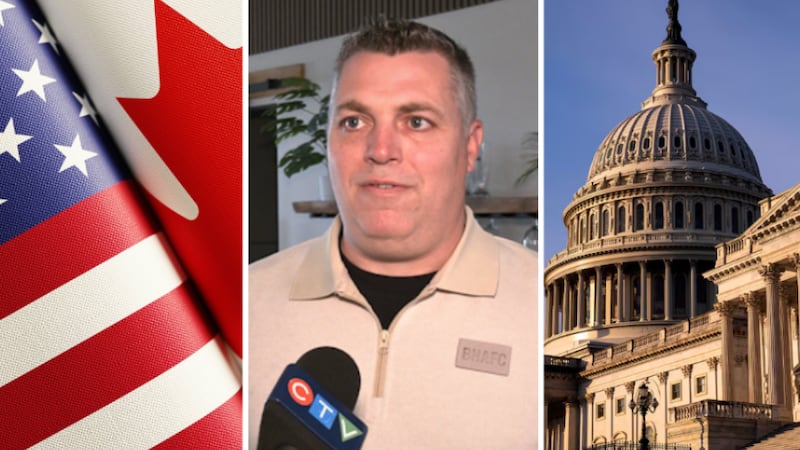
The fallout from the Democrat tsunami that crashed over the U.S. Congress was swift on Wednesday, after American voters rejected President Donald Trump’s turbulent second term with a midterm election blowout. In a stinging rebuke of the second Trump administration, Democrats flipped long-held Republican Senate seats in Texas, Maine and South Carolina. The blue wave also washed over House seats and down-ballot votes, sending shock waves throughout the Republican party. Trump acknowledged Wednesday that his unpopular war with Iran affected the election but maintained he was committed to the military campaign. Talking to reporters while walking around the construction site of the new White House ballroom, Trump suggested he was open to working with Democrats before later saying he would use his presidential veto to block their agenda. Polling before Tuesday’s votes showed that Trump’s approval had plummeted due to rising gas and diesel prices, high inflation and the war with Iran. The trade war with Canada became a ballot box issue in close contests in Maine and Michigan where Democrats defeated their Republican opponents. Lifelong Michigander Aaron Corley, 60, said Trump’s attacks on Canada were among the factors driving his vote in Tuesday’s midterms. He said he felt ecstatic as he watched Americans send a message to the “orange man.” “It was wonderful,” Corley said in Dearborn on Wednesday. Michigan Democrat Abdul El-Sayed — a constant target of Trump and the Republicans — beat GOP Senate candidate Mike Rogers. Trump’s attacks on Canada were unpopular enough in Michigan to force Rogers to distance himself from the president’s trade war. Trade tensions also upended the Senate race in Maine, where Democrat Troy Jackson ended the nearly 30-year run of Republican Susan Collins. While Collins had publicly opposed Trump’s tariffs on Canada and lobbied for some exemptions, Jackson accused her of not doing enough to fight the president’s broader tariff regime. The president even tried to give Collins a boost in the close contest by making changes to 50 per cent tariffs on a range of Canadian goods. The move was not enough to stop the blue wave from sweeping the trade-dependent state, driven in part by high energy prices and a steep drop in Canadian tourism. The defeat of centrist Republican candidates who pushed back on Trump’s Canada tariffs may convince Democrats and the GOP that fighting with America’s northern neighbour is not a winning strategy, said Matthew Lebo, a political-science professor at Western University in London, Ont. American lawmakers may be “nicer about Canada” but Trump will still be president, Lebo added. “As Prime Minister (Mark) Carney has said, this is a ruptured relationship,” Lebo said in a text message. “An election doesn’t undo that. Even if the temperature goes down, Canadians don’t have much reason to trust the U.S. is back on track.” While the Democrat landslide will change the distribution of power in Washington, the party does not have a large enough majority to override presidential vetoes or remove Trump from office without the help of Republicans. House Democrats have prepared an ambitious 100-day agenda focused on affordability and conducting sweeping oversight of the Trump administration — but achieving their election promises could prove difficult. The outcome also has left the Republican party unmoored and looking for leadership. It’s not clear whether Trump — now the GOP’s unpopular lame duck leader — retains his control over his base. Voters in some of the most Republican-safe areas showed their frustration with the president and the GOP. In Texas, James Talarico broke a decades-long Democrat losing streak by trouncing Trump-aligned Senate candidate Ken Paxton, while the governor’s race shocked observers when Democrat Gina Hinojosa ousted incumbent Republican Greg Abbott. “The remaining Republican senators and members of the House will see what happened … and do some recalculating about what will get them re-elected in 2028 and beyond,” Lebo said. “Being too close to Trump was a losing strategy for many.” In the wake of the election, reports said Republican Mike Johnson of Louisiana would not seek reelection as House speaker. Vice-President JD Vance, who is widely expected to seek the Republican nomination for president, issued a long post on social media blaming the blowout loss on Trump’s war in Iran. “If you’d like to argue it was worth it, that losing the Senate for the next (six) years was worth it, then do so. Argue it was a worthwhile cost to pay. Agree or disagree, that’s at least honest,” Vance said in the post. “But everyone knows why we lost. And any honest conversation about where we go from here must start there.” When asked about Vance’s possible leadership bid on Wednesday, Trump did not say whether he’d throw his support behind his vice president. “You don’t know who’s talking about running. You can have people running, you can have a lot of people maybe, or a lot of people running, or maybe nobody’s going to run,” Trump said. “Maybe he won’t run. I don’t know who’s going to run.” Kelly Geraldine Malone, The Canadian Press With files from Eli Ridder in Bangor, Maine