ADVERTISEMENT
Platform Tracker
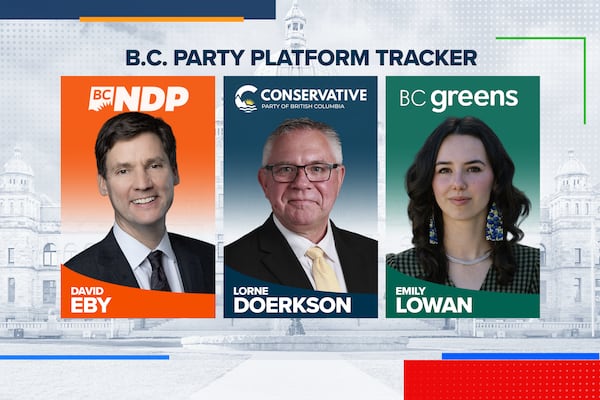
With B.C.’s snap election rapidly approaching, political parties have been criss-crossing the province sharing their platforms with voters. Below are some highlights of the promises from the three main parties to give voters a sense of where they stand on key issues.
Note: This tracker will be updated as promises are announced throughout the campaign.Health Care | Economy | Public Safety | Cost of Living | Housing | Environment | Education
Health Care
B.C. NDP The NDP promises to improve primary and emergency health care by opening 20 new clinics, expanding hours at primary care centres, and bringing more internationally trained health-care workers to B.C.
David Eby’s party vows to further address worker shortages by adding 1,000 training seats for nurses and nurse practitioners. Incentives like loan forgiveness and discounted tuition would be offered for those who commit to practising in rural or remote communities.
For seniors, the NDP promises to expand in-home care by adding 500 health-care workers. Under the party’s plan, previously paused long-term care projects would go ahead, and more beds would be added.
The NDP pledges to add addiction treatment beds and expand involuntary care as well, in addition to introducing a province-wide women’s health strategy.
The NDP says its health-care promises would be funded through a new tax on the province’s highest-income earners.
B.C. ConservativesThe Conservatives vow to end temporary ER closures by establishing a new $50 million fund.
The party’s solutions to the health worker shortage include promises to “train more doctors here in B.C., bring home Canadians who studied medicine abroad, and speed up international credential recognition.”
Lorne Doerkson’s party also commits to launching an “expert commission” that will find ways to reduce wait times.
The party has promised to resume work on long-term care projects that were halted in the latest budget and to “cut unnecessary design rules” to help build new long-term care facilities more quickly. A new women and children’s hospital for Surrey is also being promised.
The Conservatives’ plan for mental health and addictions would expand involuntary care through “mandatory treatment” and “compassionate intervention.”
The party pledges to keep the province’s system “universal and publicly funded”—while also vowing no new taxes—and has called claims it will expand privatization “fearmongering.”
B.C. GreensThe Greens promise to increase access to primary care and reduce pressure on ERs by building community health centres in “every region” of the province that would provide “team-based care and long-term support.”
Increased funding for nurses, improving nurse-patient ratios, and phasing out the use of private staffing agencies are being pitched to retain health care workers.
Emily Lowan’s Greens also promise to “cover mental health care through the public system” and to combat the toxic drug crisis with “effective harm reduction and real investment in voluntary care.”
Further, the party says it will increase the number of publicly funded long-term care facilities available for seniors.
The party promises to commission an assessment of the health effects of LNG and fracking as well.
The Greens say a proposed new tax on the “ultra rich” whose wealth exceeds $50 million would help fund the measures.
Economy
B.C. NDPThe NDP has touted the LNG Canada investment decision as Canada's "largest private-sector investment ever," and points to $130 billion in "major projects" that are planned for the province.
B.C. has increased its exports to non-U.S. markets by 16 per cent during U.S. President Donald Trump's trade war, and the NDP promises to double critical minerals exports within five years.
The party also vows to set minimum requirements for B.C.- and Canadian-made materials in public infrastructure.
New Democrats promise to provide interest-free loans to small businesses affected by the trade war, and to introduce a "youth hiring tax credit," which would provide $5,000 to small businesses that hire a young person to their first full-time, 12-month job.
B.C. ConservativesThe focal point of the Conservatives' economic plan is making the province an "energy superpower" by tripling LNG production by 2035.
The plan promises to re-engage proponents of projects that were proposed and then abandoned, encourage proponents to move their headquarters to the province, and work with the industry, First Nations and local colleges and universities to ensure the province has a trained LNG workforce.
The party also vows to stimulate economic growth by appointing a "minister for red tape reduction" and introducing a "one in, two out" policy for "red tape" regulations.
The Conservatives would scrap the PST on "machinery, equipment and business software" for three years to spur private sector investment.
B.C. GreensThe Greens’ economic platform focuses on "economic fairness for all," with plans including a "windfall tax" on "mega-corporations," a new royalty deal for oil and gas companies, and a "Fair Share Act" that would establish one-time and ongoing wealth taxes for those with assets worth $50 million or more.
The party also promises to support small businesses by implementing commercial rent control and focusing on "community wealth building."
As far as plans to stimulate economic growth, the Greens promise "record investments in renewables and good green union jobs," touting plans for clean energy and home retrofits, as well as selective logging and a focus on value-added products in the forestry sector.
Lowan’s party vows to increase minimum wage by one per cent annually “until parity with the living wage is reached.”
The party opposes the Pacific Link pipeline, Phase 2 of LNG Canada, and all new fossil fuel development.
Public Safety
B.C. NDPIf re-elected, the NDP promises to double the capacity of programs targeting repeat violent offenders and property crime offenders, while also hiring 50 more Crown prosecutors.
Some of those prosecutors would form a unit dedicated to extortion, racketeering and gang-violence cases, operating alongside the existing B.C. Extortion Task Force.
Eby says the party’s violent offender initiative has already reduced police interactions by 50 per cent and led to increased charge approvals.
The NDP also vows to establish involuntary care at the Okanagan Correctional Centre. In addition, the party plans to expand the Civil Forfeiture Office—which seizes the proceeds of crime from gangsters and others—while pursuing “immediate provincial penalties” such as driving suspensions and cancelled business licences for those caught with illegal guns. Those would be separate from criminal prosecutions.
The NDP says it has hired more than 250 extra RCMP officers, added 240 new police training seats and opened two involuntary care facilities. Another two facilities are in the works, and the party promises more to come.
B.C. ConservativesSaying the province has become “devastated by crime” under the NDP, the Conservatives plan to crack down on street disorder by recruiting more law enforcement and bringing in stricter drug policy.
The party promises to add 500 RCMP officers and 150 civilian staff to be deployed to rural areas over five years, hire 50 more Crown prosecutors, and expand the Justice Institute of B.C.’s Police Academy.
It vows to establish a court stream for repeat offenders, strengthen bail and warrant enforcement and expand electronic monitoring.
On drugs, the Conservatives vow to end safe supply programs and “stop illegal drug use” in hospitals and shelters, while expanding access to naloxone and recovery services. They also promise to amend the Mental Health Act to empower police to “connect people with mandatory treatment.”
The party also says it would tackle extortions with specialized investigators and “clear reporting and protection pathways” for victims.
B.C. GreensThe Greens promise to treat toxic drugs as a social issue rather than a criminal one and vow to decriminalize possession for personal use.
The party says it will provide regulated, pharmaceutical alternatives to the illicit drug supply and expand access to mobile and 24-hour overdose prevention sites, arguing that will reduce public drug use and boost public safety. The Greens say they will ensure safe consumption sites are connection points for recovery programs.
Rather than invest in involuntary care, the Greens say they will fund housing, mental health care and voluntary treatment “the B.C. NDP failed to, to ensure people who use drugs have the full range of support needed.”
Cost of Living
B.C. NDPThe NDP promises to spend $250 million expanding universal child care if elected, and to add another 7,200 school-based care spaces as well.
The party further plans to address affordability by reining in grocery giants and oil companies.
To reduce grocery bills, the party vows to cap profits on essential food items while banning “anti-competitive real estate deals” it says are used by major chains to keep smaller grocers out of their neighbourhoods.
The NDP also promises a temporary suspension of the province’s gas tax, alongside a crackdown on “oil company gouging.” Between the two measures, the party says drivers could save up to 30 cents per litre on gas.
The NDP has vowed to freeze ICBC car insurance rates for three more years as well, while touting estimated savings of about $1,000 per year for the average driver since taking office.
B.C. Conservatives The Conservatives have promised a $1,000 tax cut for “nearly every” worker in the province, which would be achieved by raising the basic personal exemption from the current $13,216 up to $32,000.
The party also said it will expand the $10-a-day childcare program by allowing independent providers to participate while making sure spots go to families with “the fewest alternatives and highest need.” The party promises to increase the Affordable Child Care Benefit—but has not committed to an amount.
A $500 “children’s activity credit” is also being pitched as a way to help more families afford to enroll kids in camp or activities.
On food costs, the Conservative party’s pitch is to “cut agricultural red tape to lower grocery bills and unleash our farmers.”
The Conservatives also say they would remove PST from Canadian beer, wine and spirits. Doerkson also vows his government would “never raise taxes.”
B.C. Greens The Greens pledge to increase minimum wage, social assistance and disability assistance—promising to push the latter two “above the poverty line,” then index them to inflation.
The party also vows to resume expansion of the province’s $10-a-day child care program, with an aim of reaching universal access by 2031.
Lowan’s party promised to provide free public transit in phases, first becoming available to British Columbians under 25 and over 64.
The Greens also vow to invest $100 million into creating a network of public grocery stores to sell locally sourced groceries and staple products at affordable prices.
Housing
B.C. NDP The NDP promises to introduce a tax on new condos that go unsold for more than a year, with an aim of pressuring developers to sell thousands of units of existing inventory. That tax would begin at two per cent, then increase by one percentage point each year a new condo remains on the market.
The party would also hike the vacancy tax for both domestic and foreign housing speculators, to two per cent and five per cent, respectively. Eby has credited the tax—along with short-term rental restrictions—with helping to push down asking rents in the province.
For the homeless, the NDP announced plans to open a new centre in Vancouver’s Downtown Eastside where people can “congregate during the day” when they don’t have access to temporary overnight shelters. The centre would be open 12 hours per day, seven days a week.
B.C. Conservatives The Conservatives’ platform on housing promises to “bring down the cost of building and buying a home” by cutting red tape, changing the building code, and reducing fees for builders and developers.
The party also pledges to end provincial targets, arguing where housing gets built should be “a decision of local government and local residents, not bureaucrats in Victoria.”
The Conservatives vow to reverse changes to the Property Tax Deferment Program as well, decreasing interest for homeowners who defer their taxes back to prime minus two per cent. The current rate is prime plus two per cent.
Introducing a provincial Multigenerational Home Renovation Tax Credit, available to people who build a secondary suite for a senior or an adult with a disability, is also among the party’s promises on housing. The amount would be equivalent to the existing federal credit.
B.C. Greens The Greens promise to invest $1.5 billion in non-profit housing, with a goal of building 26,000 affordable rental units annually through “targeted investments” in housing co-ops and non-market providers.
The party would also implement vacancy control, which ties rent to a unit rather than a tenant—meaning landlords would not be able to dramatically increase rent when someone moves out.
The Greens say they would also take up a previous NDP promise to end pet bans and build on it by establishing management guidelines on pets in rentals.
Environment
B.C. NDPThe New Democrats promise to work with the federal government to protect 30 per cent of B.C.'s land by 2030. They've also promised $30 million annually for the B.C. Watershed Security Fund and "strict new water-efficiency standards" and electricity caps for new AI data centres.
The party plans to create a "Clean Futures Fund" that will use a portion of provincial revenue from oil and gas development to fund climate action programs, with an initial investment of $50 million.
The same amount—$50 million—is also promised for the conversion of old-growth logging deferrals into "permanent protections," while supporting the retrofitting of mills to make more value-added products using second-growth timber.
On wildfires, the NDP vows to match donations to the Red Cross up to $20 million to help fund recovery from this summer's wildfires. The party also pledges to support rebuilding infrastructure in affected communities.
B.C. Conservatives The party argues in its "B.C. Energy Superpower Plan" that LNG from B.C. will reduce greenhouse gas emissions by replacing higher-emission fuel use in Asia and Europe.
The party also promises to complete the North Coast Transmission Line "on a fixed deadline" and hold regular calls for new power supplies, including renewables, hydro and gas-fired power plants.
In addition, the plan includes promises to "end emissions limits that are currently stopping further investment in B.C." and "work with industry to assess barriers to investment from the CleanBC plan."
On wildfires, the B.C. Conservatives have promised to "procure new firefighting aircraft, including waterbombers, reduce dangerous forest fuels around communities, make prescribed fire easier to use without lowering safety standards, allow qualified firefighting resources to work more quickly during emergencies, and create a dedicated fund to invest in early detection and prevention technologies."
B.C. Greens The Greens promise to "stop new fossil fuel development" and "institute a climate plan that lives up to the science of climate change and protects this generation and all generations after that."
The party pledges to support clean energy and home retrofits, institute "selective logging and value-added industries" in forestry and "fully fund old-growth deferrals."
The Greens vow to end raw-log export and diversify milling as well. Their plan includes investments in facilities that use smaller-diameter, lower-quality fibre, and support for forestry workers as the industry transitions.
The party wants to implement a royalty framework that captures 50 per cent of net profits after production costs from companies in the oil and gas sector as well.
The Greens say they will create open competition for response technology used by the B.C. Wildfire Service and prioritize tech produced within the province.
Further, they vow to increase wildfire training for volunteer, First Nations, and municipal firefighters.
Education
B.C. NDP The NDP’s education platform is focused on continuing efforts to improve the school system.
If re-elected, the party says it will keep building or upgrading schools—including a new high school in Surrey and a middle school for Burke Mountain—while hiring thousands more teachers, education assistants and counsellors.
According to the NDP, 250 new or seismically upgraded schools are currently “complete or underway” across the province.
Eby’s party also boasts the Feeding Futures program—introduced in 2023—as the largest investment in school meals in the province’s history, serving more than 265,000 students.
B.C. Conservatives Doerkson has vowed the party will “repeal” SOGI—inclusive educational resources related to sexual orientation and gender identity—if elected.
The party promises to bring education “back to basics” by restoring letter grades and reintroducing “consistent, supervised, curriculum-based provincial examinations to raise standards.”
The Conservatives also pledge to “bring back shop classes and build shop facilities in new schools” to prepare students for careers in the trades.
Doubling playground equipment program funding, which is currently $5 million, is also among the party’s promises.
Establishing provincial rules on cellphone use in classrooms and working to “enable” School Liaison Officer programs are also part of the Conservative platform.
B.C. Greens The Greens’ education platform focuses on closing what they call an “inclusive education funding gap,” vowing to end annual funding shortfalls to the tune of $316 million.
The party also promises to introduce universal meal and school supplies programs, while ensuring there is at least one counsellor for every 250 students.
In addition, the Greens say they will build a capital plan to ensure each school meets safety, reliability, and climate resilience standards.
Lowan’s party says it will continue “supporting and expanding the SOGI-123 initiative,” and vow to enact an official pause on the use of artificial intelligence in B.C.’s K-12 classrooms.
Top Election Stories
Premier-designate says he’ll scrap B.C.’s housing targets
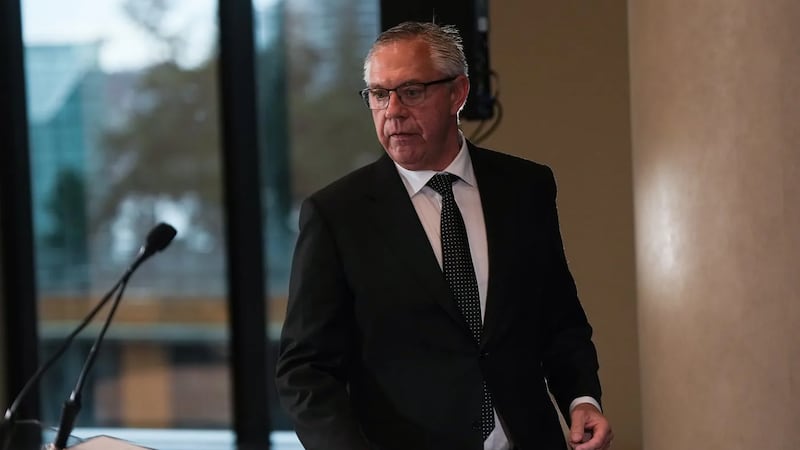
Lorne Doerkson says he will get rid of municipal housing targets and legislation allowing multiplexes to be built without rezoning.
Power Play
Vassy Kapelos hosts Power Play on CTV News Channel, talking to people and players who dominate the political scene in Canada.
Watch now
Question Period
Don't miss an episode of CTV's Question Period, the national political landmark show with Vassy Kapelos on CTV, CTVNews.ca and the CTV News App.
Watch now