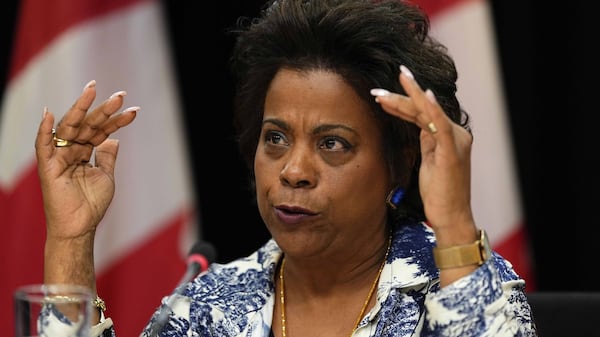
For decades, B.C. politics was dominated by a centre-right coalition that drew support from voters aligned with both the Liberals and the Conservatives at the federal level. A new poll released Tuesday by Research Co. suggests the B.C. Conservatives will struggle to rebuild such a coalition with Kerry-Lynne Findlay as their leader. The Conservatives have fallen behind the governing NDP in voting intention, according to the poll, which found 44 per cent of decided voters would cast their ballots for the New Democrats if an election were held today. A total of 39 per cent would vote for the Conservatives, with 10 per cent supporting the B.C. Greens and five per cent backing CentreBC, the new party led by former B.C. Liberal cabinet minister Mike Bernier. “Back in June, we had a tie,” said Research Co. president Mario Canseco in an appearance on CTV Your Morning Vancouver Tuesday. “We had the two parties at 42 per cent.” It should be noted that each party’s support remains within the poll’s stated margin of error of the other. The online poll surveyed 801 adult B.C. residents from Aug. 12 to 14, and the results have been weighted to census data for age, gender and region in B.C. Research Co. claims a margin of error of plus or minus 3.5 percentage points, 19 times out of 20. This means actual support for the NDP among decided voters could be as high as 47.5 per cent or as low as 40.5 per cent, while the Conservatives could be as high as 42.5 per cent and as low as 35.5 per cent. Still, the trend from Research Co.’s last poll to this latest one is not favourable for the Conservatives, and individual metrics for the party leaders may offer some clues as to why. More disapprove than approve of Findlay Since winning the party’s leadership race in May, Kerry-Lynne Findlay has looked to remake the B.C. Conservatives in her image, as new party leaders often do. More than half of the party’s caucus staff has turned over since Findlay became leader, with executive director Angelo Isidorou—the man widely credited with orchestrating the party’s rise from obscurity to the brink of power in 2024—the most high-profile departure. Last week, Kamloops Centre MLA Peter Milobar, who had run against Findlay for party leader and was serving as the party’s finance critic, announced he was leaving the party and would sit as an Independent. In a statement announcing his decision, Milobar said he respects the will of party membership and Findlay’s right to shape the party as she sees fit, but added that his values “don’t align” with the party’s new direction. Disapproval of Findlay outpaces approval among the general populace, according to the Research Co. poll. Roughly a third of those surveyed (34 per cent) said they approve of her performance, either strongly or moderately, while 46 per cent disapprove. That puts Findlay’s personal popularity behind that of her party, as measured by vote intention. Premier David Eby, meanwhile, is running ahead of his party. Forty-nine per cent of those surveyed said they approve of his performance as premier, compared to 41 per cent who disapprove. “I think part of what we see here is an inability for the Conservatives to connect on an emotional level,” said Canseco during his Your Morning appearance. “You know, there are people who are dissatisfied with the way things are going. David Eby’s (approval) numbers used to be in the 60s not too long ago, so this is essentially a drop. But Kerry-Lynne Findlay is actually lower than Emily Lowan, the leader of the Green Party.” Lowan’s approval stood at 38 per cent in the Research Co. poll, with 34 per cent disapproving and a larger share of respondents unsure how they feel about her than about either Eby or Findlay. Canseco noted that Findlay’s disapproval has risen more than her approval since the last time his company polled B.C. residents. “We saw a significant increase in disapproval,” he said. “A couple of months ago, people didn’t know who Kerry-Lynne Findlay was. Now, there’s more than 40 per cent who say, ‘I don’t like where this is going.’” How will federal Liberals vote provincially? Looking at Findlay’s approval by federal vote helps crystalize the problem she and her party are facing. The Liberal Party of Canada won 41.8 per cent of votes cast in B.C. in the 2025 federal election, slightly more than the 41 per cent won by the Conservative Party of Canada. Findlay is popular with B.C.’s federal Conservatives, according to the Research Co. poll, with 77 per cent of those who cast ballots for Pierre Poilievre’s party last year approving of Findlay. Among federal Liberals, however, Findlay is not well liked. Sixty-two per cent of B.C. residents who voted for Mark Carney’s party in 2025 disapprove of the B.C. Conservative leader, with 42 per cent of those doing so “strongly,” according to Research Co. Federal Liberals are much kinder in their assessment of Eby, with 66 per cent approving of his performance as premier, though most of those (50 per cent overall) do so “moderately,” rather than strongly. This divide shows up in provincial vote intentions as well. Those who voted Liberal in the 2025 federal election largely told Research Co. they would cast ballots for the NDP, rather than the Conservatives, at the provincial level. If a provincial election were held today, 57 per cent of federal Liberal voters said they would vote for David Eby’s party, compared to 10 per cent who said they would vote for Findlay’s. A significant minority—18 per cent—said they were unsure how they would vote in a provincial election. Of course, there was a notable swing toward the Liberals from B.C. residents who might usually vote for the NDP in federal elections in 2025, so some of those expressing an intention to vote for David Eby’s party in Canseco’s poll may be more left-leaning than the average federal Liberal. Still, it seems likely that Findlay and the B.C. Conservatives will need more than 10 per cent of federal Liberals in their corner if they are going to topple the NDP in the next provincial election. With files from The Canadian Press