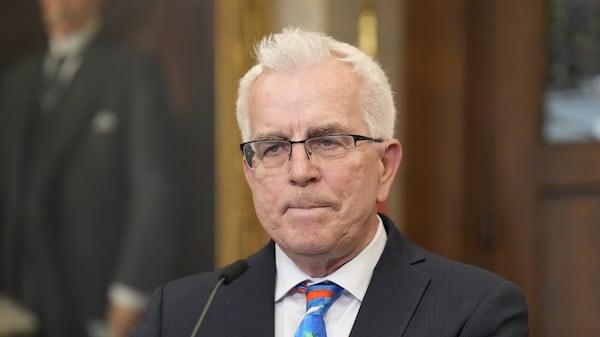
WINNIPEG — Manitoba Premier Wab Kinew says he wants a “people-first” approach to artificial intelligence as he announced that a massive data centre southeast of Winnipeg will not go ahead. Kinew said Thursday that the sheer size of the project, the energy it will consume and its impact on the community outweigh the limited gains. “There’s a big threat to the environment and not much benefit to the economy,” he told reporters at the Manitoba legislature. He said he was also skeptical of the long-term demand for centres of this scale given advances in computing. U.S.-based Jet.AI and Consensus Core Technologies, a British Columbia firm, were hoping to build a centre powered largely by natural gas turbines near Ile des Chênes. The companies say they’ve secured 142 hectares of land in the area for the project, which could scale up into the hundreds of megawatts or even into the gigawatts. Consensus CEO Wayne Lloyd said in a statement that the company was reviewing the premier’s comments and looks forward to a “robust engagement process” with the Manitoba government. He said the project doesn’t need power from the provincial grid, though the companies have also promoted that the land is near major electrical infrastructure to offer cost-efficient power. Lloyd said the project would provide more benefits than some data centres. “It creates a significant amount of well-paying union jobs both during and after construction,” said Lloyd. “It will also provide millions of dollars in annual local tax revenue that would directly fund major community benefits.” Kinew said Manitoba has existing AI data centres and will have more, but said the hyperscale operations are a far different order of magnitude. He said by comparison, the data centre would use 100 times the power of an operation like the Selkirk steel mill and that the energy could go toward more productive uses. “If we could do 100 Selkirk steel mills or a data centre, which one is going to create more long-term benefits, which one is going create more happiness, which one’s going to create more jobs?” Chuck Davidson, CEO of the Manitoba Chambers of Commerce, said the premier should make clear what kind of AI projects the province is interested in, since more projects will be coming. “This issue isn’t going away any time soon,” said Davidson. “It’s going to be important for the premier and the government to indicate now in terms of, if you don’t want the mega data centres, what is the size and scope that you think makes the best sense for Manitoba?” The announcement came on the same day Prime Minister Mark Carney unveiled the federal AI strategy that aims to capture more of the technology’s economic potential. In a release, the federal government noted Canada is among the slowest countries to adopt AI at scale, which risks undermining trust and driving Canadian talent and startups abroad. Kinew said that while it’s clear AI is transforming the economy and society, it’s not known what direction that change is headed. “I think Manitobans want that to happen in a way where AI serves us, and we’re not servants to AI,” said Kinew. This report by The Canadian Press was first published June 4, 2026. Ian Bickis, The Canadian Press