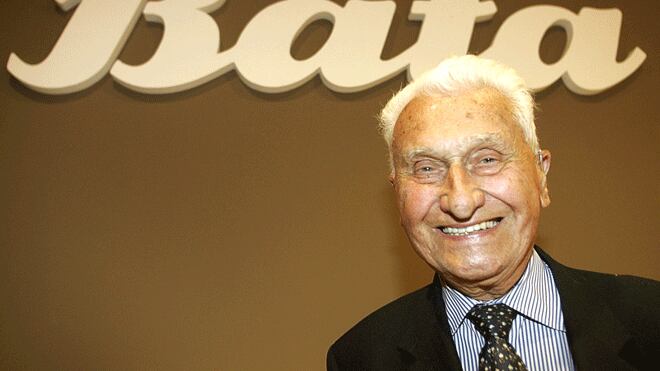
TORONTO - Hundreds of millions have walked in the shoes made at Thomas Bata's plants, but few were able to match his business expertise and zeal. Bata, who made Canada his adopted country and turned a family business into a global shoe empire, has died at age 93. Leslie Tenenbaum, the company's general counsel, said Bata died early Monday in Sunnybrook Hospital only weeks before his 94th birthday. Tenenbaum did not give the cause of death. He said a company statement will be issued later. Funeral arrangements were not immediately known. Bata is survived by his wife, Sonja, a son and three daughters. Bata was born in Praha, Czechoslovakia, Sept. 17, 1914, from a family of many generations of cobblers. He apprenticed with his father, Thomas Sr., who began the company on a shoestring in 1894 in Zlin, Czechoslovakia. The original four-man plant quickly expanded and was in 27 countries by the time Thomas Sr. was killed in a plane crash in 1932. At 18, Thomas Jr., an only son, was eager to make a name for himself. He was sent to England to be schooled and came to Canada in 1939, at a time when Nazism was on the rise in his homeland. About seven years after arriving in Canada, having served with the Canadian army on the battlefields, Bata returned to his freshly liberated birthplace, but not for long. When the communists took over the country after the Second World War, they seized his factory and declared Bata a capitalist evil. "I found it very sad," Bata told The Associated Press in a 2005 interview, "because what we thought was liberation really became a dictatorship of the communists." The regime gave the company a new name and it went on making shoes, but it was Bata, headquartered in Toronto, that remained a byword for shoes. It was under his stewardship that the company put in a new plant at Batawa, Ont., and saw the Bata Shoe Organization thrive. Touted as the largest shoe manufacturer in the world, by the early '90s the company sold about 300 million pairs of footwear a year -- or about 11 pairs for each Canadian annually. After the Communist government fell in Czechoslovakia, Bata made a triumphant return to his hometown in December 1989. Vaclav Havel, the Czech dissident leader and playwright turned president, asked Bata to come back. "Vaclav Havel sent me a message through my wife and said: `Tom should come as soon as he can'," Bata recalled. Cheering crowds greeted him at the airport in Prague on his arrival. Even though he had always demanded the return of his family's Czechoslovak enterprises, Bata talked not of past times but to the years ahead. "The future will be when all of us in Czechoslovakia and Zlin regain the position in the world that rightly belongs to us," he told thousands of well-wishers from atop a hotel balcony. Many, including the director of the shoe company, wanted Bata to take back 49 per cent control of the Zlin factory. But at the time, Bata said he wasn't ready to put money into the country's economy. "We are manufacturers," he told a news conference. "We are shoe-dealers and we are experts in the shoe industry. "But we are not investors." Havel awarded him the country's top decoration, the Tomas Garrigue Masaryk Order, in 1991, and he also received high Slovak and Canadian decorations. Bata last visited the Czech Republic in June. Vaclav Klaus, the current Czech president, issued a statement on Bata's death, calling him "one of the greatest personalities of our time has left." "Despite ill fortune in his homeland, he managed to succeed in the world and became for us a symbol of business success. We will all miss him," Klaus said. The Bata name is recognizable in virtually every part of the world. In the late 1950s, while visiting a plant in Tunis, local staff brought Bata and his wife a sample of a poster they had been putting together. The poster was of a family, each carrying a shoe box. The caption beneath read: Pas un pas sans Bata. (Not a Step Without Bata). The catchy slogan became a virtual trademark for Bata in French-speaking countries. Almost every continent sports a plant and stores of the company whose stated objective is to put a pair of shoes on every pair of feet. In his autobiography, Bata said he looked forward to the day when free trade and democracy would enter a new era. "At age 75," wrote Bata, "some of my contemporaries may be content to sit in rocking chairs, watching all the excitement around them; personally, I have every intention of being part of it." Besides his business activities, Bata also served as chairman of the Organization for Economic Co-operation and Development's business and advisory committee on non-members. His son Thomas George Bata took over the shoe company from him in 2001. With files from The Associated Press