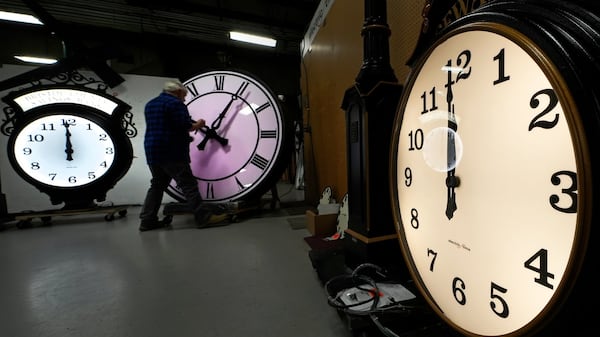
International timekeepers have voted to eliminate a 50-year-old time adjustment that has long been an operational bane to data servers, financial traders, websites and other technologies. On Thursday, delegates with the International Bureau of Weights and Measures (BIPM) voted to abolish the leap second, at a general conference in Versailles, France. The leap second was introduced in 1972 as a way to correct the discrepancy between solar and atomic time, to account for the Earth’s irregular rotations. Since then, the leap second has been added 27 times. “Every time we introduce a leap second into the system, what happens is we no longer have continuous time scale at the atomic level, and so all of the systems that depend on continuous and synchronous time have to shift a little bit,” Georgette MacDonald, director general of the National Research Council of Canada’s metrology research centre, told CTV’s Your Morning on Friday. Modern infrastructure depends on “synchronicity in timing and high accuracy,” MacDonald said, adding it takes a lot of “manual work” to ensure that users aren’t impacted. The leap second had become a technical headache for airlines, tech giants, financial markets and other digital infrastructure, by causing website crashes, tech glitches and timing errors. Abolishing the leap second eliminates the work required to adjust for the “discontinuity that happens in the atomic times scale,” MacDonald said. As of May 20, 2027, the world will switch to Continuous Coordinated Universal Time (UTC), which does not incorporate the adjustment. The BIPM agreed to let the difference drift between solar and atomic time, and when required adjust by a “leap hour.” Experts estimated it could be 3,000 years before the difference gets that large. A “leap hour” adjustment is easier to plan for and something everyone is already somewhat accustomed to," MacDonald said, referring to the twice-yearly adjustments made to switch between daylight time and standard time. “It’s something that’s actually easier to understand than the introduction of a second.” With files from CNN