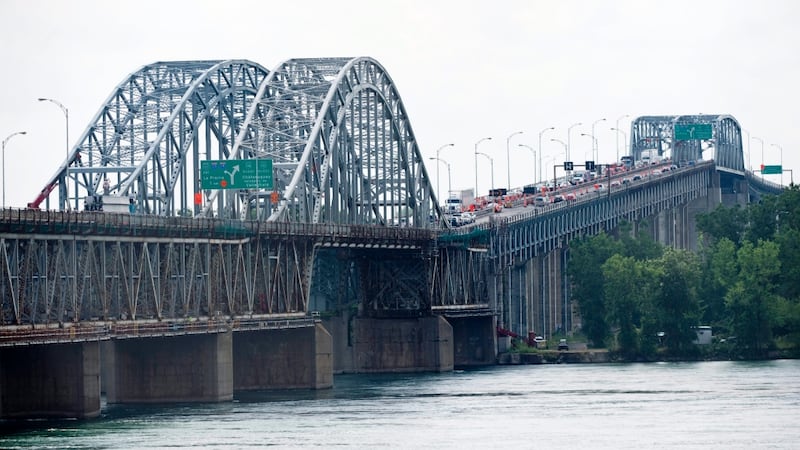
From radio hosts who fooled thousands to cars dangling from bridges, Saskatoon has built a reputation for pranks that have surprised, confused and amused residents. One of the most infamous dates back more than 50 years, when two trusted radio hosts convinced listeners the country was switching to “metric time,” sparking widespread confusion. Wally Stambuck and Denny Carr, hosts of the CFQC morning program The Wal n’ Den Show, built a loyal audience and a reputation for elaborate April Fools’ jokes. “Wally Stambuck and Denny Carr were two very different people,” local historian, author and Historic Saskatchewan admin Thom Cholowski said. “But paired together they were absolute masters,” he said, noting their strong on-air chemistry. Their most famous stunt, known as “Larmencaller time,” played off Canada’s transition to the metric system, which began in 1970 and included the switch from Fahrenheit to Celsius on April 1, 1975. “April 1, 1975, was the perfect storm of an epic April Fool’s gag,” Cholowski said. That morning, Stambuck and Carr told listeners that time would also be converted. Under their invented system, the day would be divided into 10 hours, each with 100 minutes. Carr came up with the idea, and former CFQC promotions manager Jason Schoonover named it Larmencaller time based on his Dutch heritage, noting Celsius is named after Swedish scientist Anders Celsius. “I created Simon Larmencaller, a 17th-century Dutch scientist,” Schoonover said. “I used the Celsius template and recreated it.” Bev Beyak, then 20 and working in promotions, was tasked with building the system. “My job was to figure out how to make metric time,” Beyak said. “I sat down with my calculator, and I worked out all those times.” She said the show went on air at 6 a.m. “We had to make a chart for the announcers. Every time they announced what time it was, they had to correspond it with the actual Larmencaller time that we had invented,” she said. So, when it was 9 a.m., listeners would hear it was 3.75 in “Larmencaller time.” The station’s phones lit up right away. Some listeners were confused or upset. Others quickly realized it was a joke. As more people appeared to believe it, the hosts pushed the story further. “They started to say things like, ‘Well, you can take your watches and clocks to the local jewelers and get the dials replaced for the new metric time,’” Cholowski said. “And that the City of Saskatoon is going to be changing the clock tower at taxpayers’ expense.” He said some people even called Revenue Canada, now the Canada Revenue Agency, to ask how employees would be paid under the new system. The confusion eventually reached Parliament Hill. Cholowski said the House of Commons was in session when a Saskatchewan MP raised the issue. “‘Mr. Trudeau, you’ve gone too far. The people of Saskatchewan do not want metric time,’” the MP said, according to Cholowski. “And the response was, ‘What are you talking about?’” As word spread, Schoonover said people watched Stambuck and Carr through a studio window. “They were having the time of their life,” he said. “They knew they were on a hot one.” He said they committed to the joke until noon, when they revealed it was an April Fools’ hoax. The ‘City of Bridges’ and bold pranks Saskatoon’s reputation for pranks is not limited to April Fools’ Day. In August 2017, one of the parrots from the local Earls restaurant flew the coop and ended up perched on the Traffic Bridge, drawing attention across the city. It is one of several attention-grabbing incidents tied to the city’s bridges. One of the most memorable came in 2002, when a bright red car marked with the letter “E” was suspended from the Broadway Bridge. Even without its engine and transmission, officials estimated it weighed about 800 pounds. Retired journalist Doug Lett covered the story at the time and said he was eager to report on it. “I was actually hoping to get that story because it was just kind of a fun story,” Lett said. He said reaction was mixed, with some seeing it as a costly stunt at taxpayers’ expense and others as a light-hearted prank. “I think for a lot of morning commuters it just kind of gave us a smile,” Lett said. It was not the first time. In 1999, a red car was hung from the Canadian Pacific Railway Bridge. Many suspected engineering students were behind the stunts, pointing to the car’s colour and symbol. Engineering the unexpected For engineering students, such stunts are part of a long-standing tradition. Kieran Kucharyshen, president of the Saskatoon Engineering Students’ Society, said the tradition dates back decades. “A lot of it was the engineering students trying to let off steam from their exams, but over time, it evolved into crazy stunts,” he said. In 2000, shortly after the skywalk between the Thorvaldson and Arts buildings opened, students placed their red car on top of it with a sign reading, “Nowhere else to park!” The long-running rivalry with the College of Agriculture has also inspired pranks. The car has been placed on top of the agriculture building and even inside the agriculture lounge, welded around a pole. Kucharyshen said stunts like the 2002 bridge incident require both ingenuity and creativity. “It definitely takes a lot of ingenuity and engineers definitely have the creativity to do something like that,” he said. He said the university cracked down on pranks in 2009, leading to agreements between engineers, the university and other college societies to ensure future stunts did not harm people or cause property damage. While some of these pranks are now a thing of the past, they remain part of stories told decades later, remembered for the confusion, laughter and reaction they sparked.