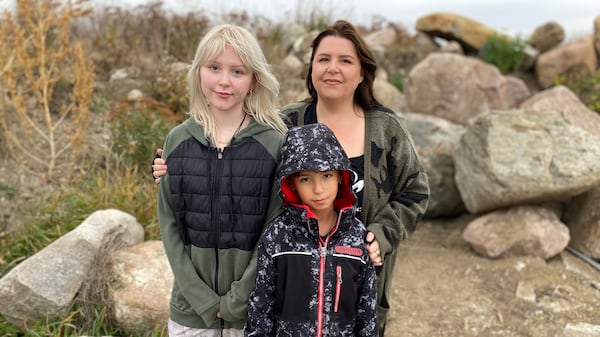
Back-to-school shopping is looking a little more expensive in Saskatchewan this year. With elementary and high school students across the province returning back to classrooms after the Labour Day long weekend, parents like Alex Jordan are doing their best to keep costs low. “Everything was about $45, and I have extra stuff at home, but the lady ahead of me, her son’s bill, looked like almost $200,” she said. Jordan says she opts to buy only needed supplies and tries her best to reuse as much of last year’s supplies instead of buying the entire list. She says there are some schools or classrooms, like her sister’s child attending kindergarten, where teachers will take a $25 donation and buy all the supplies for the class. Jordan says it isn’t easy keeping up with certain items either as descriptions or reasoning for needing the item change. “So, I’m asking the employees in there. Well, what is this one? Where is this? Then sometimes at the end of the year, they come back with stuff and maybe a quarter of the supply is used,” she said. Jordan isn’t the only one noticing an increase in prices. Captain Derek Kerr with the Saskatoon Salvation Army says the annual backpack program that hands out backpacks stocked with essential supplies for low-income families ahead of the school year was under more demand than ever. “We’ve seen the need increase in our community exponentially,” he said. “The need is out there, and we’re trying to meet that need.” Kerr says the program is funded with $60,000 of donations, and inflation and price increases have hindered the ability to help more families. “Our buying power is decreasing,” he said. “We’ve tried to go midway on a lot of the product, but maintaining a certain standard to assist as many people as we can.” John Graham, the director of government relations with the prairie division of the Retail Council of Canada, says inflationary pressures and trade wars are leading to increases at stores for many items on school supply lists. As parents follow tips and tricks to keep costs low, retailers are making that task difficult this year. “There’s no doubt that the global disruption caused by U.S. policies has already begun to directly impact some costs for Saskatchewan retailers,” he said. “In particular, you look at goods out of Southeast Asia and China.” Graham says from pencil cases to sneakers and calculators, a lot of what students need this school year are sourced from those countries. Some parents have taken to second-hand stores or privately negotiating a sale through online spaces like Facebook Marketplace to save even more. A survey of 1,211 Canadian shoppers with children attending school from Caddle, in association with the Retail Council of Canada, in May found sticker shock as a major concern. Ninety-one per cent of respondents feel prices have increased, with 53 per cent of that group saying back to school shopping “is a lot more expensive.” Graham is keeping an on potentially more increases as trade uncertainty could coincide with the holiday shopping season. “We anticipate seeing prices escalate on particular foreign suppliers as we get closer into the fall and holiday shopping season where that in-store inventory is going to more fully include the direct ripple impacts of global tariffs,” he said. Kerr and his volunteer staff were handing out roughly 1,500 backpacks to families on Wednesday and Thursday. Dozens of people who missed the application have been calling him every day. He says that highlights how prices have increased. “We’ve seen families struggling to make ends meet and if it comes down to putting food on the table or paying the rent, the school supplies are probably going to be the last thing that you’re concerned about,” he said.