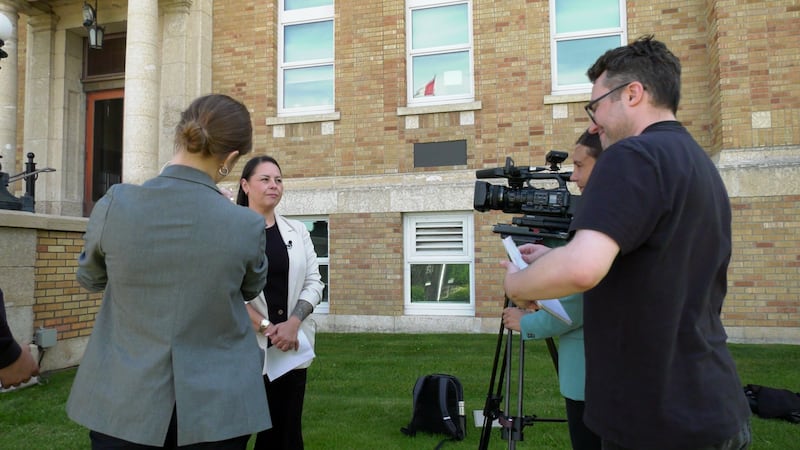
Flooding across Saskatchewan has resulted in various communities declaring local states of emergency, and many road closures. Matthew Siemens told CTV News that the flooding is causing havoc for many in the central region of the province. “You hop on the grid road and you can almost always get to where you need to go. But right now, with the way some of the rural areas are flooding, there are places you can’t get to and there’s people being isolated and trapped,” he explained. Siemens is located in Shellbrook, which is one of 15 RMs currently under a state of local emergency. As the founder of SaskLakes, which is a virtual directory of lakes in the province, he has witnessed firsthand how the rising water levels are rapidly impacting communities. “Some of the spots that when I got there, about half the road was gone. I talked to people who had driven through there three hours earlier, and they said the road was dry and it was good and everything was solid,” he recalled. “So within that three hour period, it went from the road is dry to half the road is gone.” Tyler Harrison, an emergency services officer manager with the Saskatchewan Public Safety Agency (SPSA), told CTV News that while 15 communities are under states of local emergency, there have not been any requests for evacuation support or reports of damage to homes made to the SPSA. Many roadways have been closed due to the flooding. The Highway Hotline listed 19 closures on Monday afternoon due to water impacting road conditions. “They’re either closures or there’s water on the top of the highway and folks are advised to be cautious and alert in that specific area,” Ministry of Highways spokesperson Dan Palmer told media. “There’s several across the east-central and northern parts of the province, there’s quite a few.” There are several environmental factors that have contributed to the current wet conditions across the province. According to Matt Loney, a meteorologist with Environment and Climate Change Canada, the combination of late winter snowfall, immediately followed by a quick warm up has been a significant contributing factor. “This prolonged spell of cold weather well into April ... by the time May comes around, the temperatures warm up quickly because it’s sort of like a pent up demand, where the warmth was denied for so long, but then those seasonal temperatures come back and so we see that there’s that melt rapidly happen,” Loney said. Loney added that the spring snowstorms which made their way through the province also played a major role in the current wet conditions. “Especially as you go further North, you got walloped actually in April, in that big snowstorm that happened two weeks ago. So all of that leading to above normal temperatures, above normal precipitation in some of the basins, and then all coming to a melt with temperatures warming up this past week, and causing this overland flooding, that would be trouble in a lot of areas,” he explained. Siemens shared that while it can be a stressful time for those in the impacted communities, many are banding together during the uncertainty. “Take care of each other ... if you’re up at the lake and your neighbors aren’t, take a look at their property and see if there’s something you can do to help,” he said. “If people are alone or in rural areas by themselves, check on your neighbors ... just keep an eye out for each other right now because this is ... a scary time of time of year.”