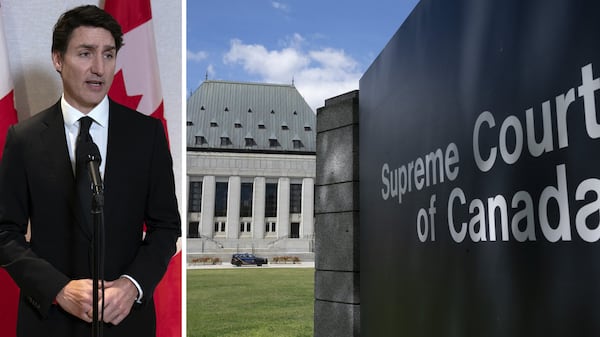
OTTAWA — A watchdog group can pursue a court challenge of a federal ethics report on Justin Trudeau’s involvement in decisions about WE Charity, the Supreme Court of Canada has ruled. In a unanimous decision issued Thursday, the top court found a provision of the Conflict of Interest Act barring such a challenge to be unconstitutional. In May 2021, then-federal ethics commissioner Mario Dion concluded that Trudeau, prime minister at the time, did not breach the conflict of interest law when he participated in decisions concerning WE Charity, which operated in Canada and abroad. The Liberal government chose WE Charity in 2020 to administer a multimillion-dollar program to encourage students to volunteer for COVID-19 pandemic-related community service. Controversy followed due to the Trudeau family’s links to WE Charity. Trudeau had participated in eight WE Day events since 2007 and his wife had been an honorary ambassador for the charity. Trudeau’s mother and brother also had taken part in paid activities for WE. Trudeau acknowledged publicly he should have recused himself from government decision-making on the matter because of the appearance of conflict. Dion concluded that while it’s always advisable to recuse oneself and inform the commissioner promptly when facing an apparent conflict of interest, there was no requirement to do so under the Conflict of Interest Act. Democracy Watch applied in June 2021 for judicial review of Dion’s ruling in the Federal Court of Appeal, alleging errors of law regarding the commissioner’s interpretation of the act and an error of fact about Trudeau’s relationship with one of the WE Charity founders. Federal lawyers argued that the Conflict of Interest Act bars judicial review concerning questions of fact and law. The Federal Court of Appeal dismissed Democracy Watch’s application, prompting the group to take its case to the Supreme Court. In its 9-0 ruling Thursday, the top court sent the matter back to the Federal Court of Appeal. The Supreme Court said political oversight of the ethics commissioner was not an adequate alternative to judicial review, and there is nothing in the Conflict of Interest Act that provides interested parties with an alternative forum to seek a review of the legality of the commissioner’s report. Writing for the court, Chief Justice Richard Wagner said the Constitution guarantees the availability of “legality review -- that is, review to ensure that an exercise of public power has not exceeded the boundaries of an administrative decision-maker’s delegated authority.” The court said that when determining whether to consider an application for judicial review, a court must examine not only the available alternative but also the suitability and appropriateness of judicial review in the circumstances. For an alternative remedy to be adequate, the court added, its process and the remedies it offers need not be identical to those available on judicial review -- but it must be adequate in all circumstances to address the applicant’s concern. Duff Conacher, co-founder of Democracy Watch, said in a statement the group applauds the Supreme Court for ending a long-standing dispute over a key legal issue. Conacher said the court’s decision sets “a clear precedent that allows all future cases challenging errors in rulings by the ethics commissioner and, by extension, all agencies, boards, commissioners and tribunals across Canada.” The decision confirms that governments cannot place themselves above the law, said Ian Miron, a lawyer for the group Ecojustice, which intervened in the case at the top court. “Instead, the decision reinforces that all levels of government are accountable for their decisions under the law,” Miron said in a statement. This report by The Canadian Press was first published July 30, 2026. Jim Bronskill, The Canadian Press