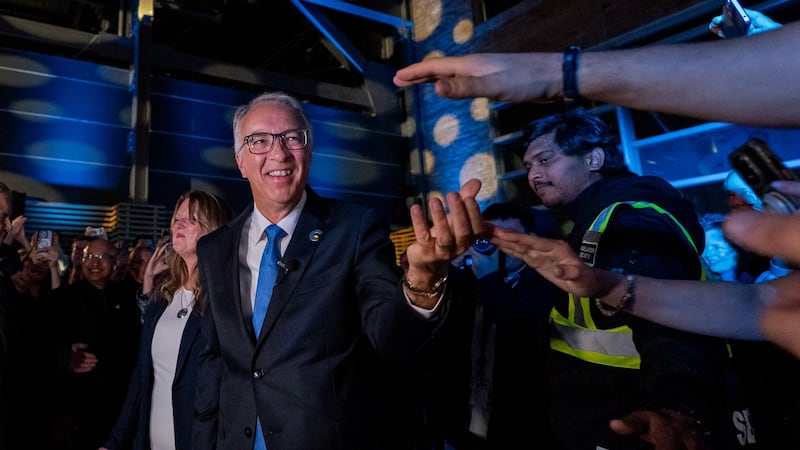
Capital Dispatch is a weekly newsletter, sent when Parliament is in session every Friday. To stay on top of what’s happening on the Hill, you can sign up to receive the latest political news and insights directly in your inbox, here. Carney’s offer to MAGA, advice for Alberta, and well-wishes for an outgoing Liberal MP It was a big week for Prime Minister Mark Carney’s one-liners. On two occasions he made headlines for his offers to help U.S. President Donald Trump with his vow to “make America great again” and his advice to Alberta Premier Danielle Smith given what he saw first-hand with Brexit. Plus, ardent environmentalist Steven Guilbeault has finally had enough, and why one bill proposing easier access to digital evidence has privacy and tech heavyweights sounding alarm bells. The week that was Let’s start with the most recent development because it could be the most consequential of the week. While some Liberals may have bristled at Carney’s offer to “help make America great again,” the olive branch of sorts – or at least an employment of some loaded language – went over like a warm blanket with one key U.S. official. In case you missed it Thursday, employing U.S. President Donald Trump’s marquee slogan, Carney told a New York City business crowd that “Canada strong will help make America great again.” And in a first sign of a potential thaw, it appears that line was well received by U.S. Ambassador to Canada Pete Hoekstra. “PM Carney said something worth repeating today: ‘A Canada strong will help make America great again.’ I think a lot of Americans can get behind that kind of positive message,” he said on X, reposting a video of the prime minister’s speech. In that speech, the prime minister detailed his economic diversification strategy, and his plans to recalibrate Canada’s relationships and reputation. Touting some key areas where the federal Liberals have made progress, Carney sought to make the case for why Canada and the U.S. should continue to co-operate in key sectors. “Above all, as you would expect, we’re focused on things that are good for Canada. This is good for all Canadians, but it’s also good for the United States,” the prime minister said. “Because a stronger Canada is a better ally.” For more from his speech and fireside chat, the full rundown is here. It didn’t go over quite as well with Carney’s biggest critic on this side of the border. Rising in the House of Commons to offer his rebuttal to the prime minister’s remarks, Conservative Leader Pierre Poilievre joked that Carney was in New York to “expand his favourite export: speeches.” “His elbows were again flapping up and down, in the rhetorical chicken dance, as he cannot seem to decide if integration with the U.S. is a strength or a weakness, he’s argued passionately for both positions in the last three months alone,” Poilievre said. Carney was in The Big Apple to pitch Canada to major CEOs and investors. According to his office, among the bigwigs he had facetime with were representative from BlackRock, Blackstone, and Morgan Stanley. He also “participated in a conversation” with members of a business roundtable, including Netflix, Inc.’s Ted Sarandos, Land O’Lakes Inc.’s Beth Ford, The Estee Lauder Companies Inc.’s Stephane de La Faverie, and Mick Beekhuizen from the Campbell’s Company. Facing questions earlier in the week about what a potential Alberta separation referendum could signal to energy investors at a time where he’s pushing for more major projects, the prime minister offered some advice “from experience” to his provincial counterpart. “In these separation issues, it is often advanced that: ‘Vote for this, and it’s a free option.’ ‘Vote for this, and we will strengthen your hand in future negotiation.’ That is a very dangerous bluff,” Carney told reporters Monday. As colleague Spencer Van Dyk reports, referencing his time as governor of the Bank of England during Brexit – when the United Kingdom narrowly voted to leave the European Union – the prime minister said that 10 years later they’re still “trying to undo what people didn’t think they were voting for.” Smith shot back saying it’s ultimately for voters in her province to decide, not Ottawa. “We had 400,000 people sign a petition saying they wanted to vote to remain, and 300,000 sign a petition saying they wanted to vote to leave, so that’s 700,000 people who have asked for this to be publicly debated and put on the ballot,” she said. The major Ottawa bubble story of the week was of course Trudeau-era Liberal and staunch environmentalist Steven Guilbeault announcing he’ll resign his seat in the House of Commons later this summer. While he’ll continue to be a member of the Liberal caucus until then – giving them one extra vote to pass what they need to before the break – Guilbeault told CTV News that he’s not the only caucus member who’s upset with the Liberals’ environmental policy shift since last year’s election. “If you look at our campaign platform during the last election — that platform, commitments that we made to Canadians — mentioned climate change 28 times,” Guilbeault said in an interview with Vassy Kapelos on Wednesday. “It did not mention ‘pipeline’ once.” “So, I think rightfully so, some people, whether they’re Liberal caucus members, whether they’re Canadians at large, are wondering what is happening,” he added. Carney was courteous about Guilbeault’s decision, though he said the deal-making he’s been doing towards new natural resource development was “absolutely” worth it. For more from the outgoing MP in his own words on why he left, and what effort the PMO made to get him to stay, that’s here. Lastly, on the procurement and major project fronts, there were two big announcements this week that could be a signal of things to come. Does the decision to go with Swedish company Saab’s “GlobalEye” aerial warning system signal anything about the non-U.S. origins of other outstanding military procurements? And was the Germans signing on to buy Canadian LNG an attempt to sweeten their submarine bid? Time will tell. Not to be missed Canada-U.S. trade minister heading to Washington Canada-U.S. trade minister Dominic LeBlanc heads to Washington next week to talk trade, ahead of the July 1 deadline for a review of the Canada-U.S.-Mexico free trade deal (CUSMA). Ahead of the trip, LeBlanc told CTV News he had a one-hour video meeting Monday with United States Trade Representative, Jamieson Greer. The Canada-U.S. trade minister said they were also joined by Canada’s Chief Trade Negotiator to the U.S., Janice Charette. LeBlanc didn’t share further details as to what’s on the agenda or when he will be in the U.S. capital. He was last in Washington to discuss trade in March. Privacy czar, tech giants want changes to lawful access bill Canada’s privacy commissioner and key representatives from major tech companies are adding their voices to calls for significant amendments to the Liberals’ contentious bill, which proposes a revised “lawful access” regime that’s meant to make it easier for law enforcement to access digital evidence. Testifying on Tuesday, representatives from two of Canadians’ most-used technology companies – Google and Apple – and other experts sounded alarms about implications for Canadians’ use of encryption services, overbroad new ministerial powers, and the security risk of retaining metadata. For a detailed breakdown of their concerns, and what kinds of amendments the opposition is eyeing, I’ve got your full recap from the marathon committee hearing. Curious what the minister had to say the next day? That’s here. Transport vows action after W5 uncovers luggage scheme And, a W5 investigation into drug smuggling and baggage-tag tampering at Canada’s busiest airports is prompting Transport Canada to promise swift action to improve security. CTV News’ investigative unit found that at least 17 passengers on flights departing Canada were accused of drug smuggling and detained over the past year, after their baggage tags were switched onto suitcases filled with drugs. All were later released, but only after some were handcuffed, arrested and jailed. As colleague Graham Richardson reports, in a statement released Monday, Transport Canada said it is examining additional measures “to ensure the highest standards are in place to protect passengers, workers and airport operations,” and that issues identified in the investigation will be addressed quickly. The week ahead It seems hard to believe, but next week is June. And that means MPs only have three sitting weeks left before their summer break. So, I thought for this week’s look-ahead, I’d break down where key bills stand, what could reasonably be passed before the House and Senate rise, and what may be left to languish until the fall barring an eleventh-hour breakthrough. Overall, there are currently 17 government bills at various stages in the House of Commons, with another five sitting in the Senate. Not all are priorities to move in the final sitting days, but given the Liberals have a majority they do have an upper hand advancing as much as they can. Two key priority bills to watch – Bill C-31, the secondary fall budget implementation bill and Bill C-30, the spring economic statement legislation – are still before the House. Though, the Senate National Finance Committee has started a pre-study of Bill C-30, a move meant to expedite the review once the piece of legislation does pass into the Senate. A separate Senate committee is also taking on a pre-study of Bill C-20, the Build Canada Homes Act, which still needs to make it through the report and third reading stages in the House before Senators can formally begin their sober second look. It will also be interesting to see what happens with Bill C-22. Amendments are going to start being moved by MPs next week, and as I noted above, the minister appears amenable to alterations to his “lawful access” legislation, though he’s also keen to see it become law before the end of the month, is that possible? Lastly, the Liberals have promised additional bills that have yet to even be introduced. Will they push to present any new pieces of legislation before the summer break? I’m looking at you, long-awaited revised online harms act. Covering the latest political news from CTV’s parliamentary bureau in Ottawa, Rachel Aiello offers exclusive analysis on political developments straight from Ottawa.