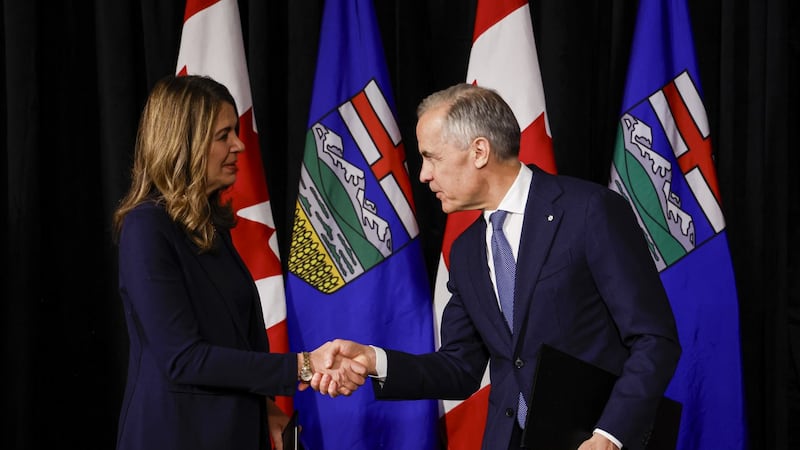
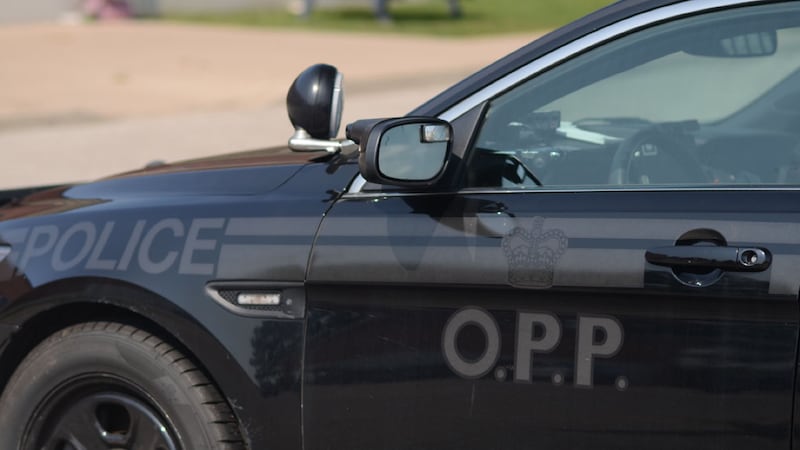
The Ottawa Police Service says two people were arrested for mischief following a protest on Parliament Hill Saturday. Protesters from Ottawa and Gatineau converged in the capital to call on the Carney government to prioritize human rights and reverse course on planned cuts to jobs and public services. The “Draw the Line” protest brought together climate justice, migrant justice, Indigenous justice, labour rights, anti-war, and Palestine solidarity groups on Wellington Street outside the Prime Minister’s Office. Similar marches have been organized for cities and towns across Canada, including Vancouver, Edmonton, Saskatoon, Winnipeg, Toronto, Montreal, and Charlottetown. The rally in Ottawa marched from Parliament Hill to the U.S. Embassy and then to the Human Rights Monument on Elgin Street. “It started out as a climate rally, but we realized that we need to build a much larger coalition. So it’s about bringing in—people who are standing in solidarity with Palestine...people who are standing up for peace in the face of a potential quadrupling of military spending," said Dru Jay, the executive director of the Council of Canadians. “It’s about cuts to public services and opposing the austerity agenda that’s been announced. And it’s about migrant justice. So, the idea is to build a coalition of all the groups working on those different issues to to stand in unison.” The demonstration also involved painting a large mural in front of the Prime Minister’s Office that said “people, peace, planet, not profit.” Organizers said the paint being used is washable. Police said Saturday afternoon that two people were arrested and Wellington Street would need to remain closed for cleanup. “Despite clashes with police and two activists being detained, spirits remained high, and a human barrier formed to allow the painting to continue,” organizers said in a news release Saturday afternoon. Roads reopened downtown to regular traffic at around 5:15 p.m. What are the demands? Protest organizers say the event is coinciding with the newest Parliamentary session and ahead of the fall budget to oppose measures put forward by Prime Minister Mark Carney, including planned spending cuts in the federal public service, the shelving of the Digital Services Tax, and bills including C-2 and C-5. Protesters are also opposed to Canada’s response in the face of Israel’s military campaign in Gaza, which the United Nations commission of inquiry this week said is a genocide. “People across movements are uniting to say enough,” said Sara Washburn, one of the Ottawa-Gatineau march organizers with Fridays for Future Ottawa, in a news release. “We refuse austerity, colonialism, climate destruction, and militarism — and we demand a future where people come before profit.” Key demands at Saturday’s protest include increasing taxes on the ultra-rich and ending corporate subsidies, particularly for the fossil fuel industry, upholding Indigenous rights and sovereignty, imposing a two-way arms embargo on Israel, cancelling planned increases to military spending, cancelling planned public service spending and job cuts, and providing permanent resident status for all migrants. “Indigenous peoples across so-called Canada are no strangers to colonial, fossil-fuelled bureaucracy, and after a few short months, Mark Carney has shown he is following suit. In his bid to protect Canadian nationalism and corporate interests at all costs, Indigenous peoples and territories are once again expendable in the name of natural resource extraction,” said Serena Mendizabal, managing director at Sacred Earth, an Indigenous women-led organization. “As migrants, workers, and everyday people also face different expressions of capitalism, colonialism, genocide, and imperialism - now is the time to bring our minds together as one, in pursuit of the future we deserve.” What has the government done? Bill C-2 relates to border security, and would give authorities new powers to search mail, facilitate police access to personal information and make it easier for officials to pause or cancel immigration applications. Bill C-5 is intended to speed up approvals for major projects and strengthen the Canadian economy in the face of U.S. tariffs, but Indigenous and environmental groups say it could undermine Indigenous rights and sidestep environmental protections. One of Carney’s first acts as prime minister, after being sworn in following Justin Trudeau’s resignation, was to cancel the carbon tax. He later cancelled the Digital Services Tax that would have imposed levies on U.S. tech giants like Amazon, Google, and Meta, a move Carney said was part of negotiations with the U.S., but which drew comments of “caving to President Trump” from the White House. Proposed cuts to the federal public service, aiming to find $25 billion in savings over the next three years, have faced stark opposition, particularly in Ottawa, where the federal government is the largest employer. At the same time, the prime minister committed to boosting military spending, pledging to hit a target of 5 per cent of the national GDP by 2035. Meanwhile, the Carney government has taken a more critical tone against Israel, most recently calling the escalation of bombing in Gaza City “horrific” and calling on Israel to adhere to international law. Carney says he intends to recognize Palestinian statehood at the UN General Assembly this month, but critics are opposed to the condition of demilitarization of a Palestinian state. With files from The Canadian Press and CTV News Ottawa’s Natalie van Rooy