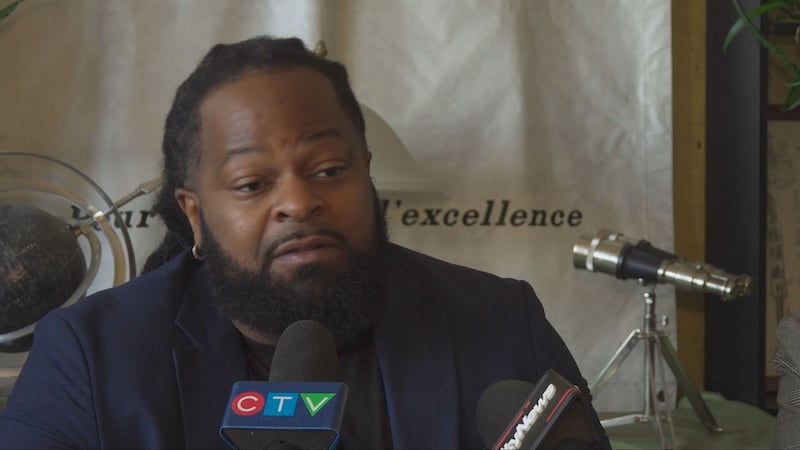
Joshua Kutryk will be the next Canadian to head to the International Space Station (ISS) as part of the upcoming Starliner-1 mission. He will be staying aboard the ISS for six to eight months, though no firm date for the launch has been scheduled. “I feel very excited to be doing this. I’ve dreamt about it for a year, for my whole life, actually, and I feel lucky and proud to be doing it as a Canadian,” Kutryk told CTV Your Morning Ottawa on Tuesday. “It’s still something rare. We don’t get to do it in this country that often and to be part of a great adventure is something I’m very grateful for.” Kutryk is in Ottawa to speak with Canadian companies and researchers who are doing science work on the ISS. He will also be speaking at schools in the capital. He says the mission is to go live and work on the International Space Station for a long time. “We call it a long-duration mission, six to eight months. Really, our role there as astronauts come down to two main tasks,” he said. “The first is running the station. It’s a fascinatingly complicated system. We have to be able to fix it, keep it running, manage all of the systems. The reason we do that is so we can do job number two, and job number two is the science.” He says the astronauts on board the ISS conduct research for researchers from across the world, many of them from Canada. “It’s research that we can only do in outer space right now, and that’s ultimately our job.” What are the challenges of being in space? Crew selection is a key element of the mission, Kutryk says, because of the nature of living in space. “It’s an important thing and it’s also a challenging thing. We will be working with a crew of seven or eight people from all over the world, in fact, many countries, for a long time,” he said. “Eight months in an environment that’s very consequential, very risky — you can’t make a mistake — very isolated, so you have to get along very, very well in this tight, tiny group.” He says there is also years’ worth of training to get ready for living in a weightless environment. “If you look at all the training that I’ll do prior to embarking on this mission, it comes down to about four- or five-years’ worth,” he explained. “Specifically for weightlessness, we’ll spend a lot of time in the water, so we’ll use neutral buoyancy labs to train for that, we’ll use airplanes to train for that, parabolic flying, and that sort of thing.” ‘A proud moment’ Kutryk says he’s wanted to be an astronaut since he was six years old. “I wouldn’t have told you that when I was six because I didn’t think it was possible,” he said. “I still view it as something that I’m very grateful for and I’m very lucky to have, so the dream has always been alive in me.” Being able to represent Canada above the world stage is also a source of pride for him. “Space travel is becoming more common, but it’s still very rare, and for Canada, we’ve done a lot historically in space, it’s something that’s brought a lot of goodness to our country, and so it’s a proud moment to do that,” he said. “Not just to go and do this technical work and science, but to be able to do it with that red maple leaf on my shoulder. It’s very special. Canada occupies a very special part in terms of world spaceflight right now, and we’re very grateful for that.”