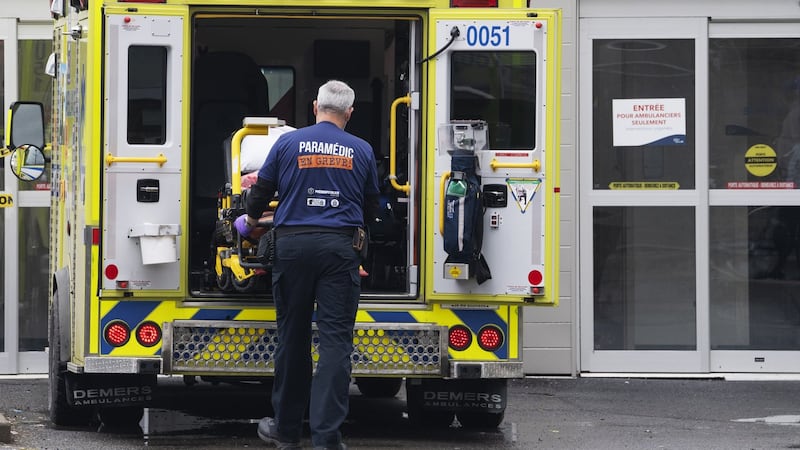
A day after city hall agreed to return to the bargaining table with London firefighters to hammer out a new contract, a union representing other first responders is warning that collective bargaining with the Middlesex-London Paramedic Service has reached an impasse. Land ambulance service is the responsibility of Middlesex County. Paramedics have been working without a contract since the end of 2024 and could begin binding arbitration this summer. According to their union, the primary issues are wages, and the minimum number of shifts part-time paramedics must work each week. “We’re at loggerheads on these things, and the die is cast,” said Andrew Swan, president of OPSEU Local 147. Swan says his membership wants to close the pay gap with other local first responders. “Ballpark, paramedics are bringing in $90,000 to $95,000 a year,” he explained. “A firefighter or police constable is bringing in between $110,000 and $120,000.” He adds that recent agreements reached in other parts of Ontario have set new expectations. “They’ve seen what some surrounding services are getting as far as a leg up, and they’re kind of content to hold out for the same,” he explained. Members of OPSEU Local 147 have been unwilling to increase the minimum number of shifts that part-time members must work because some paramedics are also employed in other jurisdictions, or as firefighters, which can result in periods of time when they’re unable to work more frequently. Swan describes it as substantially changing the terms of a part-time employee’s job. “Our chief concern is not making the work conditions untenable for certain valuable [and] experienced senior part-time staff, and making sure that they’re able to remain in the workplace,” he said. According to Swan, two tentative agreements were brought to his membership in 2025, but both times they failed to receive enough votes for ratification. In a statement to CTV News, the Middlesex London Paramedic Service writes, “We are committed to reaching a fair and responsible collective agreement that recognizes the important work that paramedics do. As negotiations are ongoing, it would not be appropriate to comment at this time. We remain focused on working collaboratively to reach an agreement.” Swan acknowledges both sides have made progress to improve language in the contract, but unless MLPS moves off its current positions around wages and part-timer employment, binding arbitration might be unavoidable. “It’s not great to wait [for arbitration] and it’s not great to have those expenses,” he said. “Once an arbitrator makes a decision, you’re bound to it. So, you can get a kind of ‘split the child down the middle decision’ where nobody walks away happy.” Both sides are committed to maintaining reliable, high‑quality care despite the contract dispute.