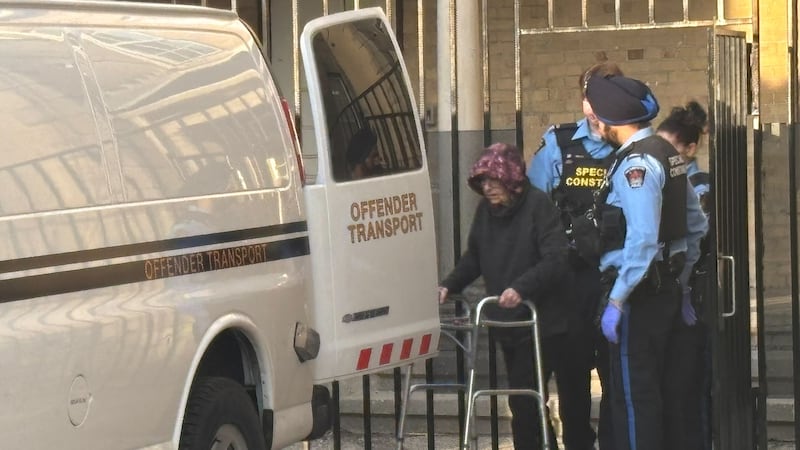
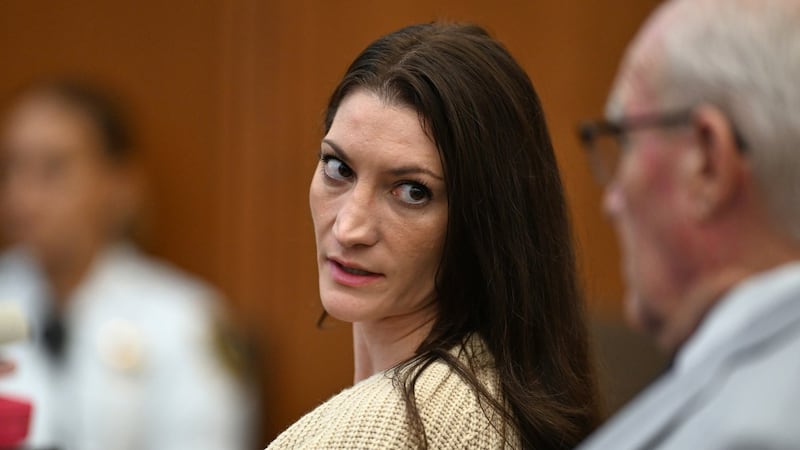
Jurors at Elfgard Oughtred’s second-degree murder trial watched a three-hour video of a conversation she had with an Ontario Provincial Police officer following her arrest on July 9, 2024. She’s accused of killing her 82-year-old husband, Gordon, at the couple’s home on Nov. 24, 2022. Almost two years later, police arrested Elfgard at the retirement home where she lived and was taken to OPP’s Brant County detachment. Her interview with Det.-Const. Petar Brujic was shown to the jury on Tuesday. In it, he asked Elfgard to tell him the truth about what happened the day of Gordon’s death. Some of her previous statements, he added, were determined to be lies. Brujic also said he aware Elfgard had attempted suicide twice in the weeks leading up to her arrest. The first time was in April 2024, before Elfgard was initially supposed to meet with OPP. Brujic said she had called another police officer the day before to ask if she was going to be arrested for Gordon’s death. “Nobody called you. You called the police to ask if you were being arrested,” Brujic told Elfgard, suggesting that the possibility was on her mind. “Did you know this day was coming?” Brujic asked. Elfgard replied: “No.” “Did you ever think you would be arrested for the murder of Gordon?” he pressed. “No,” Elfgard answered again. Brujic said the second suicide attempt happened the day she was scheduled to take a polygraph test, something he had offered her when taking her statement the previous May. Investigators had learned, he told her, that Gordon was not always a nice person. He drank a lot and could be, in Brujic’s words, “nasty.” Brujic also said he was aware Gordon was unhappy with Elfgard’s gambling and knew of a conversation where Gordon stated his wife would have to move out of their home if she visited the casino again. Brujic urged Elfgard to tell her side of the story. “The only person that’s going to be able to tell us why you did what you did is you.” “That I went to the casino?” Elfgard asked. “That you murdered your husband,” Brujic replied. He then guided Elfgard though evidence that contradicted her statements to police, including video surveillance showing her vehicle heading towards Brantford around 11:30 and not 8:30 a.m. as she originally said. Brujic also showed her photos from the crime scene which included Gordon’s half-eaten cereal bowl on a table, suggesting he was killed while eating breakfast. “So, you’re there when this takes place,” said Brujic. “No, I wasn’t there,” Elfgard insisted. Brujic told her Gordon’s blood was found in her orange Jeep. Elfgard countered that it was because she sat in the car with his blood on her hands after coming home to find him hurt and touched his body on the advice of 911 operators. Nothing was taken or stolen from the Oughtred’s home when Gordon was killed, Brujic noted. “There is nothing disturbed from that scene, nothing was stolen. It was somebody who was close to him. It was somebody who he trusted.” Brujic also suggested Elfgard found herself in a difficult situation. “I think Gordon was making some serious threats and I think that you thought that this was your only way out.” Brujic said that, in Elfgard’s account of what happened, “nothing is making sense” and the evidence showed she was home at the time of the murder, cleaned up, disposed of items and drove into town before returning home. “You’re the last one to see him and the first one to find him.” Brujic urged Elfgard to tell her side of the story, or else the evidence would speak for her in court. “You look like a cold-blooded killer, to strike a man when he’s eating breakfast.” Elfgard once again denied striking Gordon. Brujic then pointed out that, in the nearly two years since Gordon’s death, Elfgard never questioned OPP about their investigation. “Because you know what happened, Elfi,” Brujic insisted. She replied: “No, I don’t.” “Yes, you do,” he pushed back. As the interview wore on, Brujic described a scenario where Elfgard cooked, cleaned, cared for and loved Gordon, but he did not appreciate or reciprocate her efforts. He also suggested that, when Gordon took away the little bit of enjoyment Elfgard had in her life by cracking down on her gambling, she made a split-second decision to kill him. “I think he said something, and that was it. And it was almost a knee-jerk reaction, and you couldn’t stop after that,” Brujic continued. “I truly believe it was an accident.” He added: “I think you would take it back of you could.” Elfgard did not respond. Biologist’s testimony The Crown’s final witness was a biologist from the Centre of Forensic Sciences in Toronto who testified about DNA evidence, including blood stains found on the steering wheel of Elfgard’s jeep and a reuseable shopping bag found in the back seat. In cross-examination, Elfgard’s lawyer confirmed that those investigations could not confirm how or when the blood got there. Following that testimony, the Crown closed its case. Justice Aubrey Hilliard told jurors she doesn’t expect any further evidence will be called at the trial. Jurors were asked to return on Wednesday afternoon for the anticipated start of closing arguments from the Crown and the defense.