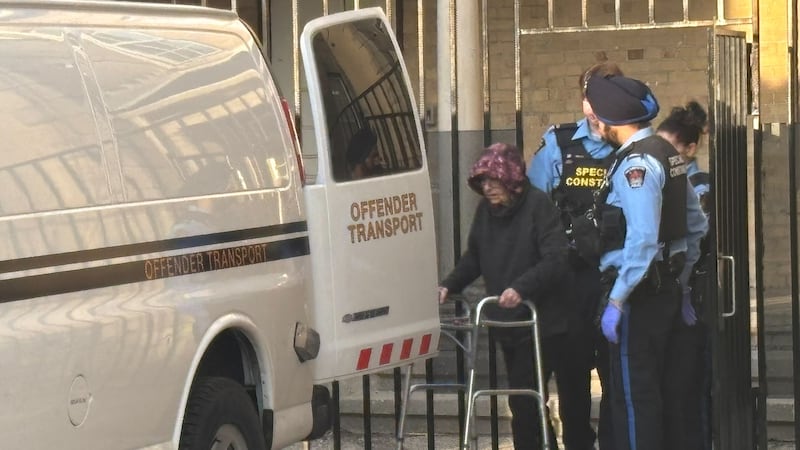
An elderly woman from Brant County, Ont. who was convicted of killing her husband with a hammer will spend 10 years behind bars before she is eligible for parole. A sentencing hearing was held for Elfgard Oughtred on Wednesday. It was also her 82nd birthday. A frail-looking Elfgard held tight to her walker as she made her way into the courtroom, helped by a pair of special constables. Elfgard was found guilty in April of second-degree murder for the 2022 death of her husband, Gordon Oughtred. An autopsy concluded his death was caused by blunt force trauma to the head. Elfgard’s second-degree murder conviction came with an automatic life sentence. However, a decision still needed to be made about her parole ineligibility, which could range from 10 to 25 years. Justice Aubrey Hilliard heard submissions on Wednesday. The Crown argued an appropriate parole eligibility would be 14 to 15 years but noted aCharter breach during Elfgard’s time in custody would bring it down to 12 or 13 years. When the jury delivered its verdict, they were given the option to weigh in on Elfgard’s parole eligibility. Eight of the jurors suggested a minimum of 10 years, while three others did not offer a recommendation. Defence counsel Nimrata Sandhu also asked the court for the 10-year minimum. In her submissions, Sandhu cited the “serious” breach of Elfgard’s Charter rights while in custody awaiting trial and noted several mitigating factors, including Elfgard’s age, poor health, lack of criminal history and custodial conditions. Sandhu then asked for the period of parole eligibility to start from the time Elfgard was first taken into police custody on July 9, 2024. That would mean she would not be eligible for parole until July 2034, when she would be 89 years old. “Whether she is actually released remains a matter of the parole board,” Sandhu added. Court hears victim impact statements The court also heard victim impact statements from family members. Crown attorney Jeff Mazin read a statement from Elfgard’s son, Ricky Huellemann, who also wrote on behalf of his sister, Rita. “We have been put through a rollercoaster of emotions during this entire process,” the statement said, in part. “Right away we both suspected (Elfgard’s) involvement in Gordon’s murder but were never absolutely sure.” Ricky’s statement called the process “somewhat stressful for me but more so for my sister,” adding that Rita has since been diagnosed with cancer. “What we have learned through this whole process is how violent the act of murder she committed was,” the statement continued. Ricky also said he and his sister couldn’t believe “that our mother is a cold-blooded killer that committed the crime and then proceeded to the casino in Brantford as if nothing had happened.” Gordon’s son, Warren Oughtred, also submitted a victim impact statement. Warren said, in the days and months following his father’s death, he and his wife took care of Elfgard. “We checked on her daily and even though she was a step-parent, we probably treated her better than our own parents,” the statement read, in part. Warren and his wife looked after Elgard until she was charged with Gordon’s murder. He said the court process, which has spanned more than two years, caused a strain on his marriage, friendships and health. “I have been suffering from constant headaches since this began,” Warren stated. “I had a CT scan and a MRI, but nothing showed up. It is all related to extreme stress.” He also noted his father’s estate had not been settled due to the ongoing court proceedings. “We would like to get everything settled to be able to get on with our lives,” Warren wrote. Judge’s decision Justice Hilliard ultimately decided on 10 years of parole ineligibility. Elfgard must also provide a DNA sample, is prohibited from owning any weapons, and ordered not to contact her children or Gordon’s son, Warren Oughtred. As Warren remains her power of attorney, she is only permitted to reach out to discuss matters related to her property or personal care. CTV News asked the Crown and defense counsel about Wednesday’s ruling. Both declined to comment on the case. Elfgard and Gordon’s families also turned down a request for an interview.