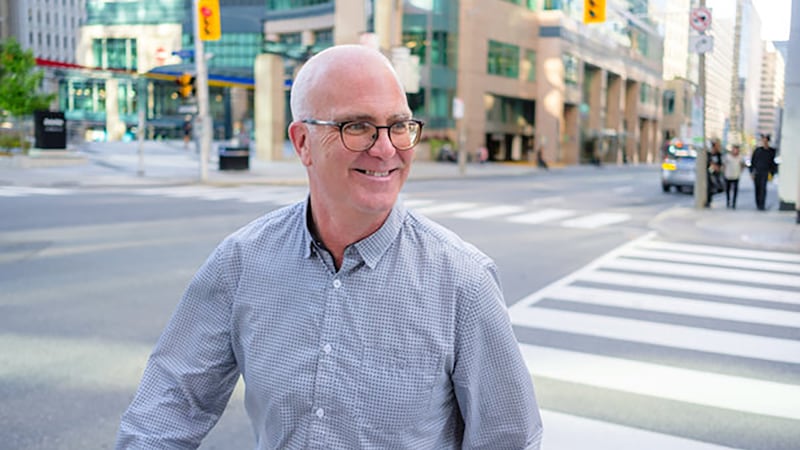
With election day just around the corner, CTV News Edmonton’s Jeremy Thompson sat down with the five of 13 mayoral candidates leading a popularity poll commissioned by the Chamber of Commerce to talk about the top issues that are shaping the race. One of the main issues candidates are hearing as they go door knocking is safety downtown, on transit and in neighbourhoods. While all mayoral candidates support a partnership model between community organizations and policing, we broke down the specifics by each of the five candidates. Tim Cartmell Two-term councillor Tim Cartmell said the city needs an “Edmonton-made plan” to tackle violent crime. “We need more people of authority visible in our public spaces,” said Cartmell. “We know for a fact that when we put more people of authority on our transit system, problems go down, calls for help go down. We know it works.” He said there needs to be a reset on the relationship with police, who he says aren’t feeling supported in their work. “We need a community police ethic that results in police officers being part of the community,” said Cartmell. While Cartmell looks toward an Edmonton-made plan, he said working with federal and provincial governments on shelter spaces and addiction resources is still essential. “That should not be on the city property tax roll,” he said. He adds that with Edmonton being the “prison capital of Canada,” people are discharged into downtown without any supports. He suggests taking those who have been released back to the communities where they committed the crime. “There needs to be a level of accountability, particularly for those preying on vulnerable people,” said Cartmell. “There has to be some consequence to those crimes … we’ve got to prosecute people when they are guilty of a crime.” Rahim Jaffer If elected, former MP Rahim Jaffer says he’ll hire 500 new police officers over four years while giving peace officers additional arrest authority training. “Not only can we manage (crime) better by having more boots on the ground, but definitely give them the support to do the things that they need to do that are kind of expanded over the sight of what traditional policing has been,” said Jaffer. He said he would also install turnstile gates on Capital and Metro Lines and renovate high-risk LRT stations to be safer. He’s also looking to launch a one-year pilot for a free transit zone covering central post-secondary hubs, downtown, Chinatown, central hospitals, and Whyte Avenue. With an increase in officers, Jaffer said the community police model and leveraging the provincial government will show results. “It’s even incumbent on us, not only to support our police officers … but it comes back to that relationship with the provincial government and how we can leverage the ability for them to get the support on the social side of things,” he said. “We have to get more people interested, get them trained properly, get them trained with the realities of policing today, cultural sensitivity, social issues … There’s no doubt we’re going to possibly need more fresh people involved … and however we can leverage that support as well from the provincial government is going to be crucial.” Andrew Knack Andrew Knack has been a city councillor representing the Nakota Isga ward since 2013, and while EPS stats suggest that the overall crime rate is in decline, he says people still aren’t feeling safe. One way to address this, said Knack, is to expand the number of transit peace officers. “While that work has actually helped measurably improve safety in transit, that work isn’t done, which is why we need to continue to expand on that,” said Knack, adding that the city has more than doubled the number of transit peace officers. He added that transit stations could use a redesign to curb crime, like what was done at Stadium Station. “When that station was redesigned, crime plummeted simply because of the design change,” he said. Speaking with community members, Knack said people will talk about safety in relation to housing and homelessness. “The amount of money that we are investing every year in trying to fill gaps is not producing good enough outcomes,” said Knack. “Far too many people are still dying. We’re seeing far too many people in the winter having limbs lost and amputations, so we need to take the lead on this … not sitting back and waiting for the provincial government anymore.” He said he wants to work with police, nonprofits and social agencies to develop a city-wide plan that can be taken to provincial and federal governments. “We have the opportunity to make a significant difference, but we need to be willing to take the lead instead of constantly saying we’re just going to keep advocating,” said Knack. “We’ve been advocating for years … at what point do you have to say that’s clearly not working.” As the city continues to grow, Knack said emergency services need to have the capacity to serve all areas of Edmonton. In particular, he said there is a shortage of fire halls in certain areas of the city where Edmonton Fire and Rescue Services are not able to meet the minimum response time which can affect insurance costs for residents. He said there also needs to be more police coverage on the southside where there are only two divisions that cover from Whyte Avenue to the airport. “The ability for police to be proactive and within the community is very challenging when they’ve got to cover such a larger range,” said Knack, adding that the city could retrofit existing properties to be used as deployment centres. When it comes to funding police, Knack is looking to maintain the existing funding formula while implementing regular reviews in response to city needs and setting expectations for accountability and transparency in spending. Omar Mohammad Pediatric dental surgeon Omar Mohammad says safety always starts with security, and when housing and food insecurity rise, so does desperation and crime. Mohammad said the city needs to start with housing solutions for the homeless that come with mental health and addiction supports. Vocational services are an “absolute must” as well. If elected, Mohammad wants to open a city-supported discount grocery store that he says will feed up to 10,000 people at one store for an entire year. “People want to pay for their groceries, they just want to be able to afford them,” said Mohammad. “You need dignity.” He said that by addressing food insecurity, the city could reduce crime by 100 per cent. In terms of safety on transit, Mohammad is on board with turnstiles at every station, but also wants to use AI technology to reduce response times and put brighter lights in transit stations. Michael Walters Former two-term councillor Michael Walters says it’s time to take politics out of policing and to build more partnerships. “A partnership model is the way of the future. We see that working in some ways downtown,” said Walters, adding that the work in Edmonton’s core needs to continue while partnerships expand to suburban communities. Walters is looking to commit to long-term predictable funding through the police funding formula to recruit, train and deploy officers where and when they are needed – particularly to address violent and organized crime. If elected, he intends to review spending under the Community Safety and Well-being Fund and cancel programs that aren’t seeing results. Walters said he is committed to 100 per cent safety on transit. “Transit must be for transit users,” he said. “Right now it sort of operates as a bit of a drop-in centre. “The reality is, vulnerable people, just like people riding the train to go to work or go to school, also need to be safe.” He suggests the city needs more spaces for vulnerable people to go during the day. “We do not have a comprehensive day shelter space … there’s no place for people that have no homes, nowhere to go during the day to spend time, so they’re in our train stations, our public libraries, they’re in front of businesses downtown,” said Walters. He says a relationship with the province needs to be strengthened in order for the city to get the right supports while building on the Alberta government’s funding solutions to homelessness, shelter spaces, drug treatment and recovery-oriented care. While he is in favour of more fare checking and mechanisms like turnstiles in transit centres, he said that police need to work more effectively with transit peace officers. “It’s about creating a space that feels safe, that people are using for healthy and good reasons.” With files from CTV News Edmonton’s Jeremy Thompson