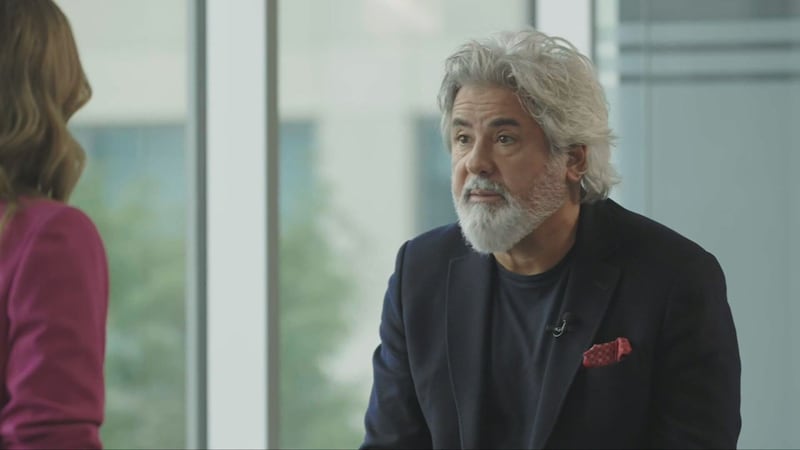
As governments release more information about unidentified aerial phenomena and researchers take closer looks at what people are seeing in the sky, a University of Calgary anthropologist is studying a different part of the UFO mystery. Dr. Shayne Dahl wants to know how people say they can make contact with extraterrestrials. The assistant professor in the University of Calgary’s Department of Anthropology and Archaeology is studying groups around the world that believe extraterrestrial beings can be contacted through a combination of technology, meditation and altered states of consciousness. Dahl describes the practice as “techno-shamanism”—a term he uses for what practitioners call Close Encounters of the Fifth Kind, or CE-5. Dahl is interested in what the growing movement reveals about religion, belief and the way people understand humanity’s place in the universe. “My main argument with the research is that CE-5 is a ritual of cosmological transition,” he said. “It’s through practicing CE-5 that people’s cosmology is shifting from the secularized, disenchanted universe into an enchanted, animate universe where there is life out there, right? We are not alone.” How people say they make contact Dahl initially expected CE-5 to be primarily an American phenomenon. His research has instead taken him to groups and practitioners around the world, including Japan, where he interviewed one of the country’s main CE-5 organizers. “This is global,” he said. The practices can combine technology with meditation and visualization. Dahl says some participants use laser pointers, Geiger counters and other devices. One technique, known as coherent thought sequencing, involves imagining consciousness leaving the body and travelling into deep space, sending what participants describe as a telepathic signal to extraterrestrial beings. “The claim is that if you do this effectively, sometimes there may be orbs that appear above you or in the sky nearby, and that the orbs can then engage with this group in different kinds of communication,” Dahl said. “One way of communicating could generally be described as photon dialog, meaning that the orb may be flashing a light sequence, and then the human groups would flash their flashlight to communicate back.” Dahl said CE-5 participants describe the practice as “a diplomatic mission on behalf of humanity.” The idea, he said, is that if non-human visitors are actually coming to Earth, humanity should seek communication rather than confrontation. Where religion and science meet Patrick Dunn, a PhD candidate and instructor in the Department of Comparative Studies at Ohio State University, studies the intersection of UFO beliefs, religion and altered states of consciousness. “People have had a tradition of trying to communicate with higher entities for many, many years, dating back to prehistoric times,” he said. “The ancient Greeks had a tradition called ‘drawing down the moon,’ which is something that women are practicing today—there’s Wiccans who practice that type of thing, and it’s a way of communicating with a higher sort of consciousness or entity for insight or communication across great distances.” Dunn adds that what’s different today is the way those older ideas are being combined with modern technology and claims about UFOs. “It’s sort of a crossover between science and sorcery, where now people are claiming to use particular scientific devices, whistling down using radio frequencies and so forth to bring the aliens to Earth or to communicate with them,” he said. Pentagon releases another batch of UFO files Dahl’s research comes as interest in UFOs or UAP (unidentified anomalous phenomena) grows internationally. The United States government released its fifth batch of declassified UAP records on Aug. 7. The latest release contains 41 files, including videos, documents and images from multiple U.S. government agencies. The material spans more than seven decades and includes six videos documenting a 2021 encounter involving U.S. Special Operations forces over the Gulf of Oman. The files also include witness accounts, historical documents and artistic renderings based on reported encounters. The releases have generated renewed public interest but remain unresolved, and it has not been established that the objects are extraterrestrial. Chris Rutkowski, a science writer who has spent decades documenting UFO reports in Canada, says the growing attention is also making the subject more acceptable within academic circles. “I think what’s happened is that scientists and people in the humanities are taking a closer look at the UFO phenomenon, since it’s less taboo to talk about this now in scientific circles,” Rutkowski said. He points to projects such as Harvard University’s Galileo Project and Canada’s Sky Canada project as examples of efforts to bring more scientific scrutiny to reports of unexplained objects. Calgary leads Canadian cities in sightings Canada has its own extensive record of UFO reports. According to data from Ufology Research, 1,052 UFO sightings were reported across Canada in 2025. More than half were classified as nocturnal lights, while just over three per cent were considered unexplained. Calgary recorded 28 reports, which is the highest total among Canadian cities, followed by Toronto with 24, Edmonton with 23 and Vancouver with 22. Rutkowski cautions that an unexplained sighting does not necessarily mean an extraterrestrial encounter. Many reports ultimately have conventional explanations. Still, he says the number of people who report seeing something unusual makes the phenomenon worthy of study. “Some surveys have suggested one in 10 Canadians have seen a UFO,” Rutkowski said. “We’re talking more than four million people, so if you’ve seen a UFO or a UAP, you’re in good company.” Artificial intelligence could also change how those reports are studied by helping researchers analyze enormous volumes of photographs and video. “We have something like 1,000 cases reported every year,” Rutkowski said. “And because we’re talking of the order of hundreds of thousands or a million images of the night sky, you really have to have something like AI doing the work for us.” Keeping an open mind For Dahl, the central question is not whether CE-5 practitioners are actually communicating with extraterrestrial life. He says anthropology gives him a different lens through which to approach the subject. “I don’t have the expertise to say yes or no or whatever, but I do have the expertise to look at how people are responding to that possibility.” Dahl acknowledges his research is still at an early stage and that he has not spent enough time observing CE-5 groups in the field to draw definitive conclusions about their experiences. But he says the beliefs and narratives surrounding UFOs are already a legitimate subject of study, regardless of what ultimately explains the objects people report seeing. “I have to be able to maintain a balance between critical thinking and being open-minded to explore the questions,” he said. “The evidence of those narratives existing is irrefutable, so we should go in and investigate why these narratives are emerging and what they mean for society.”