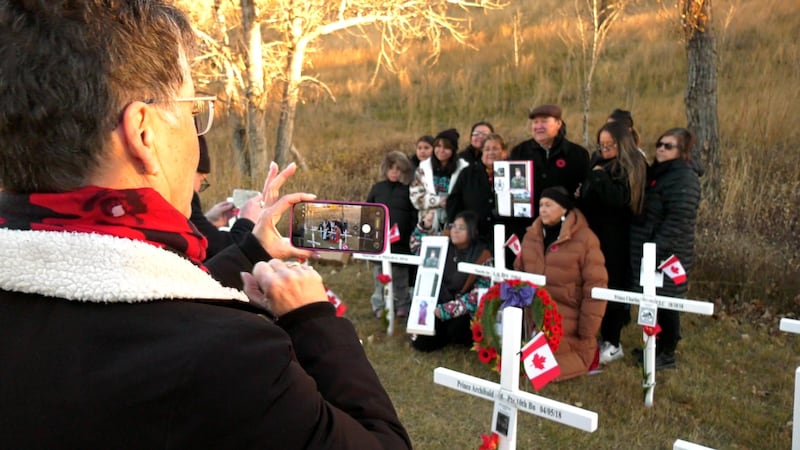
The Stoney Nakoda community is leading efforts for a legacy monument to honour Royal Winnipeg Rifleman Joe Poucette, who was born in Mînî Thnî and killed in action at the Battle of the Falaise Pocket in France on Aug. 15, 1944. Chief Clifford Poucette, Joe’s nephew, says there are many memorials in Kananaskis Country but none for a person who called the area home. “We want to show the tours and the people where our traditional lands and territories are,” he said. “My uncle, who fought in the Second World War, lost his life over there for our freedom. That’s the reason I want to honour him. We want to honour our people.” The chief says the monument will also serve as a reminder to younger generations of Joe’s sacrifice and might even lead to some enlisting in service of their country. The chief says he’s heard many stories about his uncle shared by elders. “I’m really proud of him because he was a small guy with a big heart. I always say that to people,” he said. Ken Hoover, monument project co-ordinator, is helping nation members work with Alberta Parks on approvals to move a massive stone into place where a plaque will be mounted honouring Joe. “Not only is the Goodstoney Nation involved, but the Chinook Nation and the Bearspaw First Nation have input as well, so they are the ones who chose the spot, and it’s absolutely spectacular,” he said. “It has a significant historical and cultural role in their lives. Basically, the Upper Lakes of Kananaskis is considered a meeting place, and it’s a sacred area. It’s basically the last bastion of wild spaces in the Rocky Mountains.” Hoover says the final monument design is still in the works, but it’s something long overdue in the area. “The Stoney Nakoda people are the mountain people, so they are the placeholders of that area,” he said. “I thought, ‘What a fitting tribute to pay homage to the fallen soldiers but also a wonderful tribute to Joe Poucette and other (Indigenous) soldiers who did go on and serve in the Canadian military.’” Elder Delia Poucette remembers hearing many stories about her uncle Joe from her grandma and grandpa and shares those with today’s generation. “That’s why I brought my grandchildren with me—so they can carry it on,” she said. “Like my grandma always used to say, on Nov. 11, they get up early in the morning, five in the morning, and they always call upon the spirits and they said Joe’s with us in spirit throughout the day and every time they are missing him.” She says she always thought a memorial to honour Joe was missing in the place he lived and loved, and now she’s honoured to be part of the project to see her wish come true. “So I looked up, and I said, ‘Grandma, we’re here. Joe, we’re here,’” she said. “Just like my grandma used to call out, so I know his spirit is here with us and the ones that have gone before us. They’re here in spirit—I can just feel it.” Joe was honoured at the Field of Crosses on Indigenous Veterans Day, Nov. 8, and on Nov. 10, family members were at the lake site for a pipe ceremony to bless the rock that will soon hold the memorial plaque. “There are a lot of monuments in the region that (commemorate) the First World War and the Second World War, but there is no mention of our First Nation soldiers,” said Hoover. “The pipe ceremony is more of a reflection of just recognizing the ancestors and the impact that they had on their community as a whole.”