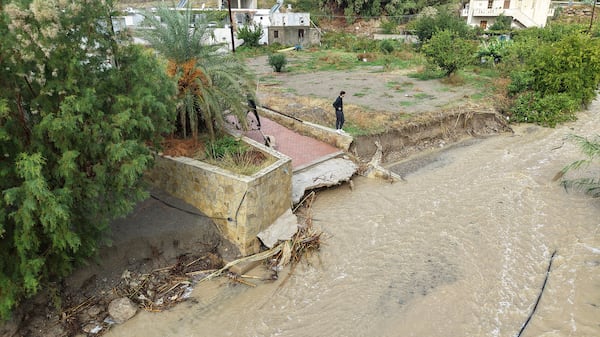
Potential for bodies. That’s what Gerry Murtagh, police duty inspector, figured would’ve been on his mind the night of Dec. 30, 2025, as water billowed up from under the road in northwest Calgary again. The force of the aged, ailing Bearspaw feeder main rupturing a second time sent a vehicle into the air. It came down with a thud next to the hole, which continued to bleed city water. Flooding rose almost to the height of the road’s median, and the windows of multiple vehicles—all now stranded. People climbed out of and atop their cars and trucks. The 911 calls followed quickly and in quantity. One vehicle was floating down the road. A family with special-needs children was trapped inside another. Someone was navigating the crisis on a broken leg. Murtagh, looking over the night’s calls with CTV News recently, said, “My main concern is, ‘Is everyone safe?’” “If we have people on vehicle roofs and water up to the windows and whatever else,” he said, “do we have bodies in the water? “Is there anyone unaccounted for?” ‘You’re trying to figure out what to do’ The main break occurred near the Sarcee Trail/16 Avenue N.W. interchange, a few blocks from the last one in summer 2024. Seemingly endless water flowed off the road, taking over pathways and continuing into the park. Dave Jones, Major Events and Emergency Management sergeant, said if you’re a cop faced with something so far outside your norm and control, “Your adrenaline’s going.” “You’re trying to figure out what to do,” he said, “but it’s also scary because it’s like, ‘What are you looking at?’ “If it’s a flood, it’s a fire (department) response, so we transition to a support role.” Dan Kim, then Major Events sergeant, now Real-Time Operations Centre (RTOC) duty staff sergeant, said support would’ve meant “mitigating anything that would impact public safety.” “Our role’s going to be to block traffic, then facilitate evacuations if we need to,” he said, “but it isn’t rescue.” Kim said, “If people are on top of a car, they’re stable.” “Water’s flowing very quickly around them,” he said, “but if the car’s not floating away and the water’s not rising, they’re safe.” ‘It would strain a district’s response’ Inside the RTOC, where the city’s policing is overseen, banks of screens would’ve shown chaos unfolding. Live feeds from the police helicopter. City cameras. Maps lit up with patrol units pulling in from all over District 2. News feeds. Anything else worth eyes. Calls for service, meanwhile, kept coming—regarding the water hemorrhage and not. Murtagh said it would’ve been clear by then, “It’s going to be a prolonged issue.” “The constant battle in policing is we have the calls to service we have to attend—we can’t not attend,” he said, “and managing those.” “We might have to say, ‘Those Priority 3 calls can wait.’” Jones said, “It would strain a district’s response.” “District 2, basically from Bowness south down to Lakeview, is massive,” he said, “and if we have 15, 18 officers working, everyone’s tasked with something.” The banks of screens would’ve shown a response, regardless of strain, falling into place. Patrol units shuttered many a road over an area of size. Lights shone down from above into the secured perimeter. Somewhere, city crews getting better-versed in water woe began work to turn off the tap. And fire department rescue teams suited up to set about saving more than a dozen people. ‘Our world got really, really busy’ There were no bodies. No injuries reported. Just frayed nerves and the knowledge, Murtagh said, “This isn’t going to be a quick fix.” After the first main break, a local state of emergency was declared. Water use restrictions were put in place. The city carried out 29 repairs along the Bearspaw line, with the work completed by November 2024. A little more than a year later, after the second break, the emergency operations centre (EOC) doors opened again. And water use restrictions were put in place again. This time, repairs took weeks, not months, though additional work to maintain and ultimately replace the line is ongoing. The lead-up to turning the tap back on is when, Kim said, “Our world got really, really busy.” ‘This was on no one’s bingo card’ It was 8 p.m. when that first vehicle left the ground on Dec. 30, 2025. It would’ve been a few hours later, Jones figured, when Kim’s phone started ringing. He figured his own would’ve gone off a few hours after that. The initial crisis was barely dealt with when Major Events rallied to the EOC to start prepping next steps. Jones said, “This was on no one’s bingo card,” but also no one thought it was anything other than the main. “It’s not a matter of if,” he said, “but a matter of when, unfortunately.” More than two weeks were spent getting police ready for the Bearspaw line to carry city water again. Kim said, “Police live in a world of responding.” “In our world,” he said, “everybody always says, ‘Oh, we’ll just cross that bridge when we get there.’ “I used to say that myself until I joined (Major Events).” Kim said he’s since discovered, “Everything needs a plan, and every plan needs a Plan B and a Plan C.” Objective 1 was to maintain public safety if putting the main back in service caused it to break somewhere else. That required an evacuation plan. Which required a staffing and deployment plan. And a communications plan. A traffic management plan. More than likely an air operations plan. All the things police scrambled to pull together on the fly in the crisis. As the line refilled, Kim said, “There were cops everywhere.” “That was intentional,” he said, “out of an overabundance of being prepared if the worst-case scenario happened.”