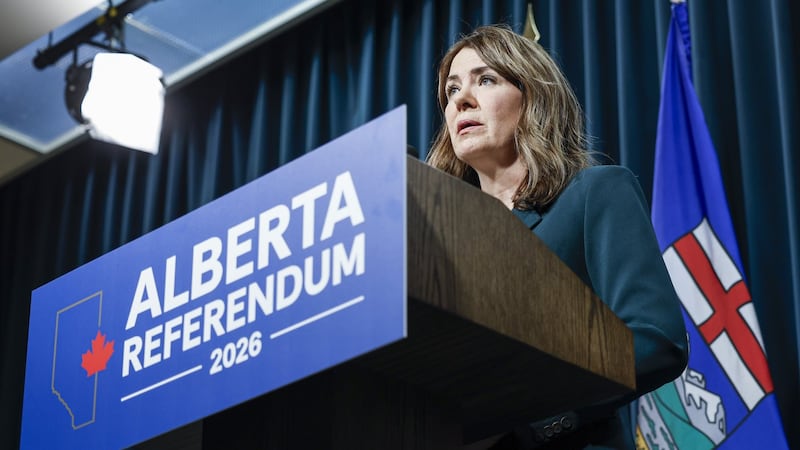
What’s fair when it comes to equalization payments may depend on your definition of fair. Prime Minister Mark Carney was in Red Deer, Alta., Wednesday, announcing a $500 million investment in housing infrastructure with Alberta Premier Danielle Smith, when he was asked about equalization payments, which have been a source of friction among the Alberta separatist movement. The federal government regularly reviews the formula for equalization, and the next deadline for renewing the agreement is at the end of March in 2029 --meaning there’s an opportunity to reassess and possibly reconfigure the formula over the next 32 months. Equalization payments are based on a measure of fiscal capacity and are allocated to provinces accordingly. The current formula is primarily based on recommendations from a 2006 report. Alberta Premier Danielle Smith recently called for a review of the equalization program, saying it needs to be reworked so Alberta has more money to look after its own priorities. Equitable public services Carney said it’s fair for Canadians across the country to expect to be able to receive equitable public services. He also said that it’s fair to challenge the formula by which those services are paid for. “It’s true across the country is that Canadians have accessed reasonably comparable services,” Carney said. “Whether it’s health, education, reasonably comparable doesn’t mean it’s exactly the same, but it’s reasonably comparable, and that they (each province) have reasonably comparable resources in order to do that.” On the other hand, the prime minister said it’s reasonable to review the formula that has upset Albertans as a tilted scale that favours have-not provinces at the expense of resource-rich western provinces. That was pointed out by Alberta Premier Danielle Smith, who welcomed the opportunity to talk about the inequality of equalization payments, which go to have-not provinces such as Manitoba, Quebec and the Atlantic provinces -- as well as just over $400 million to Ontario. “I’ve lobbied my fellow premiers at the at the table, and you can imagine that those who are benefiting from equalization want to keep the program as it is,” Smith told reporters Wednesday.“But it’s not fair because the growth in the program grows with the size of the economy, which is kind of counterintuitive, because if the economy is growing and everybody’s doing better, they should be less reliant on the equalization program. Smith said her government’s calculations have shown there’s been an “overcompensation” to have-not provinces of $7 billion over the last five years. “My pitch to my fellow premiers and now my pitch to the prime minister is: let’s just get rid of that escalator,” she said. “Let’s equalize to the point of need, and then let’s take the excess that’s in that fund and distribute it back to the provinces on an equal per capita basis. “That’ll help us with our funding pressures. And I think it will be a demonstration that just because there’s extra money, you don’t just cut a check to Ontario, who clearly doesn’t need it. They’re a powerful economy. They shouldn’t be getting equalization from smaller provinces.” Carney said there’s room to negotiate. “The second part of that equation, the reasonably comparable resources, the calculation of that, and how that that changes over time,” he said. “Some provinces do better,” he added. “There are (economic) shocks. The trade (war) stuff can be an element of that -- if it’s more persistent (in certain provinces) and that’s why the program is reviewed on a regular basis. “It’s not reviewed every year, and that’s a cooperative and engaged process. And we have a review of of that coming up,” As far as service delivery from the federal government goes, Carney pointed to Wednesday’s announcement that Ottawa is paying for housing infrastructure in Red Deer, which has undergone a population boom in recent years. “The federal government is delivering, recognizing the differences in in the capacities, the needs, the capabilities of the various provinces, and that’s what you’re seeing today,” he said. Balancing competing pressures University of Calgary economist Trevor Tombe said in an interview with CTV News that there are quirks in the formula for calculating equalization that can create disincentives for provinces to maximize their revenue -- arguably because it would cost them when it comes to their annual equalization payment. “For many equalization-receiving provinces, if you increase your resource revenues, your equalization payments will fall by quite a bit,” he said. “And that might eliminate the financial incentive to actually boost resource revenues or in the case of hydro-producing provinces, like Manitoba, or Quebec, to increase power prices. “There is an incentive within the equalization program not to increase resource revenues,” he added. “Whether than incentive actually leads to different policy choices by a provincial government –that’s much harder to say.” Expand review Tombe also said one way to address the ongoing tension over equalization payments might be to expand the review into other forms of federal-provincial transfer payments, such as health care. “Indeed historically when we do make big changes to equalization, we also tend to make changes to other transfer programs as well,” Tombe said. “That’s a way for the government to balance some of these competing pressures,” he said. “It could make changes to equalization on the one hand over payments to a province, whereas say with health transfers, that increases them. “There’s been lots of proposals to make the health transfer a function of how many elderly individuals a province has rather than right now, it’s just a strict per-capita share. “You don’t want to pre-judge the outcome of any comprehensive review of federal transfers, but we shouldn’t just look at equalization in isolation of the rest,” he said. Albertans pay more He addressed a question about why Alberta contributes more by pointing out that provinces with more high-income taxpayers will always contribute more. Tombe said there’s nothing very unique or special about federal-provincial tension over transfer payments, either --and that it’s not a uniquely Alberta thing. “We have throughout our entire history had tension between our federal and provincial governments right from the very beginning that’s centred around fiscal concerns – Canada’s very first separatist party was not in Quebec. It was in Nova Scotia," he said. “The anti-confederates,” he said, “and one of the main motivations for them wanting to exit confederation – and not wanting to join (the rest of Canada) in the first place – was that they found the system of fiscal transfer system unfair. “This (argument) is not new,” he said. “It’s not unique to Alberta nor to any particular political party. It’s natural and dare I say – unavoidable – in a country as decentralized and as diverse as Canada is, where you have very different levels of economic strength from one part of the country to another. With files from CTV News’ Angela Amato, Jordan Kanygin and The Canadian Press