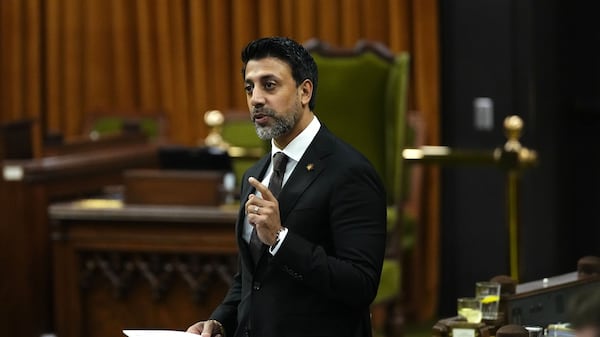
Alberta is launching a survey that will impact the books found in K-12 schools across the province, saying “multiple books” have been found in “some” school libraries that show “extremely graphic and age-inappropriate content.” Demetrios Nicolaides, minister of education and childcare, made the announcement in Calgary on Monday. The province says Alberta doesn’t currently have a consistent province-wide standard for school boards to follow when selecting “age-appropriate school library materials.” Instead, school boards have been given the freedom to select books for their own school libraries. In a news release accompanying Nicolaides’ announcement, the UCP said there are “concerns about whether strong enough safeguards are in place.” As such, the province is seeking public feedback on the creation of “consistent standards to ensure the age-appropriateness of materials available to students in school libraries.” “While this is a very contentious issue, we are pleased that the government is consulting with Albertans prior to deciding any course of action,” said Dennis MacNeil, president, Public School Boards’ Association of Alberta, in a news release. The changes won’t have any impact on public libraries, including 55 public libraries located within schools. School boards would be required to implement the new standards along with publicly available policies by the start of the 2025-26 school year. The new standards will apply to public, separate, francophone, charter and independent schools. The survey, open to all Albertans, is available online. ‘Extremely graphic’ A Monday news release from the province listed examples of books found in Alberta K-12 schools they decided were inappropriate, including: To read excerpts of the novels, you can visit the province’s website which also includes a link showing pictures of the content in question. Nicolaides said he was approached by a group of parents who provided him with excerpts from some of the above novels. “Initially, to be very honest, I was very skeptical. I thought that maybe this was examples from other jurisdictions or other countries. They showed me information though that suggested it was indeed available at a variety of different schools,” he said. “What really got me concerned is when they indicated that they had information that demonstrated this was available in elementary schools. So that’s why we took a closer look.” “When kids go to school and visit their school library, we want to know that they’re finding age-appropriate materials on the shelves,” Nicolaides said. “Yet, unfortunately, through investigations conducted by my office, we have found books in K-12 schools that show extremely age-inappropriate content.” “In some instances, sexually explicit material has made [its] way onto school library shelves, raising significant concerns for parents. These materials contain nudity and graphic explicit depictions of sexual acts and images including oral sex.” Nicolaides noted that the provincial government doesn’t have the authority to remove individual books from school libraries. “Nor am I suggesting that we have that authority,” he added. He said the province has raised their concerns about the specific books in question with the individual school boards where the books were located. Nicolaides said in addition to having new age-appropriate guidelines, the province wants to develop a process to deal with complaints and concerns about books and other library materials. “There are mechanisms already in place for parents to be able to challenge the content of any particular book that may exist in a school library, but I think there’s a little bit more work that we have to do in that regard.” Calgary and Edmonton public boards react Following Monday’s announcement, trustees from the Calgary Board of Education and Edmonton Board of Education issued a joint statement saying the decision came as a “complete surprise.” “To date, the ministry of education has not raised any concerns with either the Calgary Board of Education or Edmonton Public Schools regarding library resources,” reads the statement. “Both our divisions follow established, rigorous processes to ensure that library resources are age-appropriate and relevant for students. Both divisions have clear mechanisms in place for any member of the school community to bring forward concerns about specific resources.” The joint statement goes on to say that the UCP’s “unilateral announcement undermines the spirit of partnership” both boards would expect. “We remain committed to ensuring students have access to library resources that support their learning and development, while upholding community values and established protocols.” ‘Singled out 2SLGBTQIA+ materials’: ATA In a statement issued Monday, the Alberta Teachers’ Association (ATA) said while it agrees it’s important for materials available in school libraries to be developmentally and age appropriate, it has apprehensions with the process announced. “We are concerned that the selection process that the government has initiated has the potential to prioritize special interest groups arriving with their own predetermined agendas and to further target diverse communities,” the ATA said. “It seems like there is no coincidence that the government’s announcement on library materials specifically singled out 2SLGBTQIA+ materials,” ATA president Jason Schilling added. The organization also says that because of “decades of education underfunding,” school libraries are “rarely” staffed by certificated professional librarians or teacher–librarians who can help identify and develop guiding principles for the selection of appropriate materials. The ATA is calling on the government to: ‘Not a manufactured issue’: Alberta Parents’ Union The Alberta Parents’ Union also issued a statement reacting to the announcement. In it, executive director Jeff Park said it’s not a “a manufactured issue.” “It’s a real concern for tens of thousands of Alberta families,” he said. The Alberta Parents’ Union bills itself as a group pushing for parental choice. Park says the organization has 18,000 parents on its mailing list. “This issue goes far beyond school libraries. It’s about parental confidence in the education system and ensuring that families have meaningful input when it comes to what their children are exposed to.”