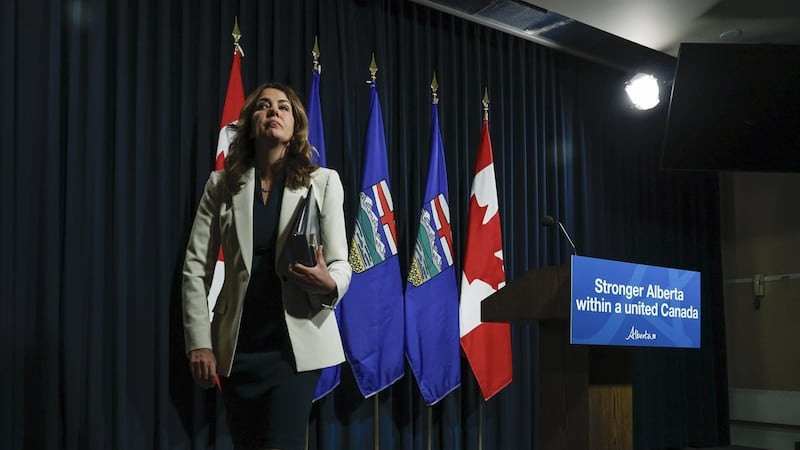
Albertans will soon be able to arrange and pay for some diagnostic imaging without obtaining a referral from a doctor or nurse practitioner under a new provincial program. Starting July 31, participating clinics will gradually accept self-referrals for MRI and CT scans, ultrasounds and X-rays. Premier Danielle Smith said the initiative will give Albertans another way to investigate potential health concerns and detect serious illnesses earlier. “Albertans will have the option to access diagnostic screening tests, including ultrasounds and X-rays, MRIs and CT scans to start directly through participating providers,” Smith said. Patients will pay participating clinics directly for the initial test. If the scan reveals a new or previously unknown cancer diagnosis, the province may reimburse the cost at the publicly funded rate. Alberta Health Minister Justin Wright said patients must bill private insurance first before the province pays any remaining eligible amount. “Patients will have a full year from the date of diagnosis to submit their reimbursement application,” Wright said. He said the province will base the reimbursement on its publicly funded rate, while private clinics will continue to set their own prices. Patients could therefore still pay out of pocket if a clinic charges more than the province’s reimbursement rate or their insurance does not cover the full amount. Tests ordered by a doctor or other health-care provider will continue to be fully covered by the province and prioritized, whether they are performed at a public or private facility. Existing publicly funded screening programs, including breast and colorectal cancer screening, will also continue unchanged. Legal experts say the changes will likely renew questions about whether Alberta’s approach complies with the principles of the Canada Health Act. Lorian Hardcastle, an assistant professor in the University of Calgary’s Faculty of Law, said the federal legislation rests on the principle that financial barriers shouldn’t block access to medically necessary care. “Historically, Canadian healthcare has been premised on this idea that you access services based on your need rather than your ability to pay,” Hardcastle said. “What we’re seeing emerge in Alberta is a system where those who can pay may very well get faster care.” Hardcastle also questioned whether evidence shows that expanding private care reduces public wait times. “There isn’t really evidence that if we look to other jurisdictions, many of whom have two tier systems, there’s not really evidence that their public private systems have benefited their public systems,” she said. Corey Hogan, a Calgary member of Parliament, said Ottawa is asking Alberta for more information as it assesses whether the changes comply with the Canada Health Act. “Any change has to be compliant with the Canada Health Act,” the Liberal MP said. “There are a lot of obviously different interpretations of what that means, but we’ve got a strong view that it’s got to be publicly accessible and publicly funded and equal access.” Hogan said Ottawa is following a formal review process before deciding whether Alberta’s plan complies with federal legislation. Hogan said he opposes the policy. “The minute you start allowing people with money to get services people without money can’t get, I think you run into a great deal of trouble,” he said. Meanwhile, Andrew Longhurst, a senior researcher with the Canadian Centre for Policy Alternatives, called the plan an explicit move toward U.S.-style health care. “This is explicitly U.S. style two tier healthcare,” Longhurst said. “If you can pay for faster access to diagnostic testing, you will receive treatment faster, and that is being encouraged by the government.” He argued the policy will widen the divide between Albertans who can afford private tests and those who must wait in the public system. “It’s going to make waits longer for everyone who can’t pay thousands of dollars for medical imaging, and it’s going to widen the gaps between who has timely access to healthcare and who doesn’t,” Longhurst said. Longhurst also said requiring patients to use private insurance before seeking provincial reimbursement could help create a larger private health insurance market. “People will be encouraged to take out private health insurance to pay privately for care,” he said. “The private market for healthcare can only exist if the public system deteriorates to the point where people can’t access care in a timely manner.” Smith said the changes will supplement, not replace, publicly funded care. “This new approach complements and strengthens Alberta’s public healthcare system. It won’t replace it,” she said. “Medically necessary care will remain prioritized and publicly funded as it always has.” Wright said participating clinics must continue to prioritize patients referred by physicians. “Any clinics that are participating in this must maintain and guarantee the same access that they have prior to July 31,” he said. “Any additional services that they take on are secondary, exclusively after physician referred services.” The government says the new approach could encourage investment in diagnostic imaging facilities. “We believe this approach can encourage investments in new clinics, modern equipment, and add additional diagnostic capacity here in Alberta,” Wright said. Officials estimate self-referrals could eventually add between 50,000 and 60,000 diagnostic exams each year. Dr. Robert Davies, a past-president of the Alberta Society of Radiologists, said more than 130 radiologist-operated community imaging clinics already provide more than 60 per cent of Alberta’s diagnostic imaging services. He said radiologists will remain responsible for deciding whether requested testing is safe and appropriate. “As providers, we continue to bear the responsibility for ensuring that the care we deliver to all patients is safe and appropriate, and perform to the same high standards, regardless of how you arrive at our doors,” Davies said. Davies said clinics are now deciding how to incorporate the program. “In the coming weeks, we will see these clinics continue to consult and develop strategies to support this new option for patients, while ensuring that patient safety and publicly funded care are not compromised,” he said. The province says it will evaluate the initiative before considering whether to expand it to additional tests or services.