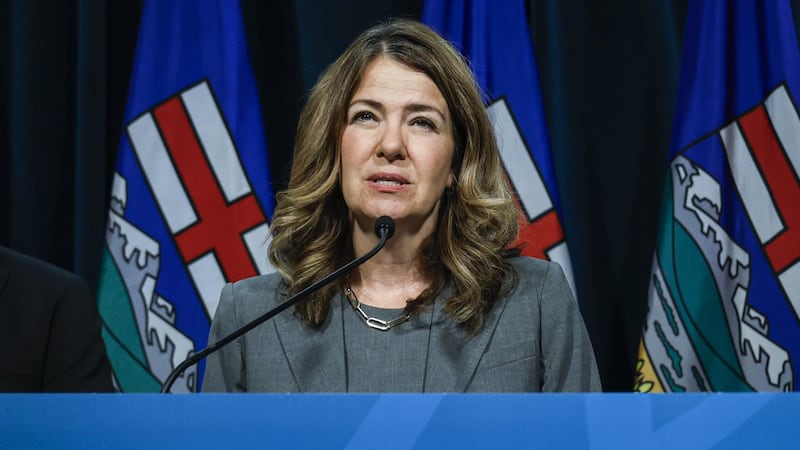
For Alberta distillers who rely on access to American customers, a fresh round of tariff threats creates a familiar uncertainty. Eau Claire Distillery founder and CEO David Farran said his company has spent the past year preparing for new trade barriers after U.S. President Donald Trump repeatedly threatened tariffs on Canadian goods. “It’s always disappointing when two friendly countries are having trade disputes and, as an industry, we’re caught a little bit in the crossfire,” Farran said. Trump signed three executive orders Monday announcing plans to impose 50 per cent tariffs on roughly US$20 billion worth of Canadian goods beginning Aug. 19. The goods include alcoholic beverages, dairy products, motor vehicles and hockey equipment. The White House said the move is in response to Canada’s “retaliation and discrimination” against American alcohol, dairy products and motor vehicles. Unlike previous rounds of tariffs, the latest measures would also apply to many goods covered under the Canada-United States-Mexico Agreement (CUSMA). The U.S. Trade Representative estimates the tariffs would affect roughly C$28 billion in Canadian exports—about five per cent of goods shipped to the U.S. and roughly 0.8 per cent of Canada’s gross domestic product. Energy, potash, critical minerals, fish and products already subject to separate Section 232 tariffs would remain exempt. Craft distillers worry about access Diamond Valley-based Eau Claire Distillery exports to 15 U.S. states but has diversified as tensions between Canada and the U.S. have continued. If the tariffs proceed, however, American consumers are likely to bear the cost. “A $40 bottle is probably going to be a $50 bottle,” Farran said. While Alberta has continued allowing American alcohol to be sold in provincial liquor stores, Farran said the broader dispute has strained the relationship between the two countries. “I think Alberta made a good decision to keep it open. The majority of the provinces have chosen to ban the importation of American alcohol, so it has been a red flag to a bull,” he said. “But I hope we get back to what CUSMA is set up for, and that this is a negotiating move that we can expect over the next 30 days.” The Alberta Craft Distillers Association says the latest tariffs create another hurdle for an industry already dealing with trade barriers at home. “You have a person (Trump) that’s creating a wake-up call within a wake-up call,” said association president Bryce Parsons. Parsons added that unresolved barriers to selling alcohol between Canadian provinces are also frustrating Alberta producers. “We’re all upset about the U.S. adding a possible 50 per cent tariff onto our product, but we’re not even sorting out what we’re doing in our own country.” He said the loss of access to the U.S. market could force smaller distillers to rethink long-term business plans. “You could say basically goodbye to the U.S. market now.” “Checking out other markets takes a lot of time, navigation and setting up. This isn’t ordering happening next week; this is like a two-year process.” Concerns extend beyond exporters While Alberta’s energy sector remains largely exempt from the latest tariffs, organizations outside traditional export industries are watching closely. Kevin Webster, CEO of KidSport Calgary and the Calgary Flames Sports Bank, said higher costs for hockey equipment could create additional barriers for families already struggling. “If that changes their accessibility and makes it tougher for families to access sport, then it’s really tough to see,” Webster said. KidSport Calgary helped more than 14,000 children last year by providing registration assistance and sports equipment, Webster said, and demand continues to grow. The organization also depends on equipment manufacturers, retailers and corporate partners for donations. “Anything that can impact our local community’s ability to support us, as well as some of those bigger companies that we’ve been able to create great relationships with, definitely has an impact on the work we’re doing.” Smith pushes for diplomacy After meeting with Canada’s provincial leaders in Prince Edward Island, Alberta Premier Danielle Smith said the focus over the next month must be on reaching an agreement rather than escalating the dispute. “We’re going to have a pretty intense period over the next 29 days, and I hope that diplomacy will prevail and the best interests of both our countries will prevail and will emerge with a signed CUSMA agreement that continues to keep a tariff-free relationship between Canada and the U.S.,” Smith said. The premier said she expects negotiations to accelerate significantly before the Aug. 19 deadline. Smith said Canada needs to negotiate not only the latest tariff threat but also existing disputes involving steel, aluminum, automobiles and softwood lumber. While Ontario Premier Doug Ford has suggested Canada consider stronger retaliatory measures, Smith dismissed the idea. “That’s not going to happen.” She also noted that approximately 97 per cent of Alberta’s exports currently continue to enter the United States tariff-free. “That’s why we want to get that number up to 100 per cent.” Transportation and Economic Corridors Minister Devin Dreeshen also weighed in, saying the dispute reinforces Alberta’s long-term strategy of expanding trade beyond the U.S. while maintaining a strong relationship with its largest customer. “The vast majority of what we produce here in Alberta is sold down into the United States,” Dreeshen said. At the same time, Dreeshen recognizes that Alberta cannot rely on a single market forever. “Just like an investment portfolio, you don’t put all your eggs in one basket,” he said. ‘This is all about leverage’ Carlo Dade, director of International Policy and the New North America Initiative at the University of Calgary’s School of Public Policy, said the latest tariff announcement should be viewed more as a negotiating tactic. “This is all about leverage,” Dade said. “The U.S. is obviously involved in negotiations with Canada and Mexico over the renewal of the North American Trade Agreement. It is also involved in more subtle negotiations with Canada and Mexico over a new permanent tariff regime.” The tariffs are being imposed under Section 338 of the U.S. Tariff Act of 1930—a trade authority that has never before been used by an American president. Dade said as the Trump administration has exhausted other legal avenues to impose tariffs, it has turned to one of the oldest powers available. He believes the broader objective is to pressure Canada into making concessions while signalling to other countries negotiating with the U.S. “Making an example of Canada is important,” Dade said. Dade also believes the strategy is designed to create uncertainty inside Canada before the Aug. 19 deadline. “I think this is a deliberate strategy by the administration to try and play Canadians against each other, to try to raise fear and uncertainty, to weaken the hand of Canadian negotiators, to force them to make a bad deal with the U.S. faster than may be necessary,” Dade said. Although Alberta is less exposed than provinces such as Ontario or Quebec because energy exports remain exempt, Dade said smaller Alberta manufacturers could still feel the effects. “If oil and gas remain exempted, then we’re doing fairly well,” he said. “But you have smaller businesses in places like Lethbridge that export manufactured goods, tractor parts, things like that.” He also noted Alberta and Saskatchewan’s decision not to remove American alcohol from store shelves ultimately did little to shield the provinces from the latest tariff threat. “Even with this U.S. administration, where you try to be nice, the reward isn’t there and you still get kicked like everybody else.”