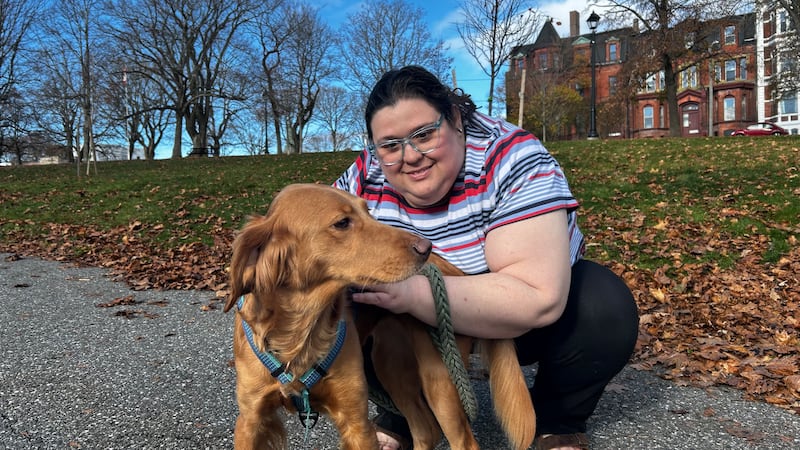
When Monica Stoilov was diagnosed with ovarian cancer, her world was turned upside down. “[The doctor] told me to go home, take the weekend, and get my life in order, but at 30 years old, you don’t know what that means,” said Stoilov. “I told him I wanted to live and do whatever it took for me to do that.” The Nova Scotia woman had just had her fourth child – who was only six months old – when she was diagnosed. Stoilov said the first symptom she experienced was excruciating abdominal pain. “It dropped me to the floor. When that subsided, I called the doctor, and my doctor wasn’t in, but I got a doctor on call who said that it was probably just a little piece of something in my uterus and it had caused an infection and put me on antibiotics,” she said. A few weeks later, during her infant son’s checkup, her own doctor pulled her aside to check on her. Stoilov’s cancer was caught early, and she ended up having a full hysterectomy at the age of 30. “It was a long haul, but I survived it. Thirty-two-and-a-half years right now. I’m one of the lucky ones,” she said. Stoilov said she was monitored for about 15 years after her surgery to make sure all was well, but the fear is always in the back of her head. “What’s really scary is you can still get ovarian cancer and not have your ovaries. It’s the type of cancer and it loves to share with other lady parts,” she said. She said women need to listen to their bodies – and shouldn’t ignore symptoms. “There’s story after story about how a woman has gone in and thought there was something wrong and she was told, ‘No, you were fine,’ just like I was,” she said. “If my GP hadn’t pulled me on that table that day, I wouldn’t be standing here. It would have advanced. It’s a silent killer.” Stoilov said for a long time after her diagnosis, she ignored that aspect of her life, but in the last five years she felt compelled to help others and has gotten involved with Ovarian Cancer Canada. “I coach others who have just been diagnosed or who have been diagnosed again and again about walking this walk,” she said. Ovarian cancer rates An estimated 3,000 Canadian women will be diagnosed with ovarian cancer this year. According to Ovarian Cancer Canada, it is one of the deadliest types of cancer among women, with more than half of patients dying within five years of being diagnosed. “For the general population, it’s really important to understand that there is no screening test for ovarian cancer, so typically when symptoms appear, it may be already late stage,” said Ovarian Cancer Canada CEO Tania Vrionis. “The biggest misconception around ovarian cancer is that the pap test screens for this disease. The pap test does not screen for ovarian cancer.” Anyone with ovaries can get ovarian cancer, but Vrionis said it is typically diagnosed in women over 55. She noted about 20 per cent of cases are related to genetic mutations. “The warning signs of ovarian cancer, the symptoms tend to mimic a lot of things that we as women experience everyday,” she said. “Changes in our appetite, feeling full really quickly, being bloated, feeling a little bit tired. Those are the types of things.” She said if those symptoms persist, it’s important to get checked. Vrionis said outcomes for the disease have not improved in the past 30 years. “We are seeing progress in terms of months, but not yet years,” she said. “We have still not cracked the code on earlier detection.” For more Nova Scotia news, visit our dedicated provincial page