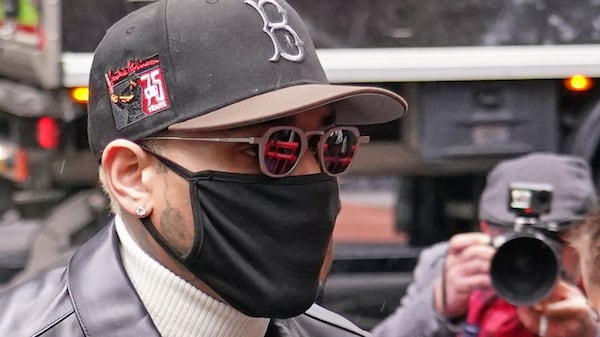
Warning: This article contains graphic content and images The man who performed the autopsies on two boys who were killed in Saint John, N.B., in January 2025 testified that they both died from multiple stab wounds. “There were some sharp-force injuries that were very significant and were the cause of death,” Dr. Erik Mont told the 14-member jury. “Cause of death was multiple stab wounds to the chest and abdomen.” Crown prosecutors called Mont to the stand at Roman Kamyshnyy’s murder trial in Saint John Friday morning. Kamyshnyy, 46, has been charged with two counts of first-degree murder. It is alleged Kamyshnyy stabbed two boys, aged 10 and 17, to death before attempting to take his own life with a nail gun on Jan. 29, 2025. Kamyshnyy has pleaded not guilty to both charges. The jury trial, which started Monday, is expected to continue until June 26. Mont has been the deputy chief medical examiner at the Nova Scotia Medical Examiner’s Office in Dartmouth, N.S., since 2009. He completed his investigation on both bodies on Jan. 31, 2025 – two days after the boys were killed. Before Mont’s testimony, Justice Darrell Stephenson advised the court that Mont would be speaking based on his expert medical opinion. He advised the jurors to only take the information they believe to be true into account when deciding on their final verdict. “It’s up to you how much or how little you rely on Dr. Mont’s opinion,” Stephenson told the jury. Doctor details wounds of 17-year-old victim Mont spent much of Friday morning detailing the wounds of the 17-year-old victim, referred to as C.D. due to a court-ordered publication ban to protect his identity. A previous court ruling has allowed the media to describe the incident as one that involves alleged domestic violence. Mont testified that the boy’s body had numerous sharp and blunt-force injuries, but he couldn’t say exactly how many wounds he counted on the body. Crown prosecutor Elaina Campbell asked how many of the wounds were substantial enough that they would require immediate medical attention. “Six, I believe,” Mont answered, after pausing to think. The courtroom was shown photos of stab wounds in the neck, chest, back, arms, and hand area. Mont detailed their sizes, which ranged from small knicks to marks as big as a few centimetres, both in length and width. Mont testified at least one of the stab wounds punctured the chest cavity, while another punctured the left lung. The Crown asked how much force would be needed to create such wounds. Mont testified it would depend on several variables, such as where in the body a sharp object penetrated, but he believed it would require some amount of force. He couldn’t comment on whether a certain wound was the ultimate cause of the boy’s death. He also told the court the pictures shown don’t properly illustrate all the smaller injuries, like scrapes and bruises, that he discovered during the autopsy. Kamyshnyy mostly kept his head down while the pictures of the wounds were shown to the court. Mont details wounds of 10-year-old victim Mont continued his testimony Friday afternoon, this time detailing his findings on the 10-year-old victim, known as A.B. Mont told the court he found at least 10 different wounds, all of sharp force, on A.B. One of the stab wounds was estimated to be more than seven centimetres deep. Mont testified that he counted four stab wounds on A.B. that would have required immediate lifesaving attention, including two that penetrated the heart, another to the left lung, and one that went through the diaphragm and pierced the liver. The doctor also detailed multiple stab wounds on the boy’s left arm and shoulder area. “Cause of death was stab wounds to the chest and abdomen,” Mont testified. When asked if he could provide an approximant time of death, Mont said it would be very difficult due to a number of factors. Based on his findings, police body-camera footage, and ambulance reports, Mont estimated the boys died no more than six hours before police arrived. He also acknowledged they could have died mere moments before police made their way inside the apartment. Officers recall formal charging of accused Det.-Const. Trinda McAlduff was also called to the stand Friday afternoon. She was one of the first police officers to see Kamyshnyy after he awoke from a medically-induced coma at the Saint John Regional Hospital on Feb. 13, 2025. She, along with other officers from the Saint John Police Force, travelled to the hospital to tell him he was under arrest for two counts of first-degree murder and check on his condition to get him formally charged through the courts. McAlduff testified Kamyshnyy did not speak during her visit, but he was able to follow with his eyes and would look at people when spoken to. He was formally charged that afternoon. The court heard Kamyshnyy remained in hospital for some time afterwards due to his medical condition, before eventually being transferred to the Dalhousie Correctional Centre in April 2025. On April 14, 2025, McAlduff said she travelled to the centre with fellow officer Robert Chessy to collect bodily samples from the accused as part of the investigation. She recalls Kamyshnyy being cooperative during the interaction.The two officers returned to Saint John following the brief interaction with the accused. Accused admitted he “killed” victims to corrections officer The final witness to take the stand Friday was Joey Raymond, a corrections officer at the Dalhousie Correctional Centre. He was questioned by Crown prosecutor Orlando Lineros about the day Kamyshnyy arrived the facility, on April 7, 2025. Raymond testified he arrived at the facility around 5:30 that day and was asked by fellow inmates why Kamyshnyy had been arrested. He told them it was for murder. Raymond told the court other inmates did a quick search of Kamyshnyy to learn more about his alleged crimes, which led to immediate “tension” in the unit and the shouting of slurs at Kamyshnyy, Raymond testified. He told the court Kamyshnyy was pulled from the unit amid the commotion. While in the hallway, Raymond said Kamyshnyy asked: “Is it going to be like this everywhere?” Raymond said Kamyshnyy allegedly went on to say: “It’s not that bad I just killed [A.B. and C.D.].” Raymond’s testimony is slightly altered due to a publication ban that prevents identifying the victims. When asked if Kamyshnyy seemed tired while making the statement, Raymond said the accused “looked refreshed.” Legal aid lawyer Shanna Wicks, who is representing Kamyshnyy’s defence, asked Raymond if he may have misheard anything that day, to which he denied. She also asked if Kamyshnyy had been generally cooperative during his time at the centre, to which Raymond said “yes.” Before dismissing the jury for the day, Justice Stephenson reminded the jurors that they first must decide if they believe Raymond’s testimony before considering any of his statements in their final verdict. The trial is set to resume at 2 p.m. Monday afternoon. Previous testimony during the trial On Thursday, the court heard from a forensic identification officer who testified that he counted 16 different cut marks in the T-shirt worn by the 10-year-old boy and 11 in the shirt worn by the 17-year-old victim. The doctor who performed emergency surgery on Kamyshnyy the day of the murders also took the stand Thursday. He told the court it took him more than two hours to remove the two nails that were deeply embedded in Kamyshnyy’s head. The jury was also shown photos of the knives and nail gun allegedly used by Kamyshnyy. The Crown previously told the court that Kamyshnyy allegedly killed the boys before trying to take his own life in an act of “desperate vengeance.” For more New Brunswick news, visit our dedicated provincial page.