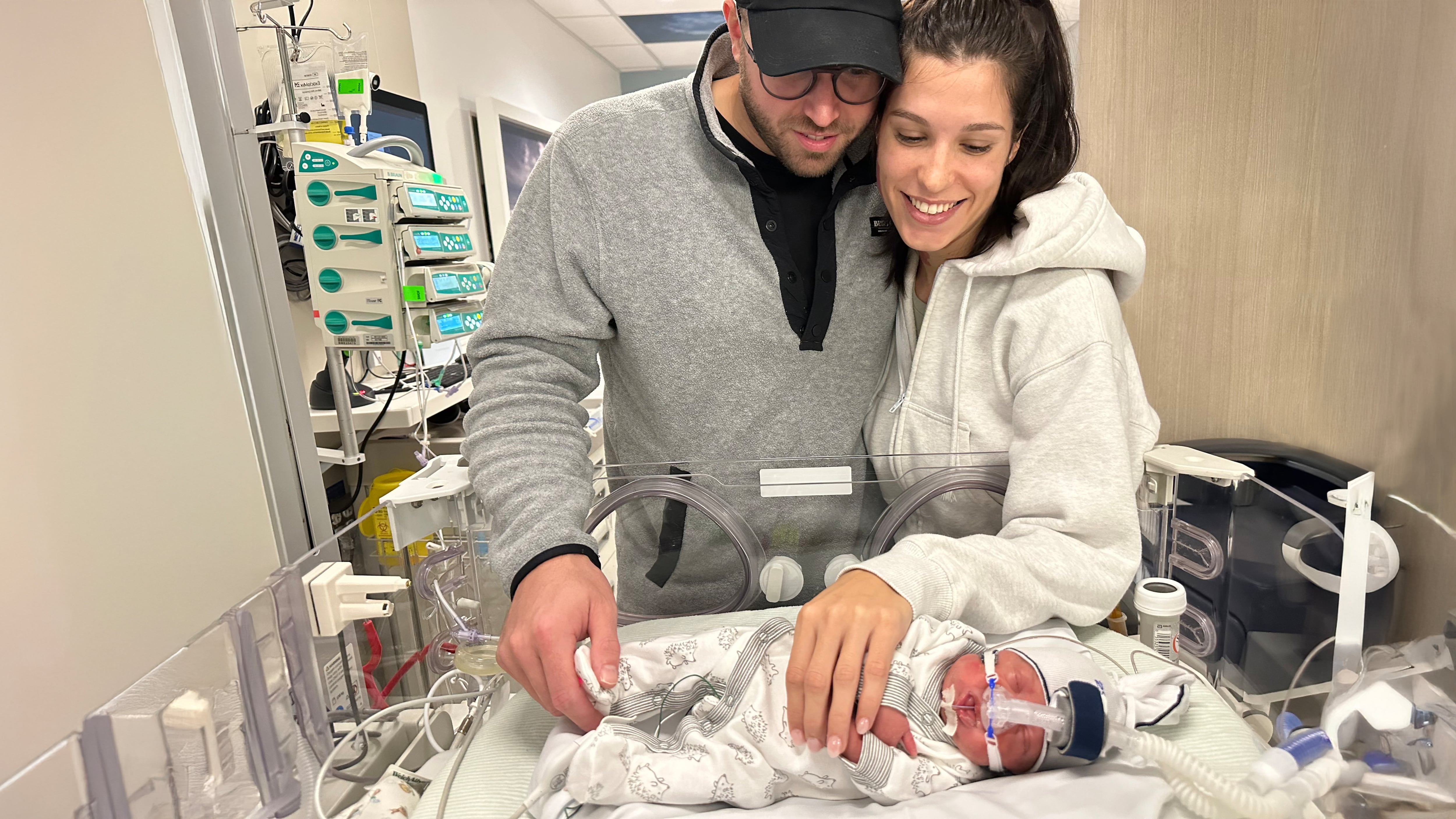
When Morgan LeBlanc’s water broke 11 weeks early in August 2023, neither she nor her partner, Brennan Kilfoil, could have predicted what their premature baby boy, Jesse, would have to overcome. Morgan experienced a pregnancy complication called premature rupture of membranes (PROM). It’s when the water breaks before 37 weeks of pregnancy and before contractions start. Unfortunately, this was not Morgan and Brennan’s first pregnancy emergency. Months earlier, Morgan had tragically experienced an ectopic pregnancy (when a fertilized egg grows outside the uterus) — a rare and life-threatening situation. She had to undergo emergency surgery at the IWK. The heartbreak and unexpected loss from the ectopic pregnancy left Morgan and Brennan devastated and their fears for their unborn son amplified. After arriving at the IWK, Morgan had an ultrasound, which showed Jesse’s umbilical cord had dropped out of its normal position, dangerously cutting off his oxygen, reducing his heart rate and putting him at risk for brain damage. Morgan needed an emergency C-section. Thankfully, Jesse survived, but he weighed just three pounds and was not yet out of the woods. Jesse was immediately taken to the IWK’s Neonatal Intensive Care Unit (NICU) for urgent life-saving care. He needed respiratory support and was placed in an incubator to help keep him warm. “I didn’t know how dangerous a baby coming that early really is,” says Brennan. A week after Jesse was born, Morgan discovered his diaper was full of blood. Unfortunately, he had developed a serious illness called necrotizing enterocolitis (NEC), which happens when tissue in the small or large intestine is injured or inflamed. It is the most common and serious intestinal disease among premature babies. Jesse needed to be intubated and have a PICC line (a long, thin tube) inserted so his care team could give him the medications and nutrition he needed. Thankfully, Jesse recovered, but soon after, he faced another major obstacle when he developed a pulmonary hemorrhage (bleeding into the lung). He needed to be intubated yet again. When Jesse’s care team discovered he had a pulmonary hemorrhage, Morgan, Brennan and their older son, Kurt, were just returning from the family lounge. They were shocked to find a large team of people in Jesse’s room, crowded around his bed. “We didn’t know what was happening,” shares Morgan. “Jesse’s colour looked off,” adds Brennan. Fortunately, Jesse’s health has continued to improve steadily since then and he continues to meet all his developmental goals – thanks to the swift actions of his IWK care team and the specialized care he has received. After spending 73 days in the NICU with their son, the family finally went home together. Jesse, now almost two and a half years old, is thriving and enjoys playing with his little sister, Summer. For Morgan and Brennan, they’ve experienced firsthand the remarkable care that the IWK provides to Maritime children and families like theirs. “The average person probably doesn’t understand how many magnitudes higher the level of care is here (at the IWK), but that’s what’s needed to help very sick babies like Jesse,” says Brennan. “They knew what to do. They knew how serious it was going to be and how to explain it to us.” “It means the difference of having Jesse here with us,” adds Morgan.