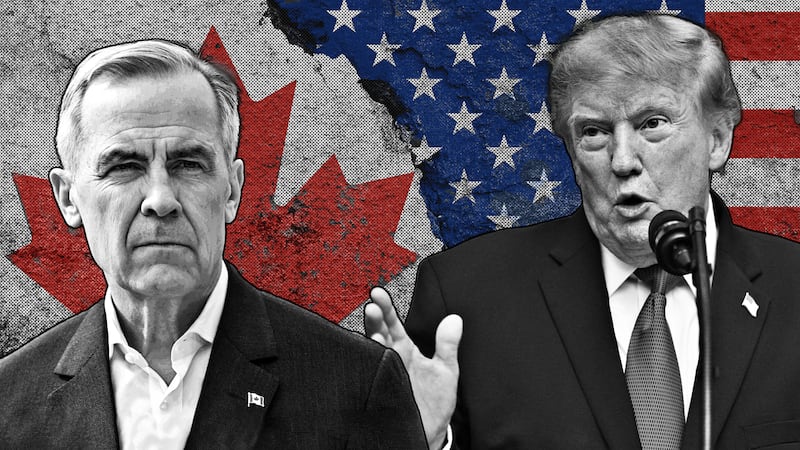
Canada was right to impose counter-tariffs after the U.S. threatened its national sovereignty during trade talks, says a public policy expert. The U.S. crossed the line by introducing issues that were “thrown in at the last minute,” which include higher tariffs for trucks, an attempt to restrict free trade deals with other nations, and an attempt to control content regulation in Canada, Drew Fagan, a professor at the Munk School of Global Affairs and Public Policy at the University of Toronto, told BNN Bloomberg. “That’s extraordinarily sensitive,” he says. With the U.S. breaking its word even after Canada made painful concessions to secure a deal, Fagan says Prime Minister Mark Carney may feel “he has no choice but to introduce counter-tariffs.” Canada walked away from trade talks on Friday night after negotiations with the U.S. collapsed saying the U.S. “asked too much and they offered too little.” A 50 per cent tariff is now active on roughly $28 billion worth of goods. Carney vowed “Canada will match Washington’s new tariffs dollar for dollar in order to protect Canadian workers, farmers, families, and businesses.” On Monday, U.S. President Donald Trump threatened to further escalate the trade war by increasing tariffs on Canadian auto, car parts and steel by 50 per cent on Jan. 1, 2027. Fagan says he hopes the dispute freezes at the current level of tariffs and counter-tariffs instead of escalating into a tit-for-tat war because, ultimately, it is Canada that hurts the most. “Canada’s not a small economy. It’s a medium-sized economy. But up against a super heavyweight, frankly, both tariffs and counter tariffs hurt Canada more than they do the U.S.,” says Fagan. “Let’s hope that politically, the Trump administration is hurt by this.” ‘Signature was written in pencil’ meaning On Friday, Carney stated the Canadian government understood that the U.S. would put “a series of tariffs on its closest allies and use economic integration as a weapon. That its signature was written in pencil.” Fagan says after seeing the deals the U.S. struck with other countries, and watching new demands come in at the last minute when Canada thought it was close to a deal, it is becoming clear what Carney meant. “Their word is not their bond,” says Fagan. He says unlike Japan, South Korea and the U.K., which accepted U.S. terms, Canada’s economy is too deeply integrated with the U.S. to blindly accept a deal. “So we’re learning from others, in effect, and that’s what he meant by written in pencil. Also, the fact that there were new demands at the last second when we thought we were close to a deal, a painful deal, a very painful deal, on Tuesday,” says Fagan. He says the U.S. is even trying to push Canada to give up its independence in making trade deals with other countries, particularly China. “That also was a bright line,” says Fagan. ‘The fight is really with China’ On Sunday, Trump wrote “Canada wants the benefits of being a State, without being one!!” on his Truth Social account. Fagan explains that much of Trump’s understanding about bilateral relations is false. “The comments that his officials have made with regard to the Canada-U.S. relationship are almost apologetic,” says Fagan. “They don’t have a rationale for why they engaged in this offensive on trade terms, purely trade terms, given the depth of Canada-U.S. relations.” He says “the fight is really with China,” because the rise of China in global trade hurts manufacturing workers in both the U.S. and Canada, but the U.S. went after Canada instead. “The Western world, you could argue, made a strategic mistake with regard to the integration of China into the World Trade Organization and global trading,” says Fagan. “We should be an ally with the U.S. with regard to the issues that are on the table, as opposed to what we’ve been turned into by the Trump administration, which is a competitor.”