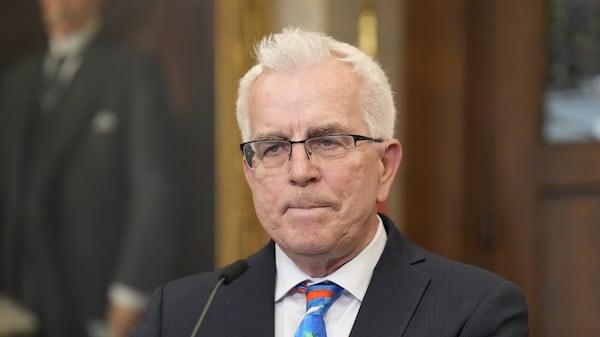
A former CIA officer says there may be more resignations from the Trump administration over the Iran war following Joe Kent’s departure, as questions mount over when the conflict will end and why the U.S. military got involved in the first place. “The dirty little secret in American politics right now is that the U.S. is at war with Iran because Israel has insisted that the U.S. go to war with Iran,” John Kiriakou, a former CIA counterterrorism head turned whistleblower, told CTV News Channel on Tuesday. Kiriakou’s comments came shortly after Kent, a senior U.S. intelligence official appointed by U.S. President Donald Trump, abruptly announced he was stepping down over concerns about the American military’s involvement in Iran. “I cannot in good conscience support the ongoing war in Iran,” Kent wrote in a letter posted to social media. “Iran posed no imminent threat to our nation, and it is clear that we started this war due to pressure from Israel and its powerful American lobby.” Kiriakou said the manner in which Kent publicly announced he would leave his post was “a powerful statement in and of itself,” adding he agreed with Kent that Iran didn’t pose any imminent threat to the U.S. prior to the start of the conflict. “There was no threat against the United States,” said Kiriakou. “This was a political decision made to appease the Israelis, and finally, somebody said the quiet part out loud.” Kent may not be the only Trump official to step down over the war, Kiriakou predicted, noting that Kent chose not to address his resignation letter to his direct superior, U.S. Director of National Intelligence Tulsi Gabbard, but to Trump himself. “Tulsi’s been very, very quiet lately,” Kiriakou said. “And when there are big foreign policy meetings that are broadcast on television, she’s conspicuously absent, so I wouldn’t be surprised to see if (Gabbard) finally resigns as well.” Hours after Kent’s resignation, Gabbard took to social media in support of Trump’s decision to attack Iran. “After carefully reviewing all the information before him, President Trump concluded that the terrorist Islamist regime in Iran posed an imminent threat and he took action based on that conclusion,” Gabbard wrote in a post on X. On Wednesday, Gabbard, alongside CIA Director John Ratcliffe and FBI Director Kash Patel, testified before the U.S. Senate Intelligence Committee at its annual hearing on worldwide threats to the U.S. When asked if he agreed with Kent’s assessment that Iran posed no imminent threat to the U.S. prior to the start of the war, Ratcliffe said he did not, and claimed the latest intelligence suggested the opposite. ‘A bad idea’ The dissension within Trump’s administration reflects the mounting political pressure he’s beginning to feel at home over the war, as higher gas prices and fears of another prolonged Middle East conflict worry some Trump supporters. Kiriakou said the war was “a bad idea from the first time it was vocalized by Benjamin Netanyahu,” noting that the Israeli Prime Minister has been attempting to convince the U.S. to take military action against Iran for years. “In all the years that I was in government, all the decades that I was at the CIA or the U.S. Senate Foreign Relations Committee, literally every Israeli prime minister who came to the United States, regardless of who happened to be president, would say: ‘Please bomb Iran,’” he said. “And the answer was always no, until this president. There’s nothing that the United States gets out of this.” Gabbard was pressed by Senators on Wednesday about the Trump administration’s stated goals in Iran, one of which was to ensure the Iranian regime could never obtain nuclear weapons. In her prepared remarks, Gabbard said Iran’s nuclear enrichment program was obliterated last summer by U.S. and Israeli strikes in June. She said the intelligence community had seen no effort by Iran in the months since to rebuild its enrichment capabilities. Gabbard noted that intelligence suggested Iran would eventually look to recover from previous attacks and resume its nuclear ambitions, but when asked if the regime posed an imminent nuclear threat to the U.S. prior to the war, she said only the president could make that determination. “The only person who can determine what is and is not an imminent threat is the president, and he made that determination,” she said. “It is not the intelligence community’s responsibility to determine what is and is not an imminent threat.” Kiriakou argued no matter the goals, the current air campaign by the U.S. and Israeli militaries, which has resulted in the death of many high-ranking Iranian officials, is not an effective strategy on its own without a plan for what happens next. “Overthrowing a government is easy; implementing something better is exceedingly difficult,” he said. “When you have a country that is literally the same size as the whole of western Europe, surrounded by forbidding mountains on three sides, and there’s no alternative that’s apparent to the current government, then what could you possibly hope to gain?”