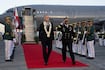
MANILA, Philippines — Prime Minister Mark Carney says Canada and the United States are making progress toward a bilateral trade agreement, but significant issues remain unresolved, including protections for Canada’s auto sector. Carney told reporters Saturday he recently held an extensive discussion with U.S. President Donald Trump and senior members of his administration. “I had a long, substantive conversation with President Trump just before leaving for this trip. President Trump, Ambassador (Jamieson) Greer, Chief of staff (Stephen) Miller,” said Carney. “We are making progress. There is the possibility of a bilateral deal, but we are not there yet.” Carney made the comments in Manila when asked about the future of Canada’s auto industry following the sale of Stellantis’s assembly plant in Brampton. He said maintaining a viable Canadian auto sector is a non-negotiable condition in any agreement with Washington. “This government will not settle for a deal with the United States that is not consistent with a viable Canadian auto sector,” said Carney. The trade comments came as Carney announced Canada and the Philippines had successfully concluded a free trade agreement. During a joint signing ceremony with Philippines President Ferdinand Marcos Jr., both leaders highlighted the growing ties between their countries and the large Filipino community in Canada. “Our people to people ties, particularly the 1 million Filipinos in Canada remain a foundation to our partnership,” said Marcos. Carney later said the agreement is expected to significantly boost commerce between the two countries. “We expect trade between our countries to triple over the course of the next decade,” Carney told reporters later. The prime minister also announced progress in negotiations with the Association of Southeast Asian Nations, saying talks on a broader trade pact have been “substantially completed.” “ASEAN brings together 11 countries, 700 million people with a combined economy worth about $6 trillion,” said Carney. “This is ASEAN’s first trade agreement outside of the region, outside of Asia, in a demonstration of our deepening partnership.” Experts say the Southeast Asian bloc represents an important opportunity for Canada as it seeks to diversify trade and reduce economic dependence on China. “ASEAN can be a strategic option for diversifying production and sales away from China and reducing dependence on China,” said Julie Nguyen, at the York University Centre for Asian Research. “It all starts with building relationships on the ground in Southeast Asia, which I believe is urgently needed now and will remain so in the years to come.”