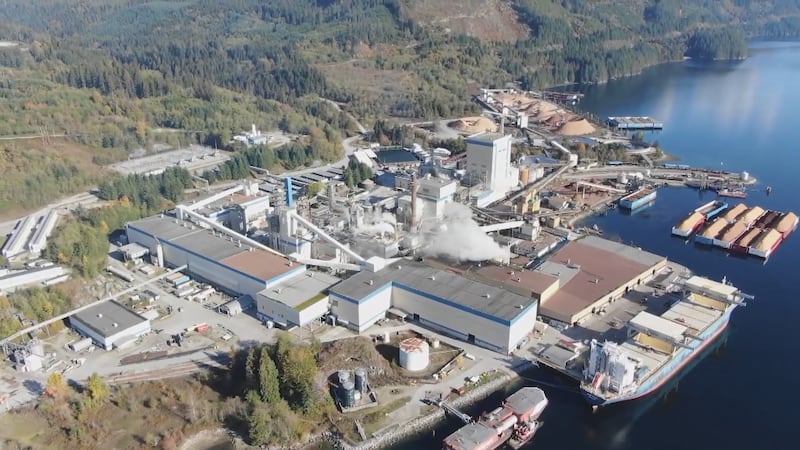
The Sunshine Coast is well known as a weekend getaway for Vancouverites keen for a fresh air and small town charm, but forestry has been the economic and cultural backbone of the region—and the pending closure of a pulp mill has rocked the community. On Thursday, Domtar announced that 400 employees at the Howe Sound Pulp and Paper Mill and Bayview Fibre Chipping facilities were notified about the “indefinite idling of operations,” citing persistent low prices for pulp on the international market, low demand from Asia, and “a decline in affordable domestic fibre.” Andrew Appleton has worked as a tug boat operator hauling massive amounts of pulp from the sprawling mill for 22 years, and calls the situation “a big melting pot of disaster” that he suspects also involves the protracted free trade negotiations with the U.S. “It was a huge gut punch to everybody all at the same time, you know, from top to bottom—all HR, all managers, all floor workers,” he told CTV News outside the mill in Port Mellon, just north of Gibsons. “I’ve got four kids and I’ve got bills to pay and I just I don’t know what’s going to happen after this.” The human toll Several workers described the mill as being a modern and efficient facility, and Domtar said it’s invested $500 million in upgrading it since acquiring the complex in 2010. That’s around the time Chris Perry went to work there after he was laid off from General Forest Products, where he’d worked for 19 years. He’s only four months from his planned retirement date but won’t make it since the mill will halt operations in October. “Everybody says, ‘Oh, it’s the tariffs.’ It ain’t the damn tariffs,” he said, pointing out B.C. has born the brunt of mill closures in recent years and workers like him feel abandoned by governments. “Look at what we’ve done with our forests, look what we’re doing with our industry.” His coworker, Ken Hall, is also facing his second layoff in the industry and described the announcement as difficult for everyone, even managers like himself. “It was not easy yesterday,” he said. “You have to support your employees the best you can, ask them to work safe through this terrible time, and we have two more months to continue to come to work.” Gibsons Mayor Silas White described the ripple effects in the community as profound, since many Sunshine Coast residents will know someone affected and will likely feel the effects themselves. “There’s a lot of, you know, associations to other forestry operations on the Sunshine Coast that are intertwined with the mill, other kinds of manufacturing operations that supply the mill—and beyond that, every restaurant, every grocery store, every business on the Sunshine Coast is going to be impacted, virtually every business in some way,” he said. A struggling sector For the past several years, the forestry sector has been limping along. Four mills have shuttered in British Columbia in the last year, and the B.C. Council of Forest Industries (COFI) counts at least 21 mills closed indefinitely or permanently since 2023. “We know that this storm has been coming, we know that the tariffs aren’t helping,” said Gavin McGarrigle, Western regional director for Unifor. He said the union has been working with Domtar and the province to try and find a way to sustain the industry, since “we don’t want to see ghost towns all across British Columbia, all across the country, because the governments can’t get it together and deal with the forestry situation.” McGarrigle is encouraged that Domtar described the move as “idling” the plant rather than shuttering it. The company announcement includes a statement from president, Luc Theriault, that the business “will monitor market conditions, domestic fiber availability and the overall business environment, and will evaluate future opportunities if conditions improve.” In a statement Thursday afternoon, the forests minister said they’ve already reached out to provide income and mental-health supports in the community. Ravi Parmar spoke to CTV News on Friday, revealing he’d been in discussions with Domtar in recent months, pointing out that pulp prices are at historic lows and suggesting none of the pulp mills in North America are currently profitable. “It’s boom and bust. You know, four or five years ago there were record profits being made and companies did not pivot, nor did they become efficient,” he said, adding that the tariff battle with the U.S. was playing a role in destabilizing the industry. “(At the same time), government policies and structures haven’t changed where they need to in order to ensure that there’s a more competitive sector, and so I think there’s an onus on all of us—industry, government, everyone—to really step up our game.”