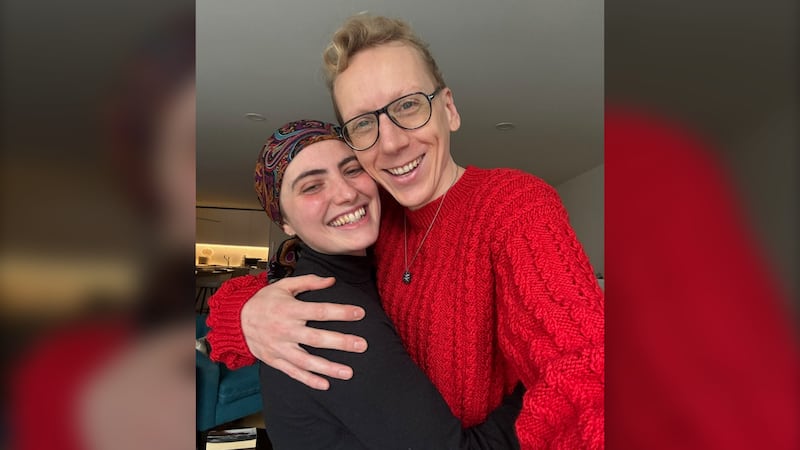
A Toronto woman battling a rare cancer says she was “devastated” to learn that while medical professionals at Ontario’s Ministry of Health agreed she needed a potentially life-saving out-of-country treatment, bureaucrats would not sign off and didn’t inform her that her application had been recommended for approval by the ministry’s doctors. “I grew up as a Canadian. So you don’t think that you’re going to have to fight an insurance company or anyone like that the way that you hear happening south of the border,” Sabrina Apitz-Grossman told Newstalk 1010 Friday. “It’s hard to fight on two fronts because you’re fighting cancer and then you’re also fighting a system that is difficult to navigate.” Apitz-Grossman, now 31, was diagnosed with a synovial sarcoma in her upper calf, near her knee, when she was 28 years old. She received treatment for the rare and aggressive soft-tissue cancer in Ontario and hoped she was in the clear. “I had radiotherapy. I had surgery. I relearned how to walk after losing a lot of calf muscle, and then I was being monitored. And in September 2025, it came back with a vengeance,” she told CTV News Toronto in a separate interview. The cancer had spread to her lungs and doctors diagnosed Apitz-Grossman with unresectable metastatic synovial sarcoma, meaning it could not be operated on. “Suddenly the prognosis changes dramatically. It’s no longer expected that you will live a long life,” Apitz-Grossman said. Standard treatments available in the province could help stretch her life out 12 to 18 months from the metastatic diagnosis. But the only promising treatment was one not available in Canada due to commercial decisions. If she wanted the treatment, she would need to go to the U.S. to receive it. Specialists in Toronto and at Memorial Sloan Kettering Cancer Center in New York determined she was an ideal candidate to receive Tecelra, a newer drug specifically designed to target her type of cancer by teaching her immune system to fight it. According to the FDA, tumors shrank or disappeared in almost half of patients who received the infusion in clinical studies. But the drug does not come cheap. Tecelra costs around US$787,000 for an entire course of treatment. Apitz-Grossman applied to Ontario’s Prior Approval Out of Country Program – a program designed to cover costs of treatment only available outside of Canada – but was asked to apply to Canada’s Special Access Program, a separate program that grants one-time permission for administration, in Canada, of substances that are not approved for sale in the country. US WorldMeds, which makes Tecelra, declined to provide it for free on compassionate grounds, but did agree to provide it to Apitz-Grossman at a discounted price of US$575,000, with Princess Margaret Cancer Centre agreeing to cover off hospital fees associated with administering the drug there. But Ontario did not agree to cover the discounted cost of the drug and she received a denial letter in April. Only through a subsequent Freedom of Information request that was answered on Nov. 3 did Apitz-Grossman learn that medical professionals at the Ministry of Health had repeatedly recommended that she be approved to receive the treatment. Her application was in fact reevaluated in June and Ontario Health recommended funding her request. But she was never informed. She has now spent the past few months fighting the Ontario health-care system to receive funding for the potentially life-saving treatment despite the fact that doctors recommended she start it in the early months of this year in order to have the best chance of survival. “It was really vindicating to see that they did understand, but really devastating to see that the clinical experts from Ontario Health had agreed with my doctors and had said this is indeed the best thing. It’s clinically indicated. It’s medically necessary. It’s the only option. And then that had just never come to me, and no one ever told me about it,” Apitz-Grossman said. All this comes as “the clock is ticking,” she says. “I want a lot more time than 12 to 18 months from what is now 15 months ago. I feel like I have a lot of life left to live. I want to see my siblings get married. I want to spend more time with my husband. I want to have a legal career. I went to law school, but cancer kind of knocked that right off course. It’s been challenging, and it’s not what you imagine for your early 30s.” Apitz-Grossman’s case came to the Ontario legislature Thursday when NDP MPP Robin Lennox brought it up. “These decisions are made based on evidence, not through the political process,” Health Minister Sylvia Jones replied to Lennox in Question Period. Lennox was subsequently kicked out for violating parliamentary rules when she responded that Jones “is lying” about the process. Liberal health critic Adil Shamji, who has been advising Apitz-Grossman through the process, also weighed in. In an interview with Newstalk 1010 Friday, Shamji said the Ford government has wasted plenty of money exploring a tunnel under Highway 401 and getting alcohol into convenience stores earlier, but is “playing games” with a woman’s life. “It’s hard to know exactly how close it got to the minister of health, but what we can know for sure is that the ministry’s own doctors… said that it would help her (Apitz-Grossman) and recommended that the ministry pay for it, and the Ministry of Health said no,” Shamji said. Apitz-Grossman has now taken the fight to court. Even though she’s not sure if she can make a difference for herself in time, she’s thinking about “legacy” and perhaps making things easier for the next person who needs treatment. She acknowledges the health minister is a in a difficult position when it comes to making determinations about treatments for rare illnesses and says she doesn’t “envy the problem.” Still, she says the people who should be making decisions about proper care are the doctors, not the bureaucrats. “I think we need to have this conversation really loudly about what we’re going to do for these patients who have rare diseases or rare cancers, where there are treatments, but they’re not standardly available in Ontario,” Apitz-Grossman said. “What do we do then? Because I think most people in Ontario don’t think that we should just allow people to die.”