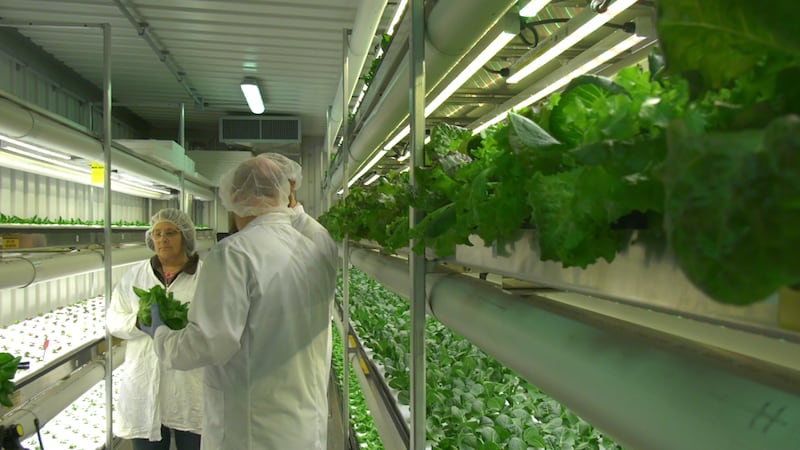
Scientists at Cornell University say they may have found a way to meet the world's growing food demands: algae. Research published in September in the peer-reviewed journal Oceanography suggests microalgae grown onshore could provide a sustainable source of food and nutrients globally. "Microalgae takes up CO2 from the air and also uses very little land, no freshwater and very little inorganic phosphorus to produce food, so that overcomes the problems of current food systems," Xingen Lei, a co-author of the study and professor of animal science at Cornell, told CTV's Your Morning on Thursday. The study's authors say marine algae-based aquaculture could produce more than the total global protein demand projected for 2050, offering "a better source of high-quality nutritional protein, essential amino acids, and other micronutrients relative to terrestrial plants." Since it does not require soil, irrigation and the open use of fertilizer, the researchers say marine algae does not need to compete with agriculture for arable land and freshwater, potentially reducing carbon emissions and the loss of biodiversity through actions such as deforestation. Using CO2, simple nutrients and sun or artificial light, Lei says microalgae could be produced on a large scale. As far as making it appealing to eat, Lei told CTV's Your Morning that this could involve choosing a more flavourful species to grow or simply extracting the nutrients and combining it with other ingredients to make a dish more palatable. A writeup published by the Cornell Chronicle on Oct. 6 noted that Lei and his colleagues found adding algae to chicken feed also tripled the amount of omega-3 fatty acids in eggs compared to normal ones. "We have an opportunity to grow food that is highly nutritious, fast-growing, and we can do it in environments where we're not competing for other uses," Charles Greene, professor emeritus of earth and atmospheric sciences at Cornell and the paper's senior author, said in the Chronicle story. "And because we're growing it in relatively enclosed and controlled facilities, we don't have the same kind of environmental impacts." Watch the full interview with Xingen Lei at the top of the article.