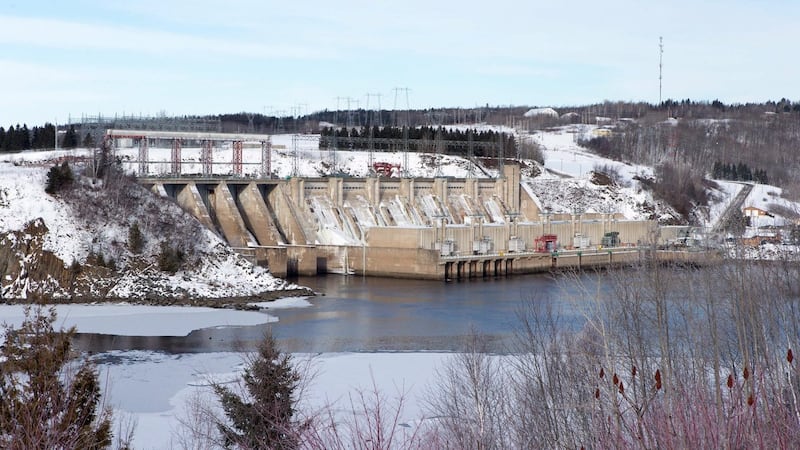
The province is planning up to $3 billion dollars in upgrades as part of its latest plans for Saskatchewan’s electrical grid. On Tuesday, SaskPower leadership was joined by Minister Jeremy Harrison to unveil Strengthening Saskatchewan’s Grid: Transmission to Power Communities and Growth at JNE Welding, a Saskatoon-based welding company building transmission infrastructure set to be placed across the province. “What we are doing is a fundamental change in how we are looking at some of those decisions building for the future, not just building for the next project,” said Jeremy Harrison, minister responsible for SaskPower. The long-term plan is focusing on three key areas. The first is fixing a longstanding issue of the mismatched northern and southern power grids. Currently there’s no connection between Saskatchewan’s northern and southern grids. To send power up north the province first needs to reroute power to Manitoba. To avoid disruptions or having to rely on other provinces, Harrison said connections will link the two systems, with a planned launch sometime in 2032. “Being able to produce and move power around the province in between jurisdictions, that’s a really important part of the consideration as we go through the nuclear, transition,” Harrison said. Wildfires last summer damaged a number of power lines in northern areas and eventually left many people without power, as two interconnections were forced offline. “I wouldn’t say that was necessarily the impetus, but that definitely was brought to light some of the challenges,” Harrison added. Plans are also in place to strengthen the grid by stretching transmission lines throughout northern Saskatchewan, strategically located to areas where critical minerals are located to further drive the province’s economy. A new 80-kilometre line is being built from Pelican Narrows to Foran Mining’s McIlvenna Bay copper mine, which is set to be completed later this year. Other plans include expansions into the northwest and far north. Roughly $2 billion is planned to expand interconnections with Alberta to the west, Manitoba to the east and the United States to the south to create more opportunity for power imports and exports. Current intertie capacity is limited to 150 megawatts with Alberta and the United States. Manitoba’s capacity is currently 425 MW. Alberta’s converter station — which is on a different grid and forced electricity to be converted from AC to DC and back to AC — has been needed over the winter, with Saskatchewan supplying additional electricity during extended cold periods this winter. “We literally have been helping Alberta keep the lights on through the cold spells that they’ve had even in the last couple of days,” Harrison said. “This will allow us to do that, in a more significant way.” Harrison said Alberta has agreed to increase the capacity of that intertie. Another $700 million project is currently underway to increase capacity to the Southwest Power Pool, Saskatchewan’s only interconnection with North Dakota. Announced in 2022, plans include expanding capacity to 650 MW by 2027, with a agreement in place for 20 years of service. Harrison said because of where Saskatchewan is located, combined with the immense demand for electricity expected over the next 25 years, the opportunity is there to take advantage of. “I think we are coming to a point where really the ability of economies to grow is going to be measured as much by their ability to put power onto grids and move it, as by anything else,” he said. “And that is a significant change.” Harrison said he and Premier Scott Moe met with François-Philippe Champagne, the federal Minister of Finance two weeks ago, and expect announcements soon on national plans to strengthen the grid. He hinted SaskPower won’t be paying for the grid improvements alone. “I think there’s going to be a federal partnership in putting this transmission infrastructure together as they get closer to their electricity strategy as well,” said Harrison.