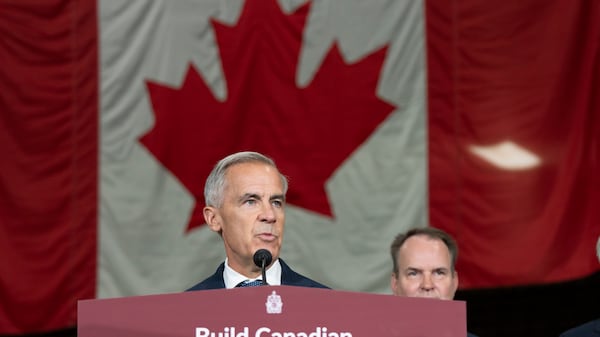
Capital Dispatch is a weekly newsletter, sent when Parliament is in session every Friday. To stay on top of what’s happening on the Hill, you can sign up to receive the latest political news and insights directly in your inbox, here. Affordability debate revived, language friction, Ma under fire, NDP leader incoming With some provinces promising their residents new tax relief, the Liberals were pressed on what more they’re considering federally. They also faced scrutiny over a floor-crosser’s comments on forced labour in China. Plus, should CEOs of major Canadian companies be fully bilingual? And who will be named the next NDP leader? Here’s what you need to know about this week in politics. The week that was As select provinces presented their annual budgets this week, amid ongoing high prices at the pump, pocketbook issues and the cost of living were a major source of conversation. The focus on tax relief – Manitoba is scrapping the PST on groceries and Ontario the HST on new homes – revived a debate on affordability in the House of Commons that as of late had slid to the backburner. Attention on the issue prompted some fierce exchanges between Prime Minister Mark Carney and Conservative Leader Pierre Poilievre on Wednesday. “Strategies and imaginary promises will not pay the bills or fill the tank. We all know that global oil prices have gone up, but that does not explain why in Canadian dollars and in litres, Americans pay $1.46 a litre at the pump while Canadians are paying $1.70. That is 26¢ higher per litre at the pump because of the prime minister’s anti-energy policies,” Poilievre said. “Will he get rid of these policies and get rid of that tax so Canadians can have some relief at the pumps?” he continued in the Commons, making good on what he recently told a New York crowd – that he doesn’t shy away from criticizing the prime minister on home soil. Carney then, shot back: “I know the member opposite was not here in the spring. It is a source of great sadness. We got rid of the consumer carbon tax. That took off 18 cents per litre. What matters is the rate of growth of wages relative to overall inflation. Wages are growing at twice the rate. This country is moving forward.” For those looking for clear answers or commitments on what the federal government may do to further address the cost of living, keep an eye out for the date on which the Liberals will unveil their “spring economic statement,” the mini-budget check-in on the state of the country’s finances. The biggest story in the country this week was the Air Canada crash at La Guardia airport in New York that killed two Canadian pilots and has now sparked a joint transportation safety investigation. The tragic event prompted political leaders to offer condolences, and later condemnation of the Air Canada CEO’s inability to do the same in both official languages. Air Canada is headquartered in Montreal, and one of the deceased pilots was a French-speaking Quebecer. “I’m very disappointed in, as others are rightly so, in this unilingual message of the CEO of Air Canada. It doesn’t matter the circumstances, but particularly in these circumstances — lack of judgment and lack of compassion,” said Prime Minister Mark Carney – who is no stranger to learning French. The crash, and scrutiny over an understaffed U.S. air traffic control system also led to new questions at home about who is guiding Canada’s skies. Colleague Heather Wright looked into that angle this week. Lastly, some late-breaking drama unfolded Thursday afternoon involving Liberal MP and recent Conservative-to-Liberal floor-crosser Michael Ma, who has come under intense scrutiny over a heated exchange he had with a China expert during a study on electric vehicles. “You claim about forced labour in Xinjiang, have you witnessed this yourself? Have you been there, ever?” he asks University of Ottawa senior fellow Margaret McCuaig-Johnston, who later told colleague Vassy Kapelos on CTV’s Power Play she thought he was kidding, given no one from the west could go witness forced labour in China firsthand. The exchange also raised questions about where the government stands, given Ma was one of a select number of MPs to accompany Carney on his recent China trip. Parliament has long held the view that forced labour is a tool of genocide against the Uyghurs. Asked to comment, the Prime Minister’s Office referred to a statement from Ma, who tried to clarify his line of questioning “referred to auto manufacturing in Shenzhen, China, and not in Xinjiang.” “I regret this mistake and apologize to Ms. McCuaig-Johnston and my fellow committee members. I condemn forced labour, in all its forms,” he said, without specifically naming China as he was also asked to do by reporters who chased him down on the Hill. Not to be missed Canada officially hits NATO defence spending GDP target After more than a decade of plodding progress and the Liberals previously downplaying the need for it, Canada has officially hit the NATO spending target of two per cent GDP set in 2014. According to data in NATO’s annual report, Canada spent more than $60 billion on defence in 2025 – an amount that adds up to 2.01 per cent of the country’s gross domestic product. Carney marked the milestone in Halifax on Thursday, while touring a Royal Canadian Navy frigate. This year’s annual report shows that all 32 alliance members have met the two per cent guideline set during the 2014 Wales Summit. Colleague Judy Trinh has all the details here. Justice minister denies premiers’ request on appointments Canada’s justice minister is pushing back on a request made by four provinces to have more say in the nomination of judges. Justice Minister Sean Fraser told reporters this week that the federal government believes the current judicial appointment process is working well. “We’ve had a lot of positive feedback… from every province, frankly, when it comes to the appointments that we have made,” said Fraser. As colleague Mike Le Couteur reports, a letter signed by the premiers of Alberta, Saskatchewan, Ontario and Quebec demanded more authority over the final say in the appointment of judges to superior court, provincial courts of appeal and the Supreme Court of Canada. Global Affairs laying off highest-skilled diplomats: union And, The union representing staff at Global Affairs Canada says the foreign service is laying off dozens of its highest-skilled diplomats, while asking other envoys moving across continents to wait months for their personal items. That’s the lead from The Canadian Press’ Dylan Robertson, pulling at another thread of the ramifications of Carney’s promised public service cuts. As he reports, the layoff plan is “causing an uproar among former diplomats and international relations experts, who say the government’s cuts are at odds with Ottawa trying to gain influence at a time of geopolitical calamity.” The week ahead Federal New Democrats from across the country are descending on Winnipeg to talk pressing policy, plot political strategy and decide who their next leader will be before the weekend’s over. After a seven-month leadership campaign that struggled to capture Canadians’ attention, there’s a lot at stake coming out of this convention for the NDP. The perception is that after two official debates, numerous campaign rallies and months of campaign fundraising, the race may be Avi Lewis’ to lose. Though there are those who say don’t count Heather McPherson or Rob Ashton out just yet. No matter who wins, the next leader will be taking the reins of a party that has a long way to go to regain ground lost over the last few federal elections. And with Carney on the precipice of a majority government, there may be years to go before they’ll get a chance to try in any sizeable way. I’m in Winnipeg to cover the convention this weekend and have got you covered with what party loyalists and former senior New Democrats are expecting Covering the latest political news from CTV’s parliamentary bureau in Ottawa, Rachel Aiello offers exclusive analysis on political developments straight from Ottawa.