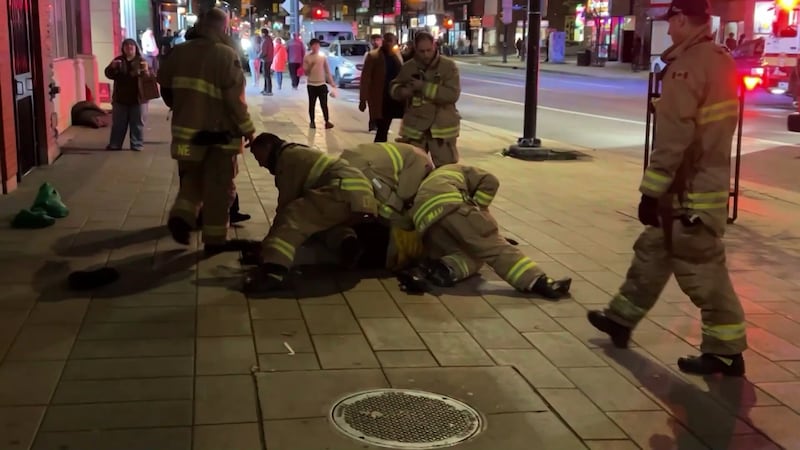
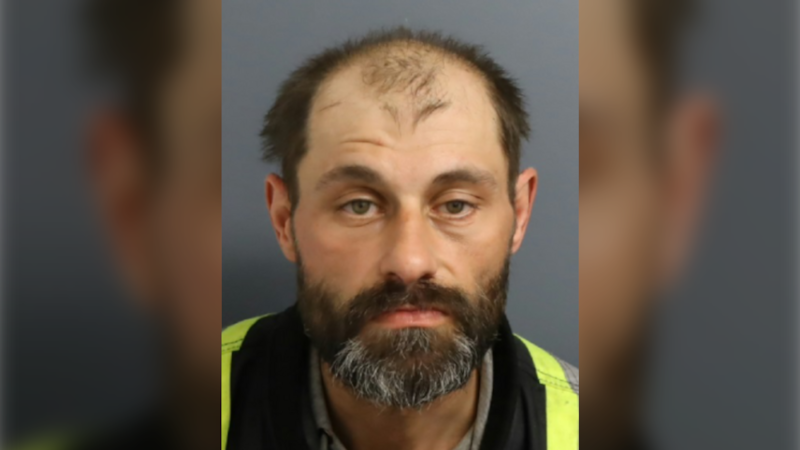
When Marek Windonski met the people who saved his life in Ottawa’s ByWard Market, he had little to say. “It’s not the words,” Windonski says, his voice breaking. “Thank you for saving my life. Saving my life for my kids. I have three kids, and they are happy that I’m still here.” Weeks earlier, the father of three had been out for a stroll and shopping when he collapsed in the ByWard Market after feeling something strange in his leg. “I felt like something was happening in my foot,” Windonski recalls. “And I remember the last thing I did was blackout.” It was a late August afternoon when Windonski collapsed on William Street. What happened over just six minutes would save his life. Nicholas Firman had been walking home after grabbing sandwiches nearby when he heard Windonski fall behind him. “I turned around and you could instantly recognize he was in distress,” Firman said. “I called 911 right away.” As Firman spoke with emergency dispatcher Brandon Pollock, another bystander, who remains unknown, began CPR. Firman sprinted toward the market building to find an automated external defibrillator. That’s where he met Enoch Ntiriawakye, a market employee who had recently taken first aid training. Together, they brought the AED back to the sidewalk, Ntiriawakye attached the AED pads and delivered a shock. “When someone’s life is on the line, I had to put my nervousness behind me,” said Ntiriawakye. “We just had to act and help him.” Seconds later, Windonski’s heart began to beat again. “I feel first shot in my heart,” Windonski said. “It was so strong. And then there was another one, and I opened my eyes, finally I got a breath.” Pollock says getting clear and concise information from people on the scene helps to prioritize the call and deliver the right resources. “We have a priority dispatch system, which helps guide us from start to finish. It was developed to help save lives,” he says. “And in this case, the system worked exactly as intended. We saved a life and we’re happy to see that.” When paramedic Patrick Savard-Limere arrived on the scene within minutes, Windonski was already conscious. “Bystanders had done an amazing job,” Savard-Limere said. “The scene was calm and collected, and I was getting accurate, precise information.” Savard-Limere says it’s rare to see a cardiac arrest patient regain consciousness before paramedics arrive. “When the chain of survival comes into play, with bystander CPR and early defibrillation, that’s usually when we see this type of outcome,” he says. “Great job to them, and I would also say that anybody that can get any type of first aid training and CPR training is very valuable. You might not use it your entire life, but for that one time you will use it, you would make a difference.” Ottawa Paramedic Services superintendent of public information Marc-Antoine Deschamps says the city has roughly 1,500 registered AEDs that 911 operators can direct callers to. Every emergency vehicle carries one as well. “Seconds count in this case,” says Deschamps. “Because members of the public used the training they received, they knew exactly what to do. It was a well-coordinated scene, and they were able to provide a precise report to the paramedics showing that. It speaks volumes to the calm and the purposefulness of their actions on that day.” Last week, Windonski, who is working towards a complete recovery, reunited with Firman and Ntiriawakye, along with the team of emergency responders at the Ottawa Paramedic Service’s headquarters. They were strangers, whom he now calls friends. “I just remember the paramedic, the action was so professional, so fast,” he says. “And the strangers, just regular people, beautiful people who want to help other people when they have problems. All I can say is thank you for saving my life.”