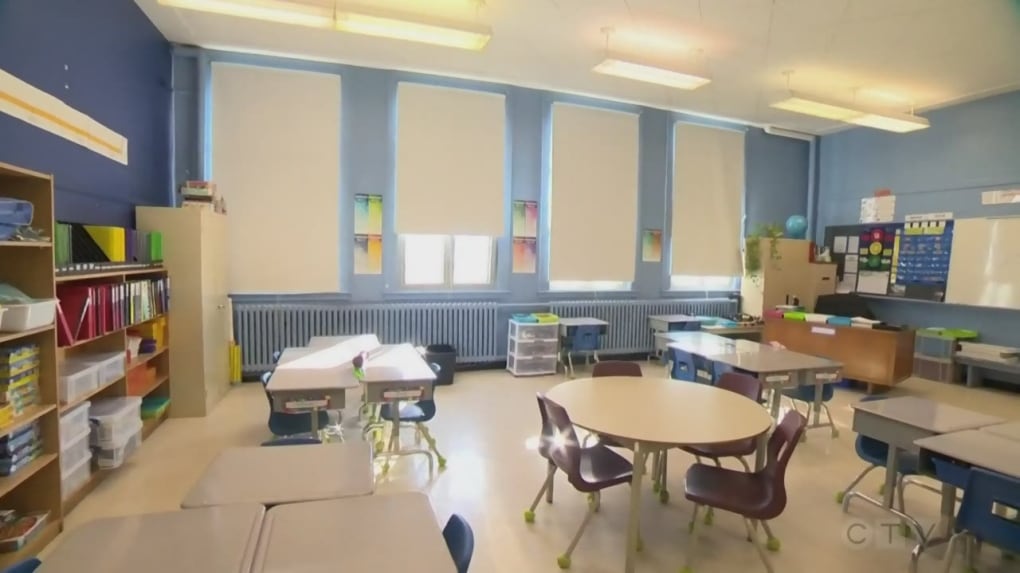
The Ontario NDP is attempting to set a maximum temperature for classrooms in the province, saying school years are getting hotter, forcing teachers and students to learn in sweltering classrooms. Ottawa West-Nepean MPP Chandra Pasma introduced a private member’s bill in the legislature that, if passed, would set a maximum temperature of 26 C in classrooms and on school buses. “As the number of extremely hot days during the school year is rising, classrooms and school buses are becoming dangerously hot, and students, teachers and education workers are being asked to learn and work in conditions that are not safe,” Pasma said in a news release. “Every child deserves a safe, healthy learning environment, no matter their postal code or the age of their school building.” Data shows school years getting hotter Data from Environment and Climate Change Canada shows that the months of May, June, and September in Ottawa have gotten hotter. For the period of 1976 to 1985, the average monthly high was 18.7 C in May, 23.2 C in June, and 19.5 C in September. From 2016 to 2025, the average monthly high was 19.8 C in May, 24.7 C in June, and 22.2 C in September. The 10-year average of the hottest day of the month each year was 28.9 C in May, 30.7 C in June, and 28.6 C in September between 1976 and 1985. The average extreme high was 30.3 C in May, 33.2 C in June, and 29.5 C in September over the last 10 years. Comparing two 30-year averages — 1966 through 1995 and 1996 through 2025 — also shows that later years are hotter than earlier ones. The 30-year average high for May was 18.6 C in 1995 and 19.7 C in 2025. In June, the figures are 23.7 C and 24.5 C, respectively, and the September averages are 19.4 C for the first 30 years, and 21.7 C for the most recent 30 years. One statistic measured by the national weather agency called “cooling degree-days” is used to estimate the air conditioning requirements of buildings. “Cooling degree-days for a given day are the number of degrees Celsius that the mean temperature is above 18 C. If the temperature is equal to or less than 18 C, then the number will be zero. For example, a day with a mean temperature of 20.5 C has 2.5 cooling degree-days; a day with a mean temperature of 15.5 C has zero cooling degree-days,” a description of the statistic says. The mean temperature is the average of the highest and lowest temperatures during the day. Comparing the 10 years of 1976 through 1985 to 2016 through 2025, the data shows that cooling degree-days are on the rise in May, June, and September in Ottawa. The 10-year average for May 1976 through 1985 was 11.82 cooling degree-days. From 2016 to 2025, the 10-year average was 15.62. In June, the figure went from 30.14 in the 70s and 80s to 54.3 during the last 10 years. September is also getting warmer, with the cooling degree-days figure jumping from a 10-year average of 13.86 between 1976 and 1985 to 22.75 from 2016 through 2025. May 2026 was 1.1 degrees cooler than average, according to Environment and Climate Change Canada, but June is expected to be hotter than normal. How many Ottawa schools have AC? The Ministry of Education says school boards are required to have protocols in place as to how they deal with heat in schools. “(School boards) are responsible for ensuring that each individual school follows all appropriate provincial and municipal health and safety requirements,” said Emma Testani, Education Minister Paul Calandra’s press secretary, in a statement to CTV News Ottawa. “The province provides nearly $6 billion in annual funding to school boards to help build new schools, renew, improve and operate school facilities, which includes air conditioning.” Ottawa’s four school boards say they continue to make upgrades to schools to install air conditioning. The Ottawa-Carleton District School Board says a majority of its schools now feature cooling directly inside classrooms and learning spaces, while the remaining facilities utilize cooled safe zones in communal areas. “To build on this momentum, our facilities team is launching an extensive work schedule beginning this summer that will see nearly 60 sites undergo work to replace, renew, upgrade, or add air conditioning infrastructure, including 12 sites that will receive new air conditioning installations of varying size and complexity,” a spokesperson said. The Ottawa Catholic School Board says more than half of its schools are fully air-conditioned, and nearly all schools have at least some amount of air conditioning. “Since 2024, air conditioning upgrades have been completed at St. Brigid School (second floor), St. Pius X School (gymnasium), St. Gregory School (gymnasium), Frank Ryan Catholic Intermediate School (second floor), St. Luke School (third floor), and St. Catherine School (several classrooms). Air conditioning is also being added to the gymnasium at Corpus Christi School this year,” a board spokesperson said. The Conseil des écoles catholiques du Centre-Est, Ottawa’s French Catholic school board, said around 80 per cent of its schools are air conditioned, and the remaining 20 per cent have fans available for classrooms and hallways. The school board also said it has policies in place during heatwaves to implement safety guidelines for recess and outdoor activities, such as drinking plenty of water, wearing a hat, and taking time to cool off in air-conditioned areas. The Conseil des écoles publiques de l’Est de l’Ontario, the French public board, said 43 of its 45 schools have some level of air conditioning. Staff are also trained to adopt good practices during periods of extreme heat, a spokesperson said.