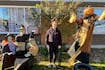
People took part in the Chain of Life Challenge to raise awareness for organ donation by hiking up mountains across Quebec on Sunday. In Montreal, Audree Descheneaux was one of dozens who hiked up Mont Royal. Twenty-three years ago, she received a life-saving liver transplant when she was just a teenager. “I had fulminant hepatitis at age 19 while traveling in Ontario,” she recalls. “I was in Toronto, and I just fell unconscious and was found and brought to hospital. I woke up a week after with a liver transplant.” Despite her young age, her liver failed. She says doctors never determined the cause. She received her transplant from a man who was 88 at the time of his death, which means her liver is now 111 years old. “We still hear today, 23 years later, taboos around organ donation, such as ‘I’m too old to donate’”, she says. “I love to hear those comments that allow me to debunk those myths. You’re never too old to be a donor.” This year her 16-year-old daughter, Olivia Blyth, is a flag bearer for the Montreal event. “Without donations, I wouldn’t be here, and I wouldn’t have all this that I have now because it saved my mom, and I mean, it’s saved me too,” says Blyth. The event also raises funds for the Chain of Life organization, which runs high school programs to educate students about organ donation. Founder Lucie Dumont says the program doesn’t try to convince students to become organ donors but instead gives them facts to make their own choice and discuss it with their families. She adds it’s a sensitive issue that can be hard to talk about at home. “It raises ethical issues, cultural, religious, philosophical, medical issues,” says Dumont. “It’s very complex; it’s not simple.” Becoming an organ donor is still rare. Last year, 196 people were organ donors in Quebec, out of more than 80,000 people who died. “People think if you die, you can give your organs,” says Dumont. “No, you have to die in a very specific situation and conditions. And because organ donation is so rare, each consent counts. So this is what we wanted people to realize: how rare it is to become an organ donor.” Descheneaux says she’s forever grateful to her organ donor for her second chance at life, and to his family, who respected his wishes. “I went back to nursing school. I had three children and married the love of my life. I’m really living life to the fullest, like nothing ever happened, but with a very deep gratitude for why and how I’m still here today.”