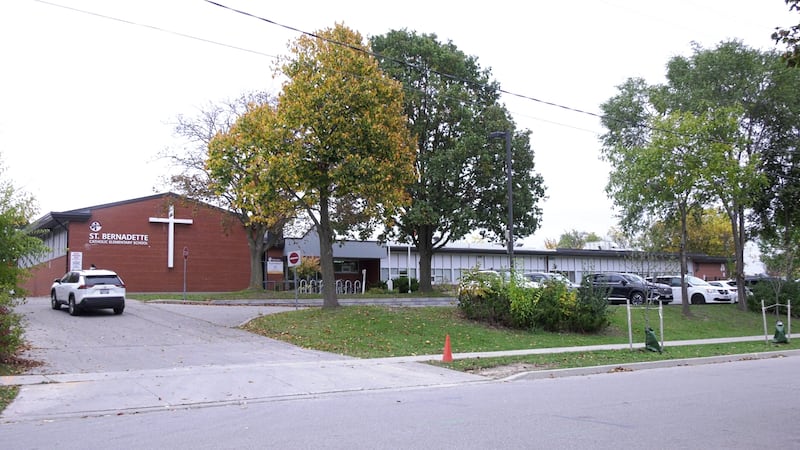
The Unifor Quebec union wants action after hundreds of workers were laid off at a commercial truck manufacturer, which the union says is related to the ongoing tariff war between Canada and the U.S. The commercial truck manufacturer PACCAR laid off around 300 Local 728 workers at its Sainte-Thérèse plant, north of Laval. “We will do everything in our power to support our members who have been hit hard by this announcement,” the union said in a news release. The company declined to comment on the layoffs. U.S. President Donald Trump said on Monday that all medium- and heavy-duty trucks imported will face a 25 per cent tariff rate starting Nov. 1. Under the North American free trade deal USMCA, medium- and heavy-duty trucks move tariff-free if at least 64 per cent of a heavy truck’s value originates in North America, via parts like engines and axles, raw materials such as steel, or assembly labour. The latest announcement comes after 175 members were laid off in August and 250 jobs were lost in December. “For the union, this decision confirms the urgent need to act quickly to preserve jobs and a historic part of Quebec’s industrial know-how,” the union said. “Time is running out for negotiations between Canada and the United States to yield concrete results, but while we await the outcome of these talks, decisive measures can be put in place now to secure the future of the plant.” Unifor would like a clear directive from Quebec to promote local purchasing from crown companies such as Hydro-Quebec and the SAQ, as well as from municipalities, police forces and other public organizations. “This episode is a wake-up call: we need a concerted strategy immediately to help PACCAR weather the storm,” said Unifor Quebec director Daniel Cloutier. “If the Sainte-Thérèse plant loses its sales in the United States, we must do everything in our power to replenish its order book with local customers. Calls for Quebec government to save jobs “The Quebec government has direct leverage to save jobs here, including through local purchasing by state-owned companies. It is up to Quebec to set an example, exercise its leadership, and call on all other levels of government in Canada to do the same.” Christopher Skeete, CAQ MNA for the Laval’s Sainte-Rose district, reacted to the news at the Quebec legislature. “It’s tragic when you lose your job and so our thoughts go for those people,” said Skeete, CAQ MNA for the Laval’s Sainte-Rose district. “At the same time, we have a lot of help being offered to the companies that are affected, and we’re going to continue to be there to protect Quebecers.” When asked by a reporter if this is the end for PACCAR, Finance Minister Eric Girard said no. “There are 1,000 employees, and they’ve laid off 300, so no, it’s not the end. There’s an expertise there, and people who are working,” he said. Economy Minister Christine Fréchette said the tariffs have created a shaky situation in the market, but tried to remain optimistic. “Uncertainty has a very negative impact. We can see that today with this announcement. I’ve met with the company and one thing I appreciate is it’s working to adapt, to open the market – the Canadian market – with new products,” she said. Revenues down PACCAR said on Tuesday that it “delivered good revenues and net income” in the third quarter of 2025, despite the numbers being significantly lower than those in 2024. “PACCAR Parts and PACCAR Financial Services continued to deliver excellent performance and strong profits. I am very proud of our employees and dealers who delivered outstanding trucks and transportation solutions to our customers,” said CEO Preson Feight in a news release. The release said that PACCAR’s net income was $590 million in the third quarter compared to $972.1 million (USD) in the same period the year prior. Revenues were down from $8.24 billion last year to $6.67 billion this year. Feight said that it produces 90 per cent of its U.S.-sold trucks in Texas, Ohio and Washington. With files from Reuters.