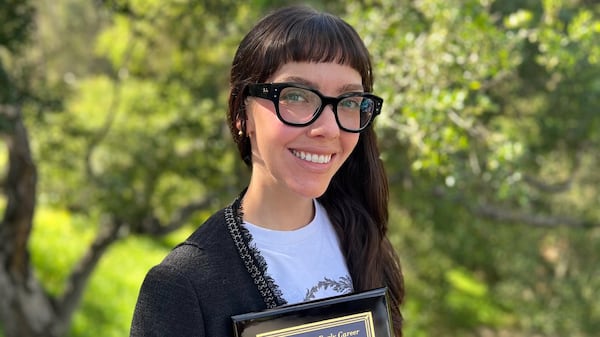
For the 24th year, dozens of up-and-coming music acts took to stages throughout Montreal’s Mile-End and Plateau neighbourhoods for Pop Montreal. The singer-songwriters, bands, and DJs can count on the festival as a place to connect with fans and put on shows as they navigate the industry, increasingly populated with AI-generated music, bot playlists and streaming sites that provide the possibility of exposure but not necessarily the promise of pay. Daniel Seligman and some friends launched Pop Montreal in 2002. The concept: highlight up-and-coming indie music in hip local spots. “We were in the right place at the right time, venues like Casa del Popolo had just started. There was a bunch of cool bands. The first year, we had bands like Metric, Broken Social Scene, The Deers. Second year, you know, we had Arcade Fire, Wolf parade, Unicorns, Patrick Watson, so, you know, you just kind of got lucky in terms of the timing,” he said. Hanorah played Pop on Friday night after playing Montreal Jazz Fest, South by Southwest, and other festivals over the past year. She said live shows “have always been the point” but that she has noticed a change in audience behaviour recently. “There have always been phones out, but I’d say it’s maybe worse than ever, or it’s something that I’m noticing a lot more,” she said. “With phone use, phone addiction and streaming being on the rise, an algorithmic sort of determination of taste, I’m also noticing a younger generation of people who are not down with that and are organizing their own phone-free events for the sheer purpose of connecting in person and creating their communities that are not dependent on giant corporations that are trying to hijack their brains and attention spans.” She, along with any artist working in 2025, has music on streaming sites such as YouTube, Apple Music and Spotify. Music publicist Eric Alper said there has never been a better or worse time to be an artist. “It’s great that you are now on the same platform as the Beatles and Lady Gaga and Justin Bieber, but it’s also horrible that you are now competing with the same eyes and ears as everybody else in the free world for the same type of time, money and energy and effort that the fans have,” he said. “It’s easy because you can get your music on there, and the rest of it is really up to you and your promotion and how hard you want to work to try to get the music out there. The problem is that you’re competing with every artist who has ever released anything in the history of the world being available, and that’s where most of the time people want to listen to.” In addition, up-and-coming artists cannot count on supporting themselves by streams alone. “On some levels, it’s democratized the music business, but obviously, the monetization is not ideal, especially for newer, up-and-coming artists,” said Seligman. “You know, you make less than a penny per stream. It’s like, what is it? $3.50 for 1,000 streams. So, unless you’re getting huge, huge numbers, it doesn’t necessarily equate to growing a real fan base.” For Hanorah and many other artists, the answer is for fans to show up to live shows, purchase physical media like CDs, vinyl or merch. AI music, for her, is “pathetic and cheap” “It’s not music. It’s recycling at best, and I think that corner cutting is apparent in the quality of the product that we see,” she said. “I’m not trying to achieve the same thing that AI music generators are trying to achieve. So if the name of the game for them is fast food, you know, the most volume possible to flood the market and make the most money like that is its own disordered goal, and it has nothing to do with making art, expressing and sharing it with fellow human beings. To me, Spotify’s future is robots listening to robots, and I have no interest in that. That’s like, good luck that I’m gonna keep playing shows and making records. And thank you very much.” Thankfully for Hanorah, there is Pop Montreal and other festivals eager to introduce music fans to new acts. “The live, real person being at a show in a sweaty bar with a band on stage, can’t be replaced by AI,” said Seligman. “We’re human beings... Obviously, art and music is such an important part of human experience and culture... I think people will always be making music. I think people want to support the bands they hear, and hopefully the AI won’t completely take over everything.”