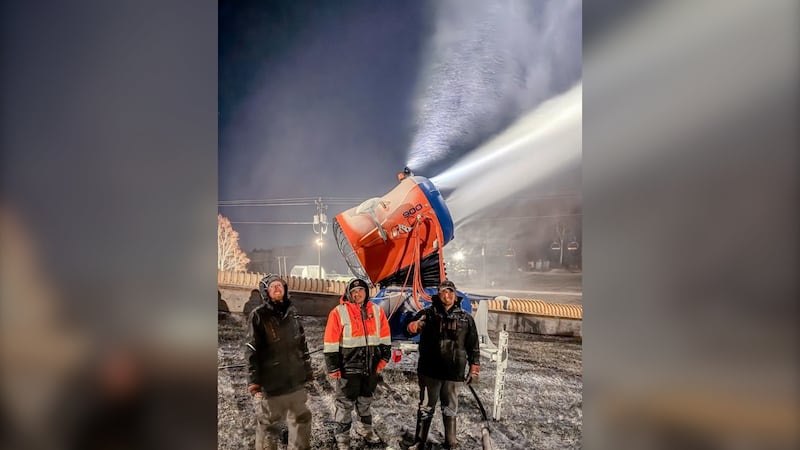
Weather experts say hosting alpine ski races in Mont-Tremblant, Que., in early December will remain a gamble for organizers after World Cup races were shelved due to a lack of snow for the second time in three years. The International Ski and Snowboard Federation (FIS) announced Wednesday that two women's giant slaloms, scheduled for Dec. 5 and 6 at the Laurentians resort, have been cancelled. FIS said it is looking to reschedule them for later in the season, at another location. Although an exceptionally strong El Nino could make this winter one of Canada's warmest on record, Weather Network senior meteorologist Doug Gillham said the challenges of hosting early-season races are likely to persist beyond this year. "To count on a strong start to the ski season is kind of a risky proposition, even more so moving forward," said Gillham, a recreational alpine skier, in a phone interview. "It's more irregular to have a consistent cold early in the season. It doesn't mean we couldn't do it next year, but I think we should be concerned moving forward, be aware that counting on good conditions early in the season is risky." This year's conditions have been extreme. Montreal has already set a record for its latest first snowfall, surpassing the previous mark from Nov. 23, 2011, with no measurable snow recorded yet. "People are polishing their golf clubs, not waxing their skis right now," said David Phillips, a senior climatologist at Environment and Climate Change Canada. Mont-Tremblant was to be the fifth event on the women's alpine skiing circuit this season and the third to feature giant slalom following stops in Solden, Austria, in late October and Killington, Vt., this weekend. Event director Nicholas Cogger said organizers reviewed the previous 10 years of conditions around the same weekend before approaching FIS about holding its first event in 2023 and determined that hosting would not have been an issue. He considered the cancelled 2024 competitions an anomaly at the time. The resort upgraded its snow equipment and regraded the mountain to prevent it from happening again, but the conditions were too great to overcome this year. Whereas a temperature difference of about 1.5 degrees could have made a difference in 2024, Cogger said this year organizers would have needed a variance of “north of seven, eight degrees.” "So I do believe that this is the outlier,” he added. “I also hope that we can see a return to normalcy in the short term." Cogger called the 2023 and 2025 events a "huge success," citing 82 million viewers and average daily attendance of 15,000 people. Canada’s Valérie Grenier won bronze on her home hill in one of last year’s races. Alpine Canada president and chief executive officer Andrew Baker said organizers are looking ahead to the next event in December 2027, even though half the competitions have been cancelled since Tremblant returned to the FIS calendar. "If we had the same temperatures as we had in 2024, we probably would have got there, but this is pretty unique," Baker said. "Our interest is certainly that we continue to look at how we can keep this event on the calendar." Peter Gerdol, chief race director for FIS, said the "super" El Nino is causing headaches for skiing across North America’s East Coast. "I don't think that Killington is much better," he said while on the drive from Boston to Vermont. "Killington is able to do it at just the very last moment." Tremblant remains on the 2027 FIS calendar. Gerdol said he plans to sit down with Alpine Canada and the Tremblant organizers to evaluate next steps. "The two events that happened were really tremendous," he said. "I have no idea of not coming any more to Tremblant, it's just that we need to talk about it together." Moving the competition to February or March would guarantee more snow, but Cogger said Tremblant is not interested in pushing it to that window, because that’s already a busy time for the resort. "This is really the best window of opportunity for us to host an event that has such an impact in terms of demand on the resources and the staff and the housing and all those things," he said. "It'd be really challenging to shut down major portions of the resort in favour of the World Cup athletes over the tens of thousands of day skiers that come and keep this place running year-round." But that choice comes at the cost of being able to guarantee the event runs at all. "We shouldn't assume that it won't work next year, but it's an increasing risk if you're going to keep putting it this early in the season," Gillham said. "This is not going to be the last time this is going to be an issue." This report by The Canadian Press was first published Nov. 25, 2026. Daniel Rainbird, The Canadian Press