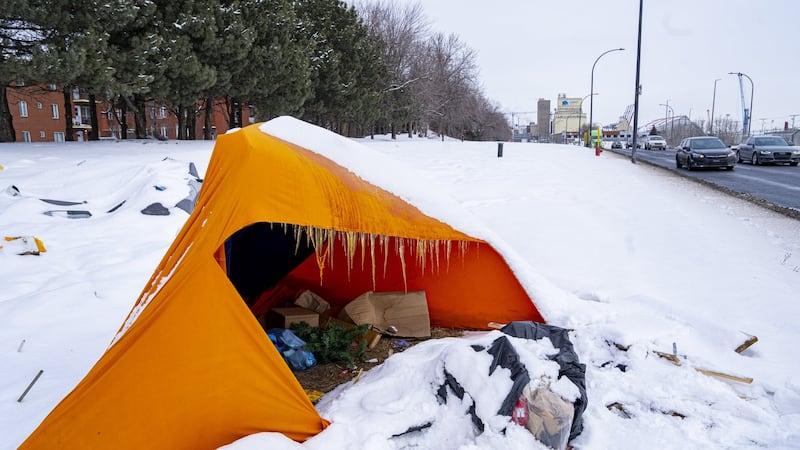
The housing crisis cost the Quebec economy $4.2 billion in 2021, according to the Quebec Observatory of Inequalities, which released on Wednesday the first part of a comprehensive study conducted with several public health departments entitled “The collective cost of the housing crisis in Quebec.” The amount of $4.2 billion represents the money that households, which spend 30 per cent or more of their gross income, cannot inject into the economy. A detailed analysis of cross-referenced data from the 2021 Canadian Housing Survey and the 2019 Household Expenditure Survey concludes that more than 510,000 Quebec households spent 30 per cent or more of their total income on housing costs in 2021, nearly one in six households. Likely to be worse in 2025 This picture, however, is not up to date as it is based on data from 2021, notes Ferdaous Roussafi, an economist at the Observatory and lead author of the study. “With rents rising in recent years, we assume that this number has increased between 2021 and 2025,” he said. This is also in light of rent data released last week by Rentals.ca, which shows an average increase of 15.8 per cent over the last three years in Quebec. Although tenants account for the largest proportion of people impacted by price increases, homeowners are also affected by the “affordability threshold.” This weighs most heavily on low-income households. In fact, the lowest 40 per cent of income earners, who bring in less than $38,000 per year, account for 70 per cent of the massive $4.2 billion bill. “These vulnerable households bear a disproportionate burden for housing compared to their other expenses,” said Roussafi. Too many expensive, vacant homes The study also shows that landlords are losing out. In the metropolitan areas of Montreal and Gatineau, researchers identified nearly 3,000 unaffordable homes (those with a monthly rent of more than $1,700) that sat vacant in 2024. This represents an economic loss of more than $41 million. “Demand is stronger for affordable rents, which have a very, very low vacancy rate of around zero per cent. So yes, investments are directed where demand is really lower,” said Roussafi. Admittedly, Quebec has improved its assistance programs, investing $204 million in housing allowances and $140 million in rent supplements in 2024, but this then puts additional financial pressure on public finances. “These are temporary measures to alleviate the crisis, not to resolve it,” noted Roussafi. “They are not structural measures. In times of crisis, these investments remain very important, but a good portion could be avoided if there were structural solutions, such as increasing the supply of social housing or diversifying and protecting the affordability of the rental housing stock.” An investment, not an expense “Housing should be seen as a social investment, not an expense,” said Dr. Mylène Drouin, director of public health for the Montreal region. She cites the example of several European countries, notably Denmark and Austria, whose “model shows that it is profitable to invest in social and community housing, and we end up recouping our initial investment overall, because it is so expensive not to house people adequately.” She says this justifies public health intervention in this area. “Housing is probably one of the most important and fundamental determinants of health in terms of its multiple impacts on the health and well-being of populations, and also on social inequalities in health,” she said. Drouin also points out the many negative impacts of housing that is too small, unsanitary or poorly insulated, including delayed child development, domestic violence, and poor mental and physical health. “Providing inadequate housing is extremely costly in terms of health care,” she pointed out. Ultimately, unaffordability can lead to homelessness, which has very high social costs. “One of the repercussions,” said Drouin, “is that people have to cut back on groceries, of course. Now, at food banks, we are told that the faces have completely changed. We have people who have one or two jobs and still have to go to food banks.” The list of costs associated with the housing crisis grows longer when you add exile, adds Roussafi. “Unaffordability can push people to move to the suburbs,” she says, noting that census data shows that eight per cent of people who moved in 2021 did so to reduce their housing costs. The result? Long commutes that could harm a person’s quality of life, increase transport costs and have an impact on the environment and road infrastructure. In all regions “In recent years, all regions have been affected, sometimes with slightly different issues,” notes Drouin. “The fact that people, with urban sprawl, have to travel much further to try to find something that meets their needs is something that is happening in all regions. We also see this in the issue of homelessness, which is clearly linked to this crisis and is no longer a phenomenon unique to Montreal.” This first part of the study, which focuses on the impact of the housing crisis on economic prosperity, is set to be followed by others “to gather evidence on what we already know intuitively,” said Roussafi. “We still need to measure the real costs in terms of health, homelessness, domestic violence, school performance, energy consumption in poor-quality housing, and so on.” The final part will consist of offering possible solutions, which Drouin hopes will include clear recognition of the right to housing, the development of social and community housing, the protection of affordable housing stock, and a curb on the issues that drive rent prices up. “It would be a wonderful social project,” she said. ”We did it for education in the 1970s, and later for daycare centres. Perhaps now we are ready for a social project on housing for all.” This report by The Canadian Press was first published in French on Sept. 17, 2025.