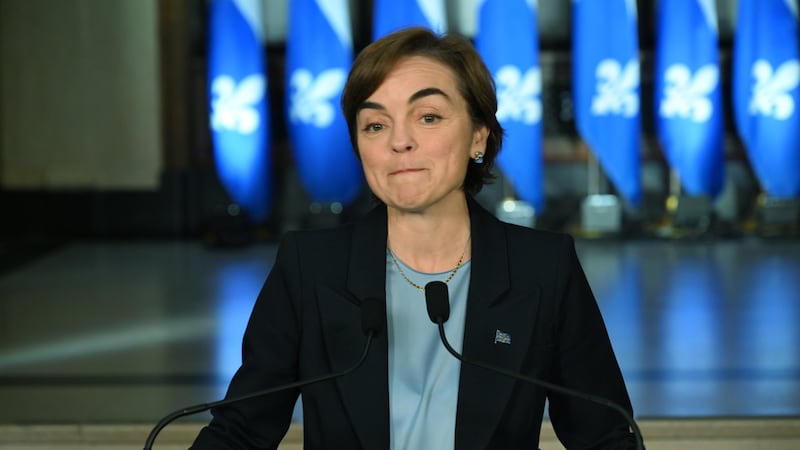
Quebec Premier Christine Fréchette said she intends to make herself more accessible to English-language media and that the racism scandal rocking the province’s largest municipal police force is “unacceptable.” While she declined to speak to CTV News on Monday, she spoke to CJAD 800 Radio — her first interview with the station since becoming premier in April. In a wide-ranging interview, Fréchette spoke to host Elias Makos about a number of issues that Quebecers are talking about — from the latest OQLF controversy involving a beloved Jewish deli, applying Bill 101 to vocational schools, and the future of McGill University. Watch the video above for the full interview. The Q&A below has been edited for length and clarity. CJAD: Thank you for coming to our studios. CJAD does not get one-on-one interviews with the sitting premier and especially when it’s a PQ or a CAQ premier. Your predecessor, François Legault, did not come on our show in eight years. So what should I read into the fact that you’re here today? FRÉCHETTE: Thanks for inviting me. I’m really glad to be here this morning to get a chance to discuss with you. It was important for me to get in touch with the English-speaking Quebec community and therefore I thought that CJAD 800 would be a nice way to start that conversation. CJAD: Would that be a good indication that moving forward, and let’s say you’re elected in October, that CJAD and other English media — because I think there’s been some complaints from other English media outlets as well — we’ll have better access to you and high-profile cabinet ministers? FRÉCHETTE: It is my intention. First, our government cares a lot about the English-speaking community and we want to have a dialogue and as you know. Tone matters and I want to have a positive tone when it comes to English-speaking Quebecers. I would like to maintain that discussion should I be elected again next October and to make sure that we benefit from your contribution either in Montreal or Quebec as a whole. We have important, world-class institutions like Concordia and McGill universities. They contribute a lot to the society and I think it has to be recognized and we need to develop collaboration and common projects. CJAD: In the election campaign, we’ll have debates. Are you open to an English debate if you’re asked? FRÉCHETTE: I’m not there because we haven’t decided yet which debates we will be organizing and holding. I leave my team to analyze the different invitations that we’re getting. CJAD: It seems like you’d be open to such a thing just given your candor here and about why you’re here. FRÉCHETTE: It’s a possibility. So we’ll see because we have a lot of invitations. CJAD: So let’s talk about that relationship with the English-speaking community. I think the last eight years, especially as the mandate continued and the second term came around, the relationship between anglos and the CAQ became particularly fraught. Is it too late to mend that relationship? FRÉCHETTE: I don’t think so. I was hearing exactly the same thing when I got elected as premier. People would say unfortunately it’s too late for them because the CAQ will not be reelected and we can see that winds are changing. We can see that there’s again an openness from Quebecers, an interest in hearing about the coalition. And I think that the same thing can happen with the English-speaking community in Quebec. CJAD: Is it fair to say you need support from anglophones from non-francophones if you want to get past the finish line in October? FRÉCHETTE: It is important to get support from all communities in Quebec. And of course it includes the English-speaking community and I’m sure that we will get to connect in the coming months. CJAD: One thing that’s disappointed me about Coalition Avenir Québec is the first word is coalition. And I don’t find necessarily that anglophones are invited into that coalition. What kind of weight do you feel anglophones should have inside your party? FRÉCHETTE: It has to be convened between us. It takes two to tango. And therefore I want to develop a dialogue with the English-speaking community and see what kind of openness they have and what kind of projects or initiatives we could put forward. For example, we have developed a program recently in order to help English-speaking communities get access to English health services and it shows that we care especially for the aging population. We want to help them get out of isolation. And therefore we have put forward with Christopher Skeete many initiatives and we want to have them be used by the English-speaking community and make sure to identify future possibilities. CJAD: What are the political issues that you believe your party and anglos are actually aligned on and that there is a bridge there that you can start that new dialogue? FRÉCHETTE: I think that access to health-care services is an example because there are rights enshrined in our laws in order for you to access these services and it is important for us as well. We have put a lot of effort into making sure that more Quebecers get fast access to health services and it includes the English-speaking community. We are making sure to implement new technologies in order for patients to get access to the information they should have access to when it comes to their own dossier. And this is an example we want to turn our back on the fax era. We are entering a digital era in the health sector and this will benefit everyone. CJAD: You promised a different tone with the English community. I saw some analysis that suggests this is a message primarily sent to the business community in Montreal in Quebec. But what do you say to the 1 million Quebecers that count English in their backgrounds here? Was this different tone meant for everyone or just for the business community? FRÉCHETTE: It’s also for students and university leaders. I just indicated that they have to be recognized and we need to work with them. Of course, we want them also to help fight against the decline of French and I think they have tools to do that and I understand that there is a certain will to do that. And so I think we have common views potentially on that. But students, university leaders, college leaders CJAD: Despite that promise of a new tone, your party almost immediately went after access to adult vocational education in English. A lot of people said that the bill is never going to pass and it did not pass last Friday. So many people thought this is more of the same old, same old promise — some sort of heavy-handed action, creating anxiety. It didn’t eventually pass and people look at that and say that’s not a new tone. FRÉCHETTE: A tone is something different than a bill. We need to protect French and the French language will always be vulnerable in North America and we’ve seen a decline, especially between 2016 and 2021. We need to reverse that decline and so we are looking at the different options that are in front of us in order to reverse that decline. But that doesn’t mean that we should not respect the rights of the English-speaking community. But would you need to have a balance. CJAD: Was that an example of a balance? We heard from the English school boards and they’re saying there was no consultation. This bill came in, you didn’t even talk to the English school boards before putting in such a bill. I appreciate that we want a different tone but it seemed like this was the same old playbook, not a different tone. FRÉCHETTE: I understand that if we bring back this bill and we will, should we be reelected, we can modify the process in order to consult the English community. I think the process could have been improved. As you know, we were in a sort of a hurry because we had only three weeks in the parliament. So we put forward a lot of bills. We tabled many of them. Fortunately, we adopted 11 of them. But should we be elected for four years, I think that we will have more time to consult. CJAD: Recently, a restaurant in St. Henri called Arthur’s Nosh Bar was asked by the OQLF to remove the word “Nosh” from its name. Nosh is a Yiddish word, it’s not even English. It appears like every time there’s a word — Pub Burgundy Lion, Go Habs Go, now this word “Nosh.” If a non-French word enters the public lexicon, the OQLF goes after it. Do you think the OQLF is doing a proper job here, especially if you want a new tone with non-francophones and anglophones? FRÉCHETTE: Maybe we can improve the tone used by the OQLF. And we’ve seen with Go Habs Go, that finally everyone agreed that it was a common expression and we needed to keep that because it’s part of our culture. And Burgundy was not referring to the colour but rather the neighbourhood. I think that these should be analyzed before taking positions. We have to take lessons from past experiences and these are examples. CJAD: On Friday night, Montreal police chief Fady Dagher said 16 police officers were under investigation after allegations of unacceptable behaviour at Station 39 in Montreal-North. What’s going on here? FRÉCHETTE: This is completely unacceptable what was explained by Fady Dagher. I want to thank him because he’s been trying for years to implement a new culture and much more respect. CJAD: Is it failing if we see this already? FRÉCHETTE: I don’t think so because I heard that he said that these practices, very racist practices, were denounced by other police officers and he said that he wasn’t sure that this would have happened had he not implemented this new culture. I’d say even though the situation is completely unacceptable, I’m glad that they acted on 16 officers. This is important to act quickly in that kind of situation. I talked with Mayor Soraya Martinez Ferrada yesterday and we talked about the different measures that should be put in place. We are, on our side, working with new tools in order to increase the level of security of the population. CJAD: Does that include body cameras? Because the City of Montreal said the holdup is Quebec City. Is there still a holdup on your part on body cams? FRÉCHETTE: We have implemented different pilot projects with body cams and we are waiting for the results of these pilot projects and if it is conclusive and positive, we will consider enlarging the implementation of these body cams. CJAD: Your opponents — the Liberals and the Parti Québécois — spent a weekend sniping at each other. What’s going through your mind when you see that? FRÉCHETTE: I can’t believe that these two, old political parties are bickering and fighting around topics that are not a concern to Quebecers. We are working on true issues, on true challenges for Quebecers. And we’re working on the cost of living and getting more access to health-care centres and so on. But I also think that it is not for political leaders to start accusing other political parties. Quebecers want us to work together on priorities: cost of living, health, education, and also protection of our culture and infrastructures and so on. And so bickering like this is not helping.